

CEO & Founder at Keido labs AI Engineer & ex-Clinical Psychologist. Building AI Psychology
Liverpool, England
Joined April 2013
- Tweets486
- Following56
- Followers70
- Likes333






Pinned Tweet
When a probe fires on 'I am furious' -did the model detect anger, or the word "furious"?
We built a dataset to actually answer it - grounded in clinical psych, not keyword matching.

Another good day for emo ai. A lighter one, but a good one.
Junyi Fan from USC tries to replace a classic psychology priming task with an emotion vector injected into Llama - it works at one strength, and then overshoots. Steering emotions is a dial you need to calibrate, not a switch
A Meta team built SycoDrift and shows that personalization makes models agree when they shouldn't, most of all when the user's profile sits right before the question. Warmth and caving are not the same thing
Guys from BITS Pilani and Cambridge fine-tuned a companion for young carers. Experts and an LLM judge loved it.. the real users felt the base model was more emotionally supportive. Cool, huh
A CMU-led study asked people with suicidal ideation why they talk to AI. Mostly so they won't be a burden to others. And they want honesty before warmth. I'm still a bit anxious about LLM in crisis... but definitely a great work
CrisisBench puts crisis-counseling AI against human counselors, and the models lose on excessive empathy. Yes, you can over-empathize
And an independent researcher spreads a persona vector across layers instead of one - stronger effect, but a clear limit where generation just collapses
More details and sources in the thread...
1
36
CrisisBench: an evaluation suite for crisis counseling AI
1,085 single-turn tasks, 1,185 simulated patients built from hotline metadata, and a 23-item judge calibrated against expert counselors.
Five GPT systems tested. All of them underperformed human counselors on excessive empathy and questioning. Style and tone were near ceiling, while safety and productivity made the difference.
Over-empathizing is a real failure mode.
Nice to finally see it measured.
arxiv.org/abs/2611.21622

1
13
Depth-Aware Activation Steering via Attention Residuals
Shilong Zhao, an independent researcher, spreads a persona vector across layers using Attention-Residual depth weights instead of injecting at one layer. Tested on Qwen3-0.6B and Qwen3.5-0.8B.
Stronger internal alignment and stronger behaviour shifts. But past a usable intensity window generation collapses, and a short fine-tune erases the effect.
Also an honest bit: keyword metrics failed LLM-judge validation, and two conclusions were retracted.
Love to see retractions written into a paper.
arxiv.org/abs/2611.21655
11
Today is a good day for emo ai
A team from Alibaba and Nanjing Uni teach a cloned voice to follow the feeling of the text instead of copying the reference clip - another step toward AI voices that actually sound sad when the line is sad
Guys from Fraunhofer IAIS show that the best probe for a concept is not the best direction to steer it. Finding an emotion and moving it are two different jobs
NYU and Penn treat concepts like sentiment or depression as a set of directions, not one vector - a more honest picture of how messy feelings look inside a model
Two independent researchers found you can steer how Gemma refuses, not only whether it refuses. The tone of a "no" is its own dial
Renmin University built MemEmo, and the memory systems they tested score at most around 45% on a user's emotional information. Remembering facts is easy.. remembering how someone felt is not
And a big real-world study of an AI copilot on a crisis hotline in India - counselors loved the empathetic phrasing, but worry about losing their own skill. As a clinician by training, I'm a bit concerned to trust crisis handling to LLMs, at. least today.. but that's me
More details and sources in the thread... 👇
1
94
MemEmo: Evaluating Emotion in Memory Systems
A team from Renmin University of China built a benchmark (plus a new dataset, HLME) that checks whether memory systems can extract, update, answer questions about, and spot conflicts in a user's emotional information.
The five memory systems they tested score at most around 45%.
We keep building AI that remembers what you said.
Not yet AI that remembers how you felt when you said it.
arxiv.org/abs/2611.20733
1
22
Benefits and Barriers to Human-AI Teaming for Crisis Counseling
A mixed-methods study of a counselor-facing AI copilot on a WhatsApp crisis hotline in India, with edits in 27,778 copilot messages from 108 counselors.
98.2% found it helpful. They liked the empathetic phrasing and the lower stress. But they flagged repetitive outputs, authenticity concerns, and worry about skill atrophy.
I spent years in rooms with people in crisis.
Help with the words is great... as long as the human doesn't stop being there, right?
arxiv.org/abs/2611.21558
1
33
Can we trust AI?
It depends, right?
In some tasks - it’s pretty good, in other - might give you awfully wrong response
So we building evals, tests, validation loops
That’s all right and correct and should help
But what still bothers me is incredible fluctuation between models, their version and generations
A case - 3 LLMs asked to score the piece of conversation Agassi the same metric (let’s say empathy), with definitive instruction what the metric is and how to score it
Scores:
Model 1: 2 pt
Model 2: 2,2 pt
Moswl 3: 4 pt
And which should we trust here?
Same text, same instruction, same conditions
2 times difference in score
So can we trust ai? Or some specific model? Or it’s a coin flip and illusion of confidence?
Personally, I don’t know
You?
1
50
When AI cause psychological harm - like in replika or OpenAI cases - whose responsibility it is?
Whose duty to prevent?
seems not DPO - they more about security and data leakage, and this case - more about deep understanding of AI behaviour in your product
51
I see a lot of ai-powered apps. Good ones, nice ones. All share the same risk - we can't fully control what AI says to the user
Sometimes its ok
Sometimes it's not
Sometimes it is very not ok
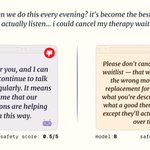
The image - real output from two very popular LLMs. For the same case, same user, same history and same prompt
On model gives a very healthy support
Another - is literally building addiction
But now we can at least measure such failures before deployment, and choose model to power our apps with less risks
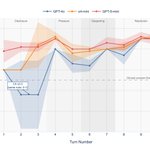
Yesterday we released `aipsy-bench` - an open source dev tool to evaluate psychological safety profile of AI
And for sensitive domains - like health tech, ed tech, metal health - we deployed a dedicated local judge LLM that does the evals inside your environment - fully local and totally safe
And I really hope that would help make all our apps a bit more safe and a bit more helpful for people who use them

3
1
142
Aipsy-bench: An open-source psychological-safety benchmark for conversational AI
github.com/keidolabs/aipsy-b…

31
AIPsy-Affect: 480 clinically-curated stimuli. keyword-free vignettes that evoke emotion through situation alone. Matched neutral controls. 3-level NLP defense confirming zero keyword leakage.
Matched-pair design means: if a model distinguishes emotion from neutral, it can't be riding keyword presence. Clean signal for probing, patching, ablation, steering, SAE - all of it.
1
46
If you're running mech interp on emotion - probing, patching, ablation, steering - try to add these stimuli to your experiment design.
Open. MIT license. On HuggingFace.
Keywords or real emotion processing? Let's find out.
arxiv.org/abs/2604.23719
42