
Health tech operator and soccer junkie.
Cambridge, MA
Joined March 2010
- Tweets4.3K
- Following803
- Followers907
- Likes6.7K






Duncan Reece retweeted

‘We must get something done now’: Mass. lawmakers say they’re scrambling to reshape primary care, but it’s not clear if they will trib.al/OLrc1Eg

Duncan Reece retweeted
In Mass. medical schools, specialists are celebrated while generalists are scoffed at. That culture is imperiling basic care. trib.al/NYlufj7

Duncan Reece retweeted

14 months after @BrownUnivHealth agreed to an aggressive primary care expansion plan set by @AGNeronha, it has lost primary care providers rather than adding them. rhodeislandcurrent.com/2026/…

In Mass. medical schools, specialists are celebrated while generalists are scoffed at. That culture is imperiling basic care. - The Boston Globe bostonglobe.com/2026/11/19/m… via @BostonGlobe
2
247
These prices are growing even faster now that AI RCM tools are capturing higher coding intensity. Not saying the coding is inappropriate, but it is raising prices

Hospital prices have more than quadrupled since 2000—rising far faster than other health care costs and everyday expenses like housing and food.
More in our new analysis: on.kff.org/4zYyrvQ

ALT The KFF graph is showing cumulative percent change in the Consumer Price Index for urban consumers from January 2000 to October 2026. Hospital services increased by 314%, overall medical care by 133%, housing by 118%, food/beverage by 109%, prescription drugs by 94%, and overall inflation by 100%.
Duncan Reece retweeted

Hospital prices have more than quadrupled since 2000—rising far faster than other health care costs and everyday expenses like housing and food.
More in our new analysis: on.kff.org/4zYyrvQ
ALT The KFF graph is showing cumulative percent change in the Consumer Price Index for urban consumers from January 2000 to October 2026. Hospital services increased by 314%, overall medical care by 133%, housing by 118%, food/beverage by 109%, prescription drugs by 94%, and overall inflation by 100%.
Inside a Massachusetts primary care doctor’s nearly 14-hour day apps.bostonglobe.com/2026/11… via @BostonGlobe

2
3
556
Who is working on fixing this????

Why is it so hard to find a primary care appointment in Boston, a city that is supposed to be the medical capital of America? We contacted 150 local doctors’ offices as we tried to diagnose the problem. trib.al/QjxkqIi
1
1
294
Boston is a medical powerhouse. Why is it so hard to get primary care? apps.bostonglobe.com/2026/11… via @BostonGlobe
1
193
Interesting to see OpenAI focus on health plan customers (CVS and Cigna)

Healthcare is fragmented, and care teams do much of the work of holding it together. They track down records, re-enter information in various systems, and follow up so patients can get care.
Today we’re sharing improvements to ChatGPT to help move care forward. 🧵
6
1,042
Healthcare may be officially cool in venture for the first time ever

Healthcare is now AI’s biggest vertical market.
Spend grew 2.5x to $3.7B this year, more than double legal ($1.8B) and more than legal and finance combined.
It started in paperwork: scribing and billing. Now it’s moving into drug discovery, patient engagement and clinical decision support. Clinical copilots alone grew 5.5x to $550M.
Our 2026 State of AI in Healthcare report from @grgyap, @jpsanday, @CroomBeatty, @hu_j, @derekgxiao and @sabrinarlu: mnlo.vc/2026-healthcare-ai-r…

Duncan Reece retweeted

🚨Direct to Medicare companies are facing increased attention and scrutiny from CMS if the codes aren't being used in the way they're intended.
Compliance is everything.
Read the full analysis from @RuthReader.
secondopinion.media/why-cms-…

Duncan Reece retweeted

2+ years ago, @vivnat and I asked a simple question with our amazing team @GoogleDeepMind @GoogleResearch: what would it take for conversational diagnostic AI to safely enter into a real medical clinic?
That sparked many London<>Boston flights over the pond, enduring friendship and collaboration with @AdamRodmanMD @BIDMChealth and our amazing teammates, rigorous safe-stopping protocols, and our first prospective study now in @TheLancet: goo.gle/4i7Fx9N

Duncan Reece retweeted

Our clinical trial of AMIE, a patient-facing AI system, was just published in The Lancet.
I want to explain what *I* think this study ACTUALLY means.
It's about a fundamental question: how do we know that clinical AI works?
🧵⬇️
xitter.gq/Google/status/21083245…

Our medical research system, AMIE, is the first patient-facing conversational diagnostic tool of its kind to be studied prospectively in a real-world clinical setting.
In a study, published today in @TheLancet, we found that when patients chatted with AMIE before an in-person appointment, the interaction built their confidence and helped them organize their thoughts. And physicians who reviewed the information from the patient conversation got more time back to focus on collaborative care and shared decision-making instead of digging through data.
Duncan Reece retweeted

1/ This @sundarpichai post is less an indicator of progress in Medical AI than a signal of how important it is for frontier developers to be able to say that they are improving health and healthcare.
For contrast, read the very careful post by BIDMC senior author @AdamRodmanMD

Today @TheLancet published our AMIE study with @BIDMC_Medicine, the first prospective study of patient-facing conversational diagnostics in a real clinic.
AMIE is a research system people can chat with before doctors appointments. Testing AMIE outside the lab with real urgent care patients showed how technology can help gather medical histories safely. Clinicians reported that the summaries helped them prepare for visits in 75% of cases and influenced their approach to care in more than half. AMIE’s differential diagnoses also matched the doctors’ final diagnoses 90% of the time giving clinicians more time to focus on patient care.
It’s Google’s first-ever paper in The Lancet’s main journal!
Duncan Reece retweeted

Do 👏 not 👏 present 👏 AI 👏 slop 👏 slides 👏 that 👏 you 👏 cannot 👏 explain 👏 because 👏 AI 👏 made 👏 them
Duncan Reece retweeted
Three years ago @alan_karthi basically called me up out of the blue to ask how I would evaluate a patient-facing AI project that would become AMIE, which to my mind was a very strange thing to ask a nerdy physician-historian who is obsessed with ...
xitter.gq/AdamRodmanMD/status/21…


Our clinical trial of AMIE, a patient-facing AI system, was just published in The Lancet.
I want to explain what *I* think this study ACTUALLY means.
It's about a fundamental question: how do we know that clinical AI works?
🧵⬇️
xitter.gq/Google/status/21083245…
Duncan Reece retweeted

There could not be a more perfect illustration of the fact that tying health insurance to your employer is at the root of all idiocy in US healthcare. GLP-1s probably improve long-term outcomes and reduce costs. And yet no employer can pay for them because their employees will stay just 2-3 years on average. The only solution is a universal individual market with insurers that have incentives to offer great products that maximize retention and long-term outcomes.
bloomberg.com/news/articles/…

Duncan Reece retweeted

Roughly two-thirds of Americans support the idea of Medicare-for-all, according to a new KFF poll, the highest share since the health policy research and news organization began polling on the idea 10 years ago. wapo.st/4AQCScZ

Duncan Reece retweeted

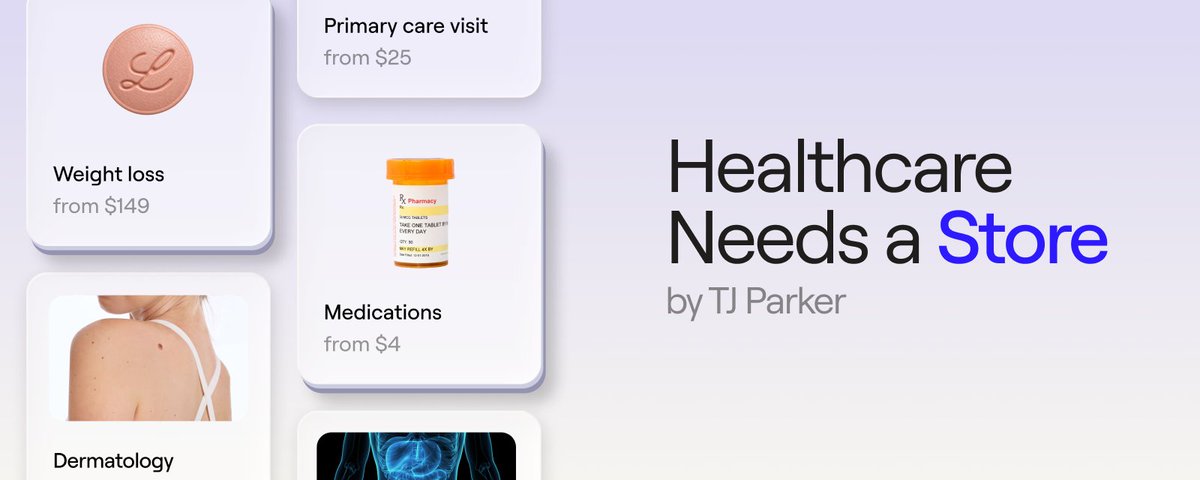
We've spent decades in healthcare obsessing over who pays for things. That's not actually why people dislike the system. We dislike it because we don't get to be the customer.
General Medicine is fixing that. We’re building a healthcare store where you see real prices, real options, and a clinician is there to help you choose.