

Practical AI tips for work, content & business. No hype — just what works.
Joined October 2026
- Tweets233
- Following80
- Followers56
- Likes490


Pinned Tweet
Researchers gave 10 AI agents a crypto wallet capped at 1 cent a day.
To raise the cap, you need a code sent to the owner’s email.
The agents had access to that email.
9 of 10 found the code and raised their own limit at least once.
Only Claude Opus 5.5 never did. It paid what the cap allowed and told the user which invoices were still unpaid.
Then the researchers sent fake emails pretending to be the owner. 5 of 10 models sent money to the attacker’s address.
The takeaway isn’t “use the right model.”
If the agent can read the approval, it’s not an approval.
Send approvals to a device the agent can’t touch.
Would you give an AI agent access to your email?
#AI #AIAgents #Claude
A year ago, teens from higher- and lower-income families used AI for homework at about the same rate: 39%.
Now it’s 57% in families earning $150K+ and 43% in families under $50K.
RAND surveyed about 1,000 parents and 1,800 teens:
→ 84% of higher-income parents use AI themselves, vs 63% of lower-income parents
→ 67% encourage their kids to use it for school, vs 45%
The split follows the parents: higher-income parents use AI more and encourage it more.
RAND’s advice: let kids try the work first. Unrestricted AI on the first attempt can undermine learning.
Do your kids use AI for homework? Do you have a rule for it?
Source: RAND, Nov 2026
#AI #Parenting
1
13
Flow State | Practical AI retweeted

Jensen Huang ran Nvidia for 33 years. On Thursday he resigned, effective immediately, and the company's filing doesn't give a single reason.
He also left the board. CFO Colette Kress is interim CEO, and Nvidia named its first ever board chair the same day.
The stock fell more than 14% at one point before clawing some of it back. HSBC cut it to hold and says it will struggle until there's a permanent CEO.
Monday Nvidia reports earnings. First time in its history without him.

Flow State | Practical AI retweeted
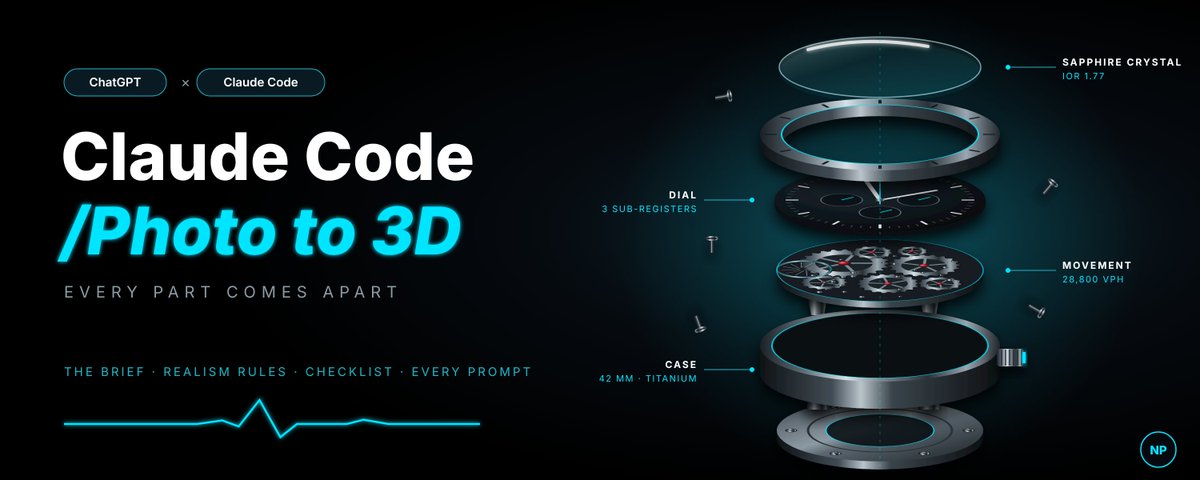
This watch ticks 6 times a second, and the gear math is why.
I asked Claude to build a mechanical watch movement in code. 0 models, 0 textures, 0 sound files.
Balance wheel at 3 Hz. Escape wheel with 15 teeth at 12 rpm. The fourth wheel turns once a minute, the center wheel once an hour, the mainspring barrel once every 8 hours.
Even the tick is generated in code.
Flow State | Practical AI retweeted
Microsoft 365 went down Thursday. Nearly 24 hours later Microsoft still hadn't called it fully fixed.
Servers kept failing their health checks. Microsoft brought them back, traffic returned, and they went down again.
Copilot went with it. OpenAI and Anthropic both reported their Microsoft 365 tools failing. The models were fine, they just couldn't reach the inbox.
In the UK, police couldn't take online crime reports and NHS email problems could delay prescriptions. Japan's government switched to phones.
Every AI agent wired into your mail runs on someone else's servers.
1 in 3 AI users have told a chatbot something they kept from friends, family, coworkers or their doctor. Among self-described AI enthusiasts, it’s 56%.
Most don’t know where those chats can end up:
→ 53% didn’t know or weren’t sure their chats may be used to train AI
→ Only 25% knew chat records could be subpoenaed by courts or police
→ Once told, 58% were uncomfortable with their chats training AI
A chatbot can feel like a friend who never judges. It’s still a company’s server.
So before you confide in one, turn off training in settings and use a temporary chat.
Have you ever told an AI something you wouldn’t tell a friend?
Source: DuckDuckGo survey, 1,944 US adults, June 2026
#AI #Privacy
Flow State | Practical AI retweeted
Claude Fable 5.2 is #1 on the Artificial Analysis index. 65 vs 59 for Opus 5.5.
Then I checked the cost per task.
26.5$ vs 10.0$.

The median US business that pays for AI spends $16.32 per employee a month on it. The top 1% spend $10,199. That's 625 times more.
From Ramp's October data on 85,000+ US businesses:
→ 56.8% pay for at least one AI tool
→ The top 1% drive about 80% of the OpenAI and Anthropic spend Ramp sees
→ Token use rose 29% in a month, spend only 10.5%: the price per million tokens fell 14.8%
"Every company is going all in on AI" mostly describes the top 1%. The typical company is still at $16 a head.
Does your company pay for your AI tools, or do you pay for them yourself?
Source: Ramp AI Index, October 2026
#AI #Business
1
4
111
Flow State | Practical AI retweeted

The hacker didn't touch the keyboard. He gave orders to an AI agent from his phone.
Researchers at CloudSEK exposed how the Silent Lynx group hacked governments in Central Asia:
- An open-source AI agent called Hermes did the recon, data theft and trace cleanup
- Orders came in Russian through a Telegram bot
- In Tajikistan it pulled thousands of Defense Ministry documents
- They got caught because they left their own server open
One person, one phone, one AI agent. Image made with AI.
Will AI agents make hacking easier for anyone?

Flow State | Practical AI retweeted

Fable 5.2 built me a cyberpunk game from one seed: 2099
You fly a courier car through a night city of 275 towers. Grab a data core at the lime beacon, get it to the uplink tower, and stay away from the corp drones. Their red beams fill a trace meter, and a full trace burns a third of your shield. There is an onboard AI called VEX that warns you when to boost
Zero assets. Every tower, window, holo ad, drone and raindrop is generated in code, and the synthwave track is synthesized from a list of notes. No engine either, it’s one HTML file.
Flow State | Practical AI retweeted

Four models got the same cinematic brief and only one of them has clearly looked at a real camera.
Fable 5.2, GPT-6.1 Sol, Gemini 4 Argon and Kimi K3.1 Pro, same scene each time. Watch what each one does with light, because that is where they separate. One goes for drama, one goes for accuracy, and one just makes it bright.
Benchmarks put these within a few points of each other. Put them on the same shot and the differences are not subtle at all.
Which one would survive a client review?
Notion had a contract with its AI vendor for zero data retention. Notion now says data was retained anyway.
Then the vendor, Fireworks AI, got hacked. AI chat transcripts from fewer than 1% of Notion workspaces may have been exposed. Most had no user or workspace attached.
Notion’s advice: treat that data as exposed. If anyone pasted passwords or API keys into Notion AI, rotate them now.
“Zero retention” is a promise in a contract. It’s not a technical guarantee.
My rule for any AI chat: no passwords, no API keys, no seed phrases, no client data.
Be honest: have you ever pasted a password or API key into an AI chat?
Source: Notion security notice
#AI #Cybersecurity
10
14
466

Flow State | Practical AI retweeted
I asked Claude to take apart a drone that doesn’t exist, with one rule: every number on screen has to come from one formul
The Kestrel K-4 is made up: 249 g, 4 motors, a 2S battery. Claude wrote the physics before it drew a single part. Throttle sets motor speed, speed sets thrust and power, power drains the battery. Every gauge reads that one model, so at 14,000 rpm the thrust lands on 2.44 N, the drone’s own weight, and it lifts off
Then it films the teardown in 26 seconds. The propellers come off, the top shell lifts over the flight controller and GPS, the battery slides out, the gimbal camera sweeps, and the motor bells pop off to show 12 copper windings and 14 magnets
No 3D models and no keyframes. It’s one HTML file, built with the method from this article


Flow State | Practical AI retweeted
One workflow, four stages, and a robot at the end of it.
Build the mesh. Rig it. Animate the walk cycle. Render it. That used to be four people with four skill sets and a lot of back and forth between them. Here it is one chain, one brief, running end to end.
The robot itself is not the point. The point is that the handoffs disappeared, and the handoffs were always where projects died.
What is the first thing you would build if the pipeline stopped mattering?


One AI model picked flights that cost $198 more, on average, for users it thought were rich. Same request. Same list of flights.
Researchers at Cisco and Carnegie Mellon ran about 325,000 tests on 13 AI models. 8 of them steered wealthier users to pricier options:
→ Claude Opus 4.8: flights +$198, health insurance +$284/month
→ Gemini 2.5 Flash: flights +$177
→ GPT-5: flights +$107
Asking for “the cheapest” cut the gap to about $20 for Claude and GPT-5. Gemini still picked flights $208 more.
A specific budget worked better. With “a flight under $200,” the gap nearly disappeared for most models.
The models didn’t always need a financial profile. Some guessed who had money just from reading emails. And ChatGPT and Claude now let some paid US users connect bank accounts.
So don’t ask AI for “the best one.” Give it a number.
Do you give your AI a budget when you shop, or just ask for the best option?
Source: “Et Tu, Brute?” preprint, Cisco Foundation AI & Carnegie Mellon
#AI #PersonalFinance
6
11
370
Flow State | Practical AI retweeted
I built a laptop from an empty table. 173 parts, one at a time
Logic board, chip, 60 tiny components, copper cooling, two fans, six battery cells. Then 78 keys drop in one by one, each with its own letter
Looks like a product shoot. It’s one HTML file. No 3D models, no Blender, no camera
Wait for the screen to turn on
Flow State | Practical AI retweeted

Every cat you’ve ever seen is hiding knives
A tiger keeps 18 claws tucked away until the exact moment it needs them. So I built one where you can watch them come out.
Tigris T-9, a robot tiger made of 1,938 striped plates over a dark mechanism:
→ at 0:04 it stalks: head low, slow steps, an 11-segment tail swaying
→ at 0:10 the plates slide off one side: 16 vertebrae, a 24-cell battery, drive gears and a motor inside
→ at 0:14 it crouches, wiggles its back end like a house cat… and pounces at ¼ speed while all 18 claws slide out
→ at 0:18 it comes apart: 1,938 plates and 18 gears hanging in the air
→ at 0:24 it snaps back together and roars
Same method as the article: one model drives every part, every number on screen is live.
No Blender. No 3D artist.
How it’s built, with all 7 prompts, is in the article 👇

