
(Macro)economist. Views are my own.
Rio de Janeiro
Joined July 2009
- Tweets704
- Following499
- Followers3.2K
- Likes1.1K



Eduardo Zilberman retweeted

The increase in uncertainty and asset volatility can propagate to the real economy, amplifying the direct effects of policies on productivity.
"Heterogeneous Beliefs, Asset Prices, and Business Cycles" with @DejanirSilva & @duduzil, may be useful to understand how.
🧵 Thread 👇

A quantitative model, disciplined with investor survey data, shows how speculation on Wall Street translates onto volatility on main street, from @SakiBigio, @SilvaDejanir, and Eduardo Zilberman nber.org/papers/w33672

Eduardo Zilberman retweeted

Thought about wearing this to the conference this morning, but I guess some would be offended. 😬

Eduardo Zilberman retweeted

No @valoreconomico de hoje, eu e Victor Rezende conversamos com o @duduzil, que assumiu há alguns meses como economista-chefe na Gávea. Clica no link para entender o que é essa "tempestade perfeita" ruim para o Brasil de que ele fala...
valor.globo.com/brasil/notic…


Eduardo Zilberman retweeted

As recently emphasized by @JohnHCochrane, high interest rates lower inflation in the textbook model only if there is a fiscal tightening. Monetary policy needs a fiscal backing. But how does the fiscal backing implicit in our models compare with the one in the data? 1/6


Segue meu artigo no Valor de hoje, com Carlos Carvalho, sobre transições nos Bancos Centrais e a condução da política monetária

Nos EUA, parece que as distorções na cesta de consumo, por conta da Covid, passaram a ir na direção de sobre-estimar a inflação relevante para os consumidores.
cc: @cardosoflm


Viva o Professor Marcelo de Paiva Abreu d

Por 37 anos de carreira acadêmica exemplar, foi concedido a Marcelo de Paiva Abreu o título de Professor Emérito
econ.puc-rio.br/conteudo/sho…

Em nome do meu orientando @ABouchardet (aceito em Brown), parabenizo os mestres pela @EconomiaPUCRio que seguirão para o doutorado no exterior.
Em um ano em q o application foi tão suado, desejo MUITO sucesso aos novos doutorandos, e alguma paciência tb, nessa nova empreitada.


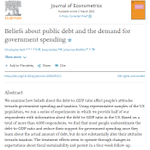
Achei q este dia nunca fosse chegar, mas aqui estou divulgando um RCT.
Tratamento: informar q a razão dívida/PIB é alta.
Resultado: tratados reduzem demandas por gastos públicos.
Não deve, mas vai q tem validade externa. No Brasil, dívida/PIB é cerca de 90% (e em expansão).


Eduardo Zilberman retweeted

Hoje foi lançada carta assinada por 200+ economistas brasileiros, incluindo ex-Ministros da Fazenda e ex-Presidentes do BC, cobrando do governo medidas de combate à pandemia. Estou entre os signatários e ajudei na redação. O que cobramos? Segue o fio 👇 bit.ly/carta-covid

Eduardo Zilberman retweeted

Merval Pereira escreve sobre carta aberta à sociedade que um grande grupo de economistas (eu entre eles...) divulgou referente a medidas de combate ao Covid-19, “O povo exige respeito, a vida necessita da ciência e de bom governo”
Lockdown emergencial
blogs.oglobo.globo.com/merva…
Eduardo Zilberman retweeted

New paper studying the development and firm dynamics effects of high and dispersed interest rate spreads using rich Brazilian administrative data sets and a GE model of occupational choice and financial frictions.

New CEPR Discussion Paper - DP15930
Dispersion in Financing Costs and Development
Tiago Cavalcanti @TiagoCa01150760 @CamEcon @Cambridge_Uni, Joseph Kaboski @nd_econ, Bruno Martins @BancoCentralBR, Cezar Santos @santoscezar82 @bancodeportugal
ow.ly/5Kei50E21kZ
#CEPR_MG

Eduardo Zilberman retweeted

In this issue of Econometrica: "Long-Term Contracting with Time-Inconsistent Agents" with @xingtanzhang
We look at an old question: How do firms contract with present-biased consumers who underestimate their bias?
We give some new answers and a way to think about inefficiency.

In this op-ed,@nfergus quotes Friedman's famous dictum, asserts that "inflation is often and in many places a fiscal phenomenon", quotes Sargent 2x. This reminded me Sargent's not-so-famous versions.
"Persistent (high) inflation is always and everywhere a fiscal phenomenon." (+)

“Inflation is always and everywhere a monetary phenomenon in the sense that it is and can be produced only by a more rapid increase in the quantity of money than in output.” Milton Friedman's monetarist credo wasn't quite the whole truth: bloomberg.com/opinion/articl…
This might explain why Sargent's great dictum is not that well-known googlewise. But do not let the Brazilian context ruin it!
After all, "persistent (high) inflation is always and everywhere a fiscal phenomenon." (+)