

Private sends on Solana. Screened, non-custodial. $DMOTH CA: 9ueEeBuYUc9X1GrNCyWHbKGnHJq1kaD2nvDapDsMpump
Joined October 2026
- Tweets174
- Following29
- Followers232
- Likes125




Pinned Tweet
Moth Pass has been updated. AI Pack and Private Payroll are now available on Duskmoth.
AI Pack 1 pass per generated plan Turn your instructions into a SOL or USDC payment plan. Review the recipients and amounts before using it AI does not move your funds.
Private Payroll 1 pass per batch Pay up to 20 recipients from your existing private balance through Privacy Cash. Review fees and recipient amounts before running the batch. Confirmed payments are not repeated when you resume.
Burn $DMOTH to get Moth Passes. Passes are optional Duskmoth’s core sending, shielding, and withdrawal features remain available without them.
A privacy tool should tell you what it can’t hide. Here’s ours.
Even with Duskmoth, these can still say something about you:
→ the public deposit into a private balance
→ the public withdrawal out of it
→ timing: sending right after you deposit is easy to connect
→ amounts: unusual exact amounts stand out
→ your browser and network metadata
→ a Moth Pass burn, which is public by design
What helps:
wait between shielding and withdrawing
use common amounts instead of very specific ones
use a different wallet to buy passes than the one you send from
None of this is a guarantee. It’s how you stop giving away more than you have to.
2
4
58
Private payments. Your own records.
Night journal is an optional log stored only in your browser. It stays off until you turn it on.
Filter it, search it, export JSON, and check a signature against the chain. Read-only, it never resends.
A journal entry isn’t a receipt. Keep exports private.
duskmoth.xyz/activity
Your Moth Passes live in your browser, not in an account on our server. That’s on purpose, and it has consequences you should know.
Why: if we kept a list of who holds which pass, the blind signature would be pointless. Local storage keeps the link between you and your pass off our side.
What it means for you:
→ passes belong to this browser profile and site, not to your wallet
→ a different browser or phone won’t have them automatically
→ clearing site data can delete them
→ restoring a backup doesn’t bring back a pass that was already spent
So: back up your passes right after the burn, and keep that file like cash. Anyone holding a usable backup can spend it.
Privacy has a cost, and it’s usually responsibility.
Two numbers matter in every private payment, and they aren’t the same.
Gross: the amount you start with. A payment request asks for this one.
Recipient gets: what actually lands after relayer and protocol fees.
That’s why Duskmoth shows “recipient gets” before you approve, and why a request link always says its amount is before fees.
Practical tips:
→ if someone needs an exact net amount, look at the preview and adjust before you send
→ fees come from the live quote, not a fixed number, so check it each time
→ a Moth Pass doesn’t remove fees
Small detail, but it’s where most “I sent 25, they got less” messages come from.
Burn once. Spend privately.
Your browser blinds a random token, Duskmoth signs it without seeing it, and you unblind it into a valid pass. The burn is public. Which pass it became isn’t.
One pass covers an AI Pack plan or a Payroll batch. The pre-withdraw check is free.
Back up your passes right after the burn. If issuance stops, resume. Never burn again.
duskmoth.xyz/pass · $DMOTH
“Pending” is the most misunderstood word in payments.
In Duskmoth, an operation can be in a few different places:
→ rejected in wallet: nothing was signed
→ submitted: sent, not proven
→ confirmed on the source side: funding landed
→ unknown: we couldn’t verify it yet
→ paid: recipient settlement verified
The one that gets people hurt is “unknown”. It feels like failure, so the instinct is to try again. That’s exactly how you pay someone twice.
What we do instead: check the chain, reconcile, and only then decide. An uncertain payout is never resent automatically.
If the screen stops updating, that’s not a verdict. Look before you retry.
duskmoth.xyz/app

Three balances. Not interchangeable.
Your public wallet is visible to everyone. Your private balance holds funds you’ve shielded. Your Moth Pass balance is premium credits in your browser, and it isn’t money.
Shield moves public → private. Withdraw moves private → recipient. Burning $DMOTH turns into passes, one way.
Seeing “insufficient”? Check which balance it means first. Don’t deposit again just to refresh it.
duskmoth.xyz/app
Duskmoth Payment Requests: paste your address, pick SOL or USDC, set the amount. You get one link and one QR.
Creating it signs nothing. Opening it sends nothing. The payer checks the details and decides in their own wallet.
duskmoth.xyz/request
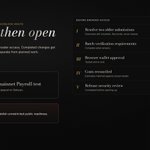
What has to be true before the MagicBlock route opens more broadly:
resolve two older submissions whose outcomes are still uncertain
complete the remaining batch-verification requirements
test wallet approval through the browser
reconcile estimated costs against actual results
complete the release security review
The three-recipient mainnet Payroll test is done. On its own, that doesn’t mean the route is ready for unrestricted public use.
We’ll post completed changes with evidence, and keep them clearly separate from what’s still planned.

We want Duskmoth’s implementation to be easy to inspect and easy to build on.
Planned GitHub updates:
→ tested SDK changes, released with test results
→ practical examples
→ compatibility notes
→ contribution guidance
We also plan to document how the MagicBlock route works in Duskmoth, what has actually been verified on mainnet, and what limits remain.
Using @magicblock technology doesn’t imply an official partnership or endorsement. It’s integration work, and we’ll describe it that way.

Planned improvements to Payment Requests are about clarity, not automation.
The goal: when you open a request, you should understand right away
→ the receiving address
→ the token
→ the amount
→ the ways you can pay it
And one rule that doesn’t change: opening a request link must never sign or send a transaction.
A request asks for a payment. It doesn’t take one. The payer stays in control of whether to pay, and how.
duskmoth.xyz/request

AI Pack turns plain words into a payment plan. Payroll runs it. The plan is to make the step in between much clearer.
Before you approve anything, these should stay visible in one place:
→ every recipient
→ every amount
→ estimated fees
→ the payment route that will be used
Same rule as always: an AI-generated plan is a draft, not permission to move funds. You review it, you approve it, and your wallet signs.
The handoff is the moment where mistakes are cheapest to catch, so that’s where we’re putting the work.

Where should Duskmoth go next?
With Requests, Activity, the Developer Hub and the Security page out, these are the proposed priorities. They focus on making what exists easier to understand and verify.
1. Clearer recovery states. Make it obvious whether an operation is waiting, unknown, partial or actually done.
2. Better release evidence. Say plainly which checks used simulated responses, which used real funds, and what’s still unverified.
3. More developer examples. Build on the offline SDK example: unavailable services, interrupted requests.
4. Mobile and accessibility. Keep improving the screens where you check addresses, amounts and fees.
Separately, MagicBlock USDC stays in internal beta until its acceptance requirements are met.
These are proposals, not a claim that work has started. No dates, no new partnerships.
What would you put first? Reply with a number.
github.com/duskmoth-dev

You shouldn’t need to risk real money to contribute to a payments project.
So the plan is a MagicBlock-focused example for contributors. It would prepare payment requests and read simulated statuses, and it needs:
→ no funds
→ no credentials
→ no wallet signing
→ no live transactions
Simulation examples and mainnet examples will be clearly separated, so you always know which one you’re running and what you’re actually testing.
It builds on the offline browser example already in SDK v0.2.2.

On the SDK side, the plan is to make Duskmoth’s responses for @magicblock transactions much more explicit: status, cost estimates and recovery.
The core problem we want to solve: three different events often get treated as one.
the transaction was submitted
the source funding was confirmed
the recipient was actually paid
They aren’t the same thing, and an integration that confuses them will eventually tell a user “done” when it isn’t. The SDK should make that impossible to mix up.
This work builds on our completed three-recipient mainnet Payroll test. Here’s one confirmed test payout from that run, finalized on Solana:
solscan.io/tx/HdZehdQ4gESYwX…

What we’re working toward next at Duskmoth.
The next phase isn’t about new features. It’s about making the payment infrastructure we already have easier to integrate, easier to understand, and easier to recover when a connection drops mid-payment.
What’s planned:
→ clearer MagicBlock responses in the SDK
→ contributor examples that run with no funds
→ a clearer review step from AI plan to Payroll
→ clearer payment requests
→ updated technical docs
Broader MagicBlock access still depends on the remaining verification checks. We’ll publish each change with evidence once it’s done, and keep it separate from what’s still planned.

Your wallet is louder than you think.
Every payment on Solana is public: who you paid, how much, and when.
Here’s the full Duskmoth walkthrough, filmed on the live app:
→ connect your wallet. Keys stay in it
→ shield, send or withdraw in plain words
→ request a payment with a link or QR
→ keep an optional local journal
→ get Moth Passes, run AI Pack and Payroll
→ read the developer and security pages
Every step shows the real screen and what to check before you approve. It also covers what to do when something gets interrupted, so you never pay twice.
Start small, read the preview, and decide for yourself.
duskmoth.xyz
Duskmoth × MagicBlock Mainnet Payroll Verified
Duskmoth’s USDC payment route built with @magicblock has completed a real three-recipient payroll test on Solana mainnet.
What we verified: • Three payments with different amounts, each confirmed at its recipient.
• One existing Moth Pass used for the entire batch—not per recipient.
• Stop-and-resume recovery without repeating the first payment.
• Observed source costs stayed within the reviewed limits.
On-chain payment proofs:
① solscan.io/tx/HdZehdQ4gESYwX…
② solscan.io/tx/PWZeCMsR7GgzaV…
③ solscan.io/tx/KaHgXHQkRrDU2f…
MagicBlock adds a separate USDC route alongside Duskmoth’s existing Privacy Cash integration.

Status check on MagicBlock USDC: it’s still an internal mainnet beta for allowlisted wallets.
What exists: a separate workflow for wallet-approved USDC send, deposit, withdraw and Payroll, with its own operation and recovery context. It’s an additional engine, not a replacement for Privacy Cash.
Before we open it to everyone, the remaining work has to show results:
→ funded Payroll acceptance testing completed
→ at least 10 successful internal mainnet batches
→ zero duplicate or lost payments in that set
→ fee accuracy and recipient settlement verified
→ remaining release-readiness findings resolved
One distinction we hold ourselves to: “source confirmed” doesn’t mean “recipient paid”. Settlement has to be proven.
duskmoth.xyz/tools

Duskmoth uses different technologies for different jobs. Mixing them up leads to wrong assumptions, so here’s who does what:
Privacy Cash provides the shielded SOL and USDC route.
Helius handles public-chain data and RPC.
Scorechain checks addresses against sanctions lists. It’s not an AML risk score and not an anonymity certificate.
Anthropic powers AI planning. A plan is a draft for you to review. The AI can’t move funds.
MagicBlock is a separate USDC engine, still in internal beta. It doesn’t replace the Privacy Cash balance.
Moth Pass gates optional premium actions. The token behind it is an ordinary public SPL token, not a privacy coin.
None of these names is a guarantee. No provider, privacy score or health check proves a payment was anonymous or settled correctly. That’s why every payment still ends with your own review and your own signature.
