

Auditor. yAcademy alumni. Formerly @Kleros_io, @ProofOfHumanity Ei incumbit probatio, qui dicit, non qui https://xitter.gq/t.co/rjKVVH3kkd…
Joined June 2014
- Tweets1.2K
- Following867
- Followers474
- Likes2.9K







Pinned Tweet
There is now a dashboard tracking how far Ethereum is from flipping BNB in verifiability hostility.
Should be added to ethereumdashboards dot com
Link below👇

1
1
170
Maybe someone should add this to ethereumdashboards dot com
bnbflippening.netlify.app/
1
39
xitter.gq/henlokart/status/19020…
Never worry about this type of problem by adding secretlint to your repositories
Include rule
secretlint-rule-secp256k1-privatekey

Post Mortem
hackmd.io/@henlokart/BJ7LaBL…

1
171
Congrats on this... Waiting anxiously for privacy again
xitter.gq/0xbowio/status/1902414…

🕵 Final contract audits are done!
Green lights ahead, just the finishing touches left, we're approaching Mainnet at full speed.
Read the audits: github.com/0xbow-io/privacy-…

2
91
ecexit.eth retweeted

Yes, Ethereum should go to Washington.
Ethereum has been a huge part of the policy conversation for years. There are many companies active in DC that build protocols, products, and services on or around Ethereum, so a lot of their advocacy relates to Ethereum either directly or indirectly. Also, as arguably the first widely-known and most successful smart contract platform, Ethereum has been the canonical example of how public blockchains other than Bitcoin work, so it has always been front and center in policy conversations since the beginning.
But Ethereum now finds itself at a disadvantage in DC.
Unlike many competing chains, there isn't a single high-powered, big-spending organization focused solely and entirely on advancing the interests of Ethereum or ETH in DC. That's not to undersell the effectiveness of industry nonprofits or Ethereum-aligned companies with their own policy functions — many are awesome. But nonprofits have a broader mandate, and for-profit companies have to look out for their own business first and foremost.
In a sense, Ethereum's presence in the policy world has mirrored its presence in the crypto world. The Ethereum Foundation has prioritized principles of decentralization, staying above the fray while leaving the dirty work of warfare to others. But compare Ethereum to other chains with dedicated policy efforts in DC. Many of them are running tried-and-true government relations strategies, not only to benefit the entire industry, but also to gain an edge in the market.
Two examples illustrate the difference. First, take Ripple, one of the heaviest hitters in DC. Ripple has been deeply engaged in policy for years and, largely in response to the SEC, co-founded Fairshake (the crypto super PAC) in 2023. Second, take Solana, since no ETH discussion is complete without reference to SOL. The Solana Foundation is highly respected in DC: they have an amazing policy lead in Amira Valliani, are a Blockchain Association member, co-sponsor events regularly, and are part of an increasingly effective effort across the whole Solana ecosystem this year.
On policy, Ethereum is punching way below its weight.
If EF or Etherealize want to get invited to the Crypto Summit, to testify in Congress, to put pro-ETH elected officials in office, etc., then it should consider establishing a dedicated policy operation in DC. Reasonable minds may differ on how to approach that task, but it doesn't require reinventing the wheel — it just requires executing the fundamentals of government relations:
1) allocate resources: enough to make a difference, in the range of millions (or tens of millions, if serious)
2) hire a policy lead: have an expert in DC focused full-time on building a comprehensive strategy
3) select priorities: these should be doable on a reasonable timeframe and material to Ethereum's success
4) engage service providers: get leverage with law firms for policy substance, lobbying firms for engagement
5) get active in the lobby: join industry associations, support independent think tanks, attend roundtables
It's totally understandable that the Ethereum ecosystem hasn't done any of this yet. It wasn't part of EF's mission, and until very recently, it may not have been worth the effort. But times have changed, and both EF and Etherealize have a different mission now. As part of that mission, they should consider a new approach to policy.


I contributed to the Privacy Pools Ceremony! You can view the steps to contribute here: ceremony.pse.dev You can view my attestation here: gist.github.com/eccentricexi…
1
43
Movement to turn Ethereum into BNB, Tron et al.
How will the community react?
xitter.gq/ethresearchbot/status/…

🤖 New EIP: N/A
By:
- Parithosh Jayanthi
-Kevaundray Wedderburn
-Josh Rudolf
-Dankrad Feist
-Justin Traglia
-Ignacio Hagopian
-George Kadianakis
🔗 github.com/ethereum/EIPs/pul…
This EIP provides hardware and bandwidth recommendations for validators and full nodes in the Ethereum network. It aims to establish clear system specifications to ensure meaningful benchmark comparisons, informed decision-making about protocol upgrades, and guidance for node operators. The proposal outlines specific requirements for storage, RAM, CPU, and network bandwidth for different node types, including full nodes, attesters, and block builders. It also suggests prebuilt hardware options and discusses considerations for storage, RAM, and bandwidth to support efficient network participation.

34
Censorship resistance means being friendly to clandestine operations.
The anon on Cuba and Venezuela should be able to run a full node (and have access to the required state) with intermittent electricity, not to mention slow connection.
3
208
Spot on.
xitter.gq/peter_szilagyi/status/…

Y'all know why #Ethereum is gonna get its ETF sooner or later? Because everyone is constantly poking at the protocol rules, so you just have to patiently wait and co-opt tiny decisions here and there, before the entire thing can be captured. Then it's just TradFi as usual.
135
Bonus: you actually build web3 instead of DINOs
xitter.gq/lex_node/status/178093…

hmm...
I advise pretty strongly on the legal side for smart contract software teams not to run infra...it's centralizing & more likely to make them fall under regulations...less likely to pass 'Bahamas test'
not a fan of incenting more vertical integration by software devs

1
119
Do Ethereum clients encrypt p2p data?
@nethermind @ErigonEth @ethnimbus @lodestar_eth @prylabs
xitter.gq/sethforprivacy/status/…

REALLY excited to see this broadly deployed, thanks to "p2p v2" being on by default now 🔒
What does that mean?
Running a Bitcoin node has always been easy to detect and surveil by ISPs, as most users run Bitcoin nodes over clearnet, use default ports, etc. But one aspect that has been particularly harmful is that all of the details about the transactions, blocks, and messages your node sends and receives has been sent in clear text with no encryption.
That approach makes it trivial for an ISP to see things like when your node broadcasts a transaction that originates with it vs a simply relaying an external transaction, harming your network level privacy.
The traditional fix for this is to run a node exclusively behind the @torproject network, but that also has its own tradeoffs (like easier Sybil attacks, slower block propagation, etc.)
Now, all of those running clearnet nodes will have their traffic between their node and any peers also running v27.0+ automatically end-to-end encrypted. While this doesn't prevent advanced analysis like timing and packet size, it does prevent an ISP from doing incredibly simple logging of cleartext traffic, adding a little more privacy and security to running a Bitcoin node.
Want to learn more? You can read the BIP and hear from the authors on an episode of @stephanlivera's podcast below.
1
1
510
@HyperledgerBesu @Teku_Consensys @reth_paradigm @gakonst reth maybe? @peter_szilagyi or geth? @sigp_io lighthouse?
I assume some data may be encrypted some but not other. I assume erigon for example doesn't encrypt blocks since it uses bittorrent?
1
113
The interactive book rust-book.cs.brown.edu is absolutely brilliant.
Thank you stranger.
1
57
#Monero people:
My node received fork A and stored the key-image of a tx where Alice paid Bob
Fork B shows up with more cumulative work, where Alice paid herself.
Which one does my node pick?
1
137
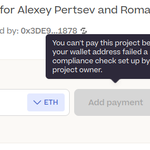
After some back and forth I was finally able to donate.
To a freer future 🍻
Still wish I knew why my address was blocked in the first place... Worrying.
xitter.gq/ecexit/status/17578990…

This is what I got.
This is a new address funded from a CEX. The only other tx is a Travala reservation.
No tornado cash, nothing.
Why am I not good enough for you? Can @juiceboxETH clarify what rule I broke or at least point me in some direction?

ecexit.eth retweeted

The all-time high Bitcoin exchange rate is not $69,000 - that was in 2021 dollars. For a true all-time high we'd need to break ~$79,000.
We need a blockchain that runs on low enough bandwidth that ionosphere propagation clandestine radio operators can break network partitions.
xitter.gq/isidoreducass/status/1…

101
ecexit.eth retweeted

The most important press freedom case in the world will be decided *this week.*

This journalist has been in a London prison for almost five years for exposing state criminality.
If the UK sends to the country he exposed he will die in a US prison cell.
This week the UK will decide. It’s now or never. Defend Assange. His life and the future of journalism depend on it.
#JohrnalismIsNotACrime
#FreeAssangeNOW
#DayX
