







Vitali retweeted

Maintainers need fixes, not more AI bug reports.
With @msftsecurity, we turned 9,791 raw AI security findings into 99 verified, private reports with suggested fixes for six open source projects. And maintainers are already shipping fixes.
What we learned from Codename MDASH, a new security project 🔍
github.blog/open-source/main…

Vitali retweeted

AI 写代码最离谱的问题:改对了一个函数,却搞坏了整个项目。💀
GitHub 上这个 Code-Graph-RAG,思路完全不同。
它把代码里的函数、类、调用关系全部变成知识图谱。
你可以直接问:
「改这个函数,会影响哪些地方?」
甚至可以让 AI 根据真实代码结构定位、修改和分析死代码。
AI 终于不只是搜索代码,而是尝试理解代码之间的关系了。
GitHub:github.com/vitali87/code-gra…

Vitali retweeted

Deploying AI in regulated domains like healthcare is about pass^k, not pass@k -- i.e getting decisions right every time, not once in k tries.
Agents that follow policies with guarantees are critical to closing the pass^k gap.
Today we're open-sourcing a research preview of symbolic-reasoning, our framework for policy-adherent agents.
Key idea: policy logic is encoded once and executed deterministically. LLMs / decision models only answer atomic factual questions. Every decision traces back to the exact criteria and answers behind it.
There's still much to build as reliable AI agents take on more complex work across healthcare and other industries. We believe the fastest way forward is building in the open.
Read more: anterior.com/insights/buildi…
Vitali retweeted

If you understand your whole codebase, the codebase isn't that important.
Real software is larger than what your brain can comprehend.

Vitali retweeted

TU AGENTE DE IA TE ESTA MIENTIENDO
MIENTE PORQUE VE EL 2% DE TU CÓDIGO Y ADIVINA EL RESTO
Le pides que cambie una función. Te dice que ya está. Y rompe 3 archivos que ni siquiera abrió. El problema no es el modelo, es que tu repo no cabe en su contexto y se lo inventa.
code-graph-rag lo hace diferente: en vez de meterle código, le da un mapa real de tu repo:
→ Construye un grafo completo: qué función llama a qué, qué clase hereda de cuál, qué se rompe si tocas esto
→ Ejecuta tus tests y captura las llamadas reales que el análisis estático no vio
→ Monorepo con 5 lenguajes mezclados: un solo grafo para todos
→ Se conecta a Claude Code como servidor MCP
→ Python, Go, Rust, Java, Node, .NET, PHP, C/C++, Ruby
→ En marcha en 5 minutos
La diferencia entre un agente que adivina y uno que sabe dónde está parado.
os dejo el repoo en los comentarios

Vitali retweeted

Making sense of any of your generated code is becoming increasingly difficult. Developer @AvagyanVitali suggests that the key to understanding code is to stop thinking of it as lines of plain text, and to treat it as a relational graph. heavybit.com/library/article…

Vitali retweeted

TU AGENTE DE IA TE ESTA MIENTIENDO
MIENTE PORQUE VE EL 2% DE TU CÓDIGO Y ADIVINA EL RESTO
Le pides que cambie una función. Te dice que ya está. Y rompe 3 archivos que ni siquiera abrió. El problema no es el modelo, es que tu repo no cabe en su contexto y se lo inventa.
code-graph-rag lo hace diferente: en vez de meterle código, le da un mapa real de tu repo:
→ Construye un grafo completo: qué función llama a qué, qué clase hereda de cuál, qué se rompe si tocas esto
→ Ejecuta tus tests y captura las llamadas reales que el análisis estático no vio
→ Monorepo con 5 lenguajes mezclados: un solo grafo para todos
→ Se conecta a Claude Code como servidor MCP
→ Python, Go, Rust, Java, Node, .NET, PHP, C/C++, Ruby
→ En marcha en 5 minutos
La diferencia entre un agente que adivina y uno que sabe dónde está parado.
os dejo el repoo en los comentarios

Vitali retweeted

TU AGENTE DE IA TE ESTÁ MINTIENDO 🤥
Y TÚ LE ESTÁS DANDO LAS GRACIAS‼️
Le pides que cambie una función.
Te dice que ya está.
Y rompe 3 archivos que ni siquiera abrió.
No es que sea tonto.
Es que tu repo NO CABE en su contexto.
Ve el 2% del código y se inventa el otro 98%.
code-graph-rag lo ataca por otro lado: en vez de meterle el código, le da un MAPA.
Así funciona:
→ Lee tu repo entero y construye un grafo:
- qué función llama a qué
- qué clase hereda de cuál
- qué se rompe si tocas esto
→ Le preguntas y te contesta. "¿Qué depende de esta función?" y te lo dice de verdad, no lo adivina
→ Monorepo con 5 lenguajes mezclados: un solo grafo para todos
→ Se conecta a Claude Code como servidor MCP
→ Se pone en marcha en 5 minutos
Y lo mejor...
Ejecuta tus tests y MIRA qué llamadas ocurren de verdad.
Luego las mete en el grafo marcadas como "esto el análisis estático no lo vio".
Funciona con Python, Go, Rust, Java, Node, .NET, PHP, C/C++, Ruby...
Una absoluta locura.
Te dejo el link al repo en los comentarios👇🏻

Vitali retweeted

Reading an unfamiliar codebase shouldn’t mean hopping between files, search results, and half-remembered call paths.
Code-Graph-RAG is a graph-based RAG system for developers working across multi-language codebases.
It helps you explore codebase structure and relationships in plain English by parsing code with Tree-sitter and storing an interconnected graph in Memgraph.
Key features:
• Multi-language parsing – supports C, C#, C++, Dart, Go, Java, JavaScript, Lua, PHP, Python, Rust, TypeScript, and TSX
• Natural-language queries – ask questions about codebase structure and relationships in plain English
• Source retrieval – returns code snippets for found functions and methods
• Flexible model providers – supports Google Gemini, Ollama, and OpenAI for natural-language-to-Cypher translation
• Dead-code detection – reports unreachable functions and methods, with an option to fail CI when candidates are found
It’s open-source (MIT license).
Link in the reply 👇


Vitali retweeted

code-graph-rag - The ultimate RAG for your monorepo. Query, understand, and edit multi-language codebases with the power of AI and knowledge graphs github.com/vitali87/code-gra…
Vitali retweeted

cmon Robert. Yea, he is a blowhole indeed.
Some examples:
multi agent/batching/subagents:
He handwaves away batching as a solution to running multiple agents simultaneously. This is literally exactly the solution that it scales very well especially tensor parallelism on vLLM. He claims he's running like 50 agents or something simultaneously. This is curious, and definitely outside of how I personally use coding agents. I currently go out to 8x.
Cost:
electricity $2K a year. His math was if you run it 24.7. This would be an agent literally running 24/7 producing actual tokens. If the GPU is indeed idle, it draws a very tiny amount of watts. Like 12. let's compare fairly. Which API/sub are you running an agent on 24/7 for CHEAPER than $2k a year? what a wildly dumb claim.
RTX Pro 6Ks are definitely expensive. he's not wrong there, but he's completely missing that people ARE buying these and ARE doing local inference and ARE running 100% of their workflow off of any API and off Opus and GPT. His only comparison was to buying a whole ass tiny box though. You can self-build an RTX Pro 6K rig for waaaaaaaaaaay less than a tinybox. You can also slowly build it up over time, as most people do.
I canceled both claude and gpt subs immediately at GLM's 5.2's release and have been entirely local since.
DSV4F is fast. Like REALLY fast. You can do 350 t/s if you are using pcie 4 or 5. I'm actually using that model over GLM 5.2 bc its so dang fast.
This is faster than even claude. You can live completely on dsv4f. Theo could (or should) too.
You can also live on GLM 5.2 2bit GGUF as a sole provider too. GGUFs don't scale quite as good with pipeline parallelism, but DSV4F you get like 1200+ t/s with bs=8.
Theo is truly speaking out of his ass. The problem is some of his arguments have merits but he's taking partial rights + ignorance and forming an argument that's just blatantly wrong.
Vitali retweeted

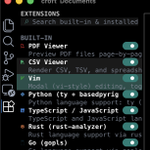
Check out Croft by @eheva87, a vscode-like IDE in the terminal! Works nicely in Moreboxed terminals too!.

Vitali retweeted

code-graph-rag
Code-Graph-RAG builds knowledge graphs from multi-language codebases and enables AI-powered querying and editing. It uses Tree-sitter to parse ASTs across 11 languages, stores structural data in Memgraph, and translates natural language questions into Cypher graph queries. Unlike vector-based RAG, it preserves exact code relationships: call chains, inheritance hierarchies, and module dep...
github.com/vitali87/code-gra…
Vitali retweeted

Finally! A RAG over code solution that actually works (open-source).
Codebases have long-range dependencies, cross-file references that independent text chunks can't capture.
Graph-Code, a graph-driven RAG system, solves this.
Vitali retweeted

Graph-Code: An Open Source Graph-Based RAG System for Any Codebase
A Retrieval-Augmented Generation (RAG) system that analyzes multi-language codebases using Tree-sitter, builds comprehensive knowledge graphs, and enables natural language querying of codebase structure and relationships as well as editing capabilities.
Features:
🌳 Tree-sitter Parsing: Uses Tree-sitter for robust, language-agnostic AST parsing
📊 Knowledge Graph Storage: Uses Memgraph to store codebase structure as an interconnected graph
🗣️ Natural Language Querying: Ask questions about your codebase in plain English
🤖 AI-Powered Cypher Generation: Supports both cloud models (Google Gemini), local models (Ollama), and OpenAI models for natural language to Cypher translation
🤖 OpenAI Integration: Leverage OpenAI models to enhance AI functionalities.
📝 Code Snippet Retrieval: Retrieves actual source code snippets for found functions/methods
✍️ Advanced File Editing: Surgical code replacement with AST-based function targeting, visual diff previews, and exact code block modifications
⚡️ Shell Command Execution: Can execute terminal commands for tasks like running tests or using CLI tools.
🚀 Interactive Code Optimization: AI-powered codebase optimization with language-specific best practices and interactive approval workflow
📚 Reference-Guided Optimization: Use your own coding standards and architectural documents to guide optimization suggestions
🔗 Dependency Analysis: Parses pyproject.toml to understand external dependencies
🎯 Nested Function Support: Handles complex nested functions and class hierarchies
🔄 Language-Agnostic Design: Unified graph schema across all supported languages (Python, JavaScript, TypeScript, C++, Lua, Rust, and Java. Go, Scala and C# coming soon)
The Graph-Code system offers four main modes of operation:
1. Parse & Ingest: Build knowledge graph from your codebase
2. Interactive Query: Ask questions about your code in natural language
3. Export & Analyze: Export graph data for programmatic analysis
4. AI Optimization: Get AI-powered optimization suggestions for your code.
5. Editing: Perform surgical code replacements and modifications with precise targeting.
By @AvagyanVitali
github.com/vitali87/code-gra…
#SoftwareEngineering #Code #Developers #Innovation #KnowledgeGraph #OpenSource #Python #DataScience #GraphDB #LLMs #RAG #GraphRAG
--
The Year of the Graph's next newsletter on all things Knowledge Graph, Graph Analytics / Data Science / AI and Semantic Tech is due in Autumn 2025.
Subscribe and follow to be in the know. Reach out if you'd like to be featured 👇
yearofthegraph.xyz/newslette…

Vitali retweeted

Finally! A RAG over code solution that actually works (open-source).
Naive chunking used in RAG isn't suited for code.
This is because codebases have long-range dependencies, cross-file references, etc., that independent text chunks just can't capture.
Graph-Code is a graph-driven RAG system that solves this.
It analyzes the Python codebase and builds knowledge graphs to enable natural language querying.
Key features:
- Deep code parsing to extract classes, functions, and relationships.
- Uses Memgraph to store the codebase as a graph.
- Parses pyproject to understand external dependencies.
- Retrieves actual source code snippets for found functions.
Find the repo in the replies!