
Sitting in peanut gallery. Free Speech is the fundamental right.
Joined February 2022
- Tweets24.7K
- Following169
- Followers218
- Likes16K





She should be held accountable for this
instagram.com/p/Df8ct71s19I/…

4
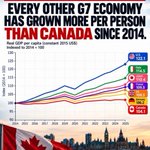
This is what Carney is doing to Canada. Lies and shell games.
Our books aren’t just cooked. We are.
facebook.com/share/v/1CNY8ij…
4
Corrupt, radicalized, activist ideologue Judges are the biggest problem in the US (and other countries list the UK) today.
The damage they are doing is incalculable. And this is one of the more intractable problems.
It needs to be addressed. Remove radical activist judges and change how they are appointed.
instagram.com/p/DgEXXD1N9Sf/…

2
Fact Checker of Last Resort retweeted

The money supply does not need to grow for an economy to grow. A fixed stock of money serves a growing economy perfectly well, because prices adjust downward as production expands. More goods chasing the same number of dollars means each dollar buys more. That is prosperity.
Central bankers treat deflation like a contagious disease, but falling prices are simply the market telling you that someone got more efficient. When Ford cut the price of the Model T from $850 in 1909 to $260 by 1925, consumers did not stop buying cars while waiting for prices to fall further. They bought millions of them. Falling prices driven by productivity growth do not paralyze economies; they reward savers and punish waste.
The key insight sits in the unit of account. Murray Rothbard made this explicit in "The Case for a 100 Percent Gold Dollar": the actual quantity of money in an economy is largely irrelevant to its functioning, because money's job is to facilitate exchange, not to exist in any particular volume. If the total supply of gold were fixed at, say, 10,000 tons forever, prices across the economy would simply denominate in smaller and smaller fractions of an ounce as output grew. The math scales indefinitely. A dollar divisible to eight decimal places (as Bitcoin already is, reaching units called satoshis at 0.00000001 BTC) gives you 2.1 quadrillion discrete units from a capped supply of 21 million coins. No economy in human history has needed more pricing granularity than that.
Governments expand the money supply because it lets them spend without taxing you directly, transferring purchasing power from your savings to whoever receives the new money first (typically banks and politically connected borrowers). By the time the new dollars reach your wages, prices have already adjusted upward. You paid the tax; someone else collected it.
A fixed money supply eliminates that mechanism. Producers compete to offer you more value per unit of currency rather than lobbying the Fed for favorable credit conditions. Capital allocation returns to the actual preferences of actual people, expressed through voluntary exchange, rather than the distorted signals that cheap credit manufactures. The economy needs honest money, denominated in units small enough to price anything from a country's GDP to a cup of coffee.


Fact Checker of Last Resort retweeted

Thomas Sowell: "The human race began in poverty, so there is no mysterious explanation as to why some people are poor. The question is, why have some people gotten prosperous, and in particular why have some gotten prosperous to a greater degree than others."
Excellent summary. The only thing I would add is that Canada should be on that list. Probably the US as well.

Take a moment to read how Ludwig von Mises described the point of no return:
"A state becomes almost unreformable when the majority of the population is financially or structurally dependent on the state (state employees, civil servants, recipients of subsidies, grants, or transfer payments, etc.). As soon as those who net benefit from or are supported by the state outnumber those who do not, the system blocks reforms, since the majority votes out of self-interest for the preservation or expansion of state services."
Doesn’t this sound familiar? France, Belgium, and Finland are already well beyond that point, followed by Italy, Germany, and Spain. In France, even the "right" RN demands a further cut to the retirement age. How is that "right"? Isn’t that the purest leftist demand?
Big-state spending works only while markets buy more sovereign debt at affordable rates. For France, they stopped last month. Politicians will next call for central-bank money printing, but that is quite naive. If printing money solved problems, why does poverty still exist?
The longer the socialist big-state illusion lasts, the more painful the inevitable cuts will be, whether state-dependent voters like it or not. Enjoy the socialist party while it lasts, it will not last forever.

1
She asks him why he’s laughing.
We all know why he is laughing.
England, WHEN are you going to come to your senses and put a stop to this nonsense?
Is there any absurd length you will not go to just to allay your fear of being called ‘racist’?
Your country has become a joke but it stopped being funny a long time ago.
Your entire culture and political establishment are sick. He knows it. That’s why he’s laughing.
People of the UK, especially the women, you need to understand the difference between having a culture and being in a ‘cult’.
Sort yourself out England.
instagram.com/reel/DgDmxWjkw…

4
Oftentimes you see these videos and you want more context.
In this case I think it’s better that you watch carefully and infer the context.
This is New York City.
Do you understand what’s happening here? It’s important that you figure out what’s going on and the context in which it’s happening.
instagram.com/reel/DfXaKqBg9…
8
Everything he says here is the straight up, unvarnished truth.
The only reason Alejandro Mayorkas is not prison for Treason, Dereliction of Duty, Perjury, and probably RICO charges in addition, is because of systemic corruption and graft across the political establishment in BOTH parties.

CONSPIRACY THEORY NO MORE:
Stephen Miller: “The Democrat Party, via the Biden-Harris Terrorist Administration devised a scheme to import illegal aliens into the country by the millions — granting them ‘parole,’ which gives them work permits, which gives them Social Security numbers, which gives them access to the voting booth — and finally hooking them on welfare like addicts hooked on drugs, all with the sole purpose of participating in U.S. elections and ultimately overthrowing the Constitutional Republic of the United States.”
The whole f**king is seditious.
2

Here we go.
youtube.com/post/UgkxVpIWscO…

3


California Democrats. Fraud, waste, corruption, incompetence.
facebook.com/share/r/1A6vqVc…
2
Fact Checker of Last Resort retweeted

In 1906, the scientist Francis Galton visited a livestock fair in Plymouth and accidentally stumbled on something that explains why central planning fails.
Around 800 visitors had paid sixpence each to guess the weight of a slaughtered ox. Galton collected the tickets and analysed them, expecting the crowd to do badly. Individual guesses were all over the place, but their average was 1,197 pounds - the ox weighed 1,198. While supposed experts - butchers and farmers - guessed poorly on their won, taken together, ordinary fairgoers had come within a pound of the truth.
Nearly a century later, in 2004, the journalist James Surowiecki popularised this effect in The Wisdom of Crowds. His argument was that in large, diverse and independent groups, individual errors cancel each other out, and the collective estimate moves towards the truth.
This helps explain why government bureaucracies so rarely match the efficiency of free markets. Friedrich Hayek called this the “knowledge problem.” The information an economy runs on is scattered across millions of people, each knowing their own circumstances, preferences and opportunities. No planner can gather it all. Markets don’t need to: through prices, they condense that dispersed knowledge into a single number that anyone can act on. The result is what Hayek called “spontaneous order”, complex coordination that no one designed.
Markets condense dispersed information into a market price. When planners abolish markets and try to design an economy and fix prices, they replace the judgement of millions with the guesses of a small group working from incomplete information. As Galton’s ox shows, no committee of experts, however clever, knows as much as all of us together. Central planning fails because bureaucrats fail to guess what the market could have told them.
