

Telling stories @IPinfo, prev @Cloudflare, @CloudflareRadar, journalist @Publico SIC @dinheiro_vivo, etc. Discoverer. Human🇵🇹. Tech, cinema, cars. Podcaster.
Lisboa
Joined January 2009
- Tweets29.3K
- Following1.4K
- Followers2.1K
- Likes24.1K







Pinned Tweet
First issue of something new I’m trying: The Internet Brief. This one: Yandex’s data centers going dark, French supermarket fridges, today’s critical PHP flaw (!!), a month of outages, and the South Pole’s satellite hours. First try, so feedback welcome!

João Tomé retweeted

Today I turn 88…I’ve seen some serious shit. The most serious of it all is love. I love my family, my friends, and my wonderful fans. The power of love remains.
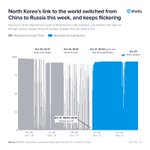
North Korea’s state websites are flickering again. The country reaches the rest of the Internet through just two carriers, one Chinese and one Russian.
Since Tuesday everything has gone through Russia, and early this morning even that link dipped three times, once to under a third of the Internet able to reach it.
The bigger problem now is the country’s own “phone book”: both servers that tell computers where .kp sites live are failing. Sites still open for most people because other servers remember the old answers, but those memories expire.

João Tomé retweeted
First issue of something new I’m trying: The Internet Brief. This one: Yandex’s data centers going dark, French supermarket fridges, today’s critical PHP flaw (!!), a month of outages, and the South Pole’s satellite hours. First try, so feedback welcome!

João Tomé retweeted
PHP fixed two critical flaws today. Wiz, which found them, says every version since 5.4 is affected, but the official updates only cover 8.2 and newer.
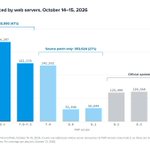
In @IPinfo's Internet-wide scan last week, at least 502,180 addresses showed a PHP version from 5.4 to 7.3: affected, with no fix at all. That’s nearly 4 in 10 of those that show a version.
Many servers hide their version, and some Linux distributions patch old ones themselves, so this is a floor.


ALERT - Multiple websites worldwide could go dark as critical PHP flaws spark global cyber alert
insiderpaper.com/critical-ph…


João Tomé retweeted

Introducing The Internet Brief, a new IPinfo data insights newsletter by João Tomé!
From Yandex data center outages to RPKI adoption and exposed supermarket refrigeration systems, the first issue explores what IPinfo's data reveals about how the Internet works and where things go wrong.
Read the first issue and subscribe for more data-driven research! 👇

PHP fixed two critical flaws today. Wiz, which found them, says every version since 5.4 is affected, but the official updates only cover 8.2 and newer.
In @IPinfo's Internet-wide scan last week, at least 502,180 addresses showed a PHP version from 5.4 to 7.3: affected, with no fix at all. That’s nearly 4 in 10 of those that show a version.
Many servers hide their version, and some Linux distributions patch old ones themselves, so this is a floor.
ALERT - Multiple websites worldwide could go dark as critical PHP flaws spark global cyber alert
insiderpaper.com/critical-ph…
Adding to this: RIPE routing data shows North Korea’s main web and DNS block (175.45.176.0/24) started flickering at 02:10 UTC on Oct 20, about 16 hours earlier, in two waves. It was almost fully gone 08:00–09:20 UTC Oct 21, then came back via Russia’s Transtelecom instead of China Unicom.
As of 15:00 UTC, kcna.kp loads from all four of our test locations (Europe, US, Japan, Russia). One of the two .kp name servers still doesn’t answer, so some lookups for other .kp sites still fail.


Nearly all North Korean websites have been inaccessible for the past day as the country experiences severe Internet disruptions.
175.45.176.0/24 contains the name servers for .kp and has been down repeatedly in the past 24hrs. @nknewsorg
nknews.org/pro/nearly-all-no…


it's the shinny dopamine thing that gives us the hit our brains crave for... difficult to navigate even with good digital literacy this day and age

Americans have a "revealed preference" for doing less of basically everything except going online and I have serious doubts that this is making us happier.
slowboring.com/p/americans-n…

João Tomé retweeted

The internet archive's Wayback Machine library is a planetary treasure. It preserves the archive of the web. Don't let publishers take it down. theatlantic.com/technology/2…


João Tomé retweeted
my agent sees some issues with this:
I see four potential problems:
1. Malicious or speculative accusations. Financial rewards could encourage people to report neighbours, colleagues, businesses or political opponents on weak evidence. Even an ultimately unfounded investigation can damage someone's reputation.
2. Rewarding allegations too early. The new fast-track mechanism can pay after criminal charges are filed, rather than waiting for a conviction. Charges are not proof of guilt, so this creates a potentially troublesome incentive structure.
3. Political discretion. Trump suggested he could personally arbitrate disputes over rewards. The DOJ's published announcement instead places award decisions within the department's discretion. Either way, transparent, independently administered criteria matter, especially when accusations could involve political opponents.
4. A market for accusations. If people can potentially earn millions for identifying fraud, journalists, activists, consultants and other intermediaries could have financial incentives to pursue accusations. That doesn't make their findings false, but it creates conflicts of interest worth disclosing.
quite interesting stuff

When do people experience mental health conditions for the first time?
— The key chart from Hannah Ritchie's new @OurWorldInData article: ourworldindata.org/when-do-p…

João Tomé retweeted

BREAKING NIUS: Für mich ist es einer der unglaublichste Auftritte von Bundeskanzler Friedrich Merz in dessen Amtszeit. Seit 17 Monaten erzählt Merz, er wolle Deutschland deregulieren, unnötige und schädliche Bürokratie beseitigen. Dann hat dieser Bundeskanzler die Möglichkeit, auf der Weltbühne, vor milliardenschweren Investoren dem Nvidia-Chef Jensen Huang eine Frage zu stellen. Und was fragt der Bundeskanzler? Er will wissen, wie man Künstliche Intelligenz am besten REGULIEREN kann. Als Huang antwortet, nunja, erstmal müsse die KI-Industrie in Deutschland aufblühen, bevor man sie regulieren könne, legt Merz nach. Er erklärt Huang, aus seiner Sicht sei entweder eine europäische oder gar eine globale Regulierung notwendig, um die "Schädlichkeit" von KI zu begrenzen.
Update: #Google says a power event in one of its three London zones caused it.
One zone in one city, and banking apps and other UK services that rely on it had problems for hours. Much of what we use every day runs on a few cloud regions.
@ipinfo’s ping scan shows London back to normal from 12:00 UTC, matching Google’s note that most services had recovered by 12:10. With full data for 10:00 UTC, London was at 91%.

Google Cloud’s London region has had trouble since 06:08 UTC today. UK banking apps and other services reported problems.
@ipinfo 's ping scan sees it too. From 06:00 UTC, fewer of Google Cloud’s London addresses answered than a day earlier. By 10:00 UTC it was 88.6%, while Google’s Belgium region stayed at 98.4%.
Google hasn’t given a cause yet.
