

On decision making. Co-author of The Myth of Experience.
Joined April 2013
- Tweets2.8K
- Following322
- Followers1.6K
- Likes4.3K




Pinned Tweet
This is the best video explainer on kind vs. wicked learning environments, and learning the wrong lessons from experience.
Beautiful illustrations, impressive presentation, superb content. I'm in awe.
Thanks @iluli_eu
Excellent new year's present :)

In their fascinating book “The Myth of Experience”, Robin Hogarth and @emresoyer argue that experience can sometimes teach us the wrong lessons as a result of “kind” and “wicked” learning environments. Find out how in my new video youtu.be/KDWfsxfRKXc
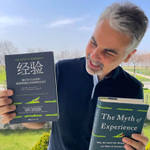
The Myth of Experience is now available in Japanese.
経験バイアス:ときに経験は思考決定の敵となる
In the book, Robin and I discuss instances where experience can be an unreliable teacher. Happy and grateful that more people will have access to it.

Robin had an extraordinary impact on my life.
I had the privilege to share many adventures with him. I'm immensely grateful.
I’ll miss him dearly, together with a lot of people, whose lives he touched and improved.


Remembering Robin Hogarth, long-time member of the Barcelona School of Economics research community who made a lasting impact on his field and on his students.
ow.ly/NPLh50RoeVo
Not only has he been a wise mentor and a dear friend, he also helped me meet other colleagues and friends.
Here’s a page from Robin Hogarth’s website that lists some of his students and collaborators over many years:
econ.upf.edu/~hogarth/Robin_…
Both are needed?
People also change from one type to the other…
Start with a mission, then love the game. Or start with the game, then love a mission.


We just published a piece on @HarvardBiz about how decision makers can unexpectedly learn the wrong lessons from failures.
Based on our book The Myth of Experience.

Effective decision-makers learn from both failures and successes. hbr.org/2023/03/dont-learn-t…
Emre Soyer retweeted

An extra-short newsletter — just a single insight from an eminent psychologist, a few months before he passed away at 45.
"Happiness is a 2x2 matrix"
davidepstein.substack.com/p/…
Thank you for the deeper dive @DavidEpstein
Hope the readers enjoy it.

"There are two ways of learning from experience. One is automatic and it doesn't take any effort on your part, and the other requires effort. And if you just leave it to no effort and rely on what you pick up, you'll pick up strange things."
davidepstein.substack.com/p/…
Chapter 19 is a must 😃🤔
#FooledbyExperience
The "HBR Guide to Critical Thinking" will help you navigate your most challenging issues, from difficult problems to tough decisions to complex scenarios.
s.hbr.org/3HHzcki

Emre Soyer retweeted

What does it take to develop true expertise? This is a good summary, presented in a succinct and clear way by Derek Muller @veritasium youtube.com/watch?v=5eW6Eagr… cc @emresoyer @BentFlyvbjerg @PTetlock et al.
Emre Soyer retweeted

There’s more to causality than causality—we need to pay attention not only to whether A leads to B, but also to how long it will take for A to lead to B, argue @emresoyer and Robin Hogarth: buff.ly/3NbLxNE

Consider a low probability yet disastrous event, which has a 1% probability of happening.
How does that risk feel?
That feeling would depend on the source of the information:
- Is it described by an expert?
- Or is it a lesson of experience?
psychologytoday.com/intl/blo…
One illusion among decision makers is the belief that machine learning is always useful:
If one’s understanding and predictions stem from machine learning based on big data, then they must(!) be reliable for decisions.
psychologytoday.com/intl/blo…
Decision strategies that got us here won’t likely be of much help moving forward.
psychologytoday.com/intl/blo…


Emre Soyer retweeted

'The assumption that there’s a clear and universal definition of failure undermines much advice for success.' @emresoyer Hogarth via @PsychToday psychologytoday.com/au/blog/…
Emre Soyer retweeted

📘 Next week, @econ_empresaUPF organizes the presentation of the book "The Myth of Experience" by @emresoyer and Robin M. Hogarth.
🗓️ May 26th, 17.45 h.
📍@UPFBarcelona & streaming
👉 More info and registration: ow.ly/eolR50JaYeU
Politeness matters for decisions, but it may not lead to the desired results if it isn’t used wisely by the decision-makers and understood correctly by the recipients.
psychologytoday.com/intl/blo…
Emre Soyer retweeted
Decision making would be much easier if results happened instantaneously—we’d make better judgments about causalities, and improve our strategies accordingly. But as there’s almost always a time lag, we’d better recognize it, writes @emresoyer: buff.ly/3NbLxNE

Emre Soyer retweeted

The new weekly reading list is up. This week I finished 4 books by some amazing authors!
And stay tuned because some of the authors will be on the podcast soon 🙌
@emresoyer @DrLindseyFitz @OlufemiOTaiwo @Ananyo
therewiredsoul.com/blog/book…