




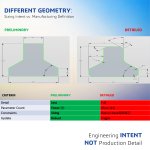


The fix isn't picking a winner. Keep an engineering structure that holds intent. Derive the build structure from it.
I've heard this called arrangements, level 5s, installations, model list items. What do you call it?
What the mashup costs you:
➡️ Engineering doing manufacturing's job too
➡️ One change, fixed in every plant's copy
➡️ Factory improvements wait on engineering
➡️ A second plant means restructuring it all again
The tell: part of your engineering structure doesn't describe the product. It describes how one plant builds it.

This came up on the "Designing With Intelligence" panel at Ai4.
If your designs keep colliding with reality after release, let's talk.
youtu.be/OyCaNu3I034?t=2317
Then it checked the real process, saw the tooling couldn't reach one joint, and moved that fastener before anything was released.
It caught a collision that normally bites two steps downstream.
I saw an AI example that stuck with me. Car body panels. The software placed the fasteners joining two panels. Handy on its own.
Every engineer knows the rework loop.
You design it. You release it. Then someone downstream finds out it can't be built the way you designed it.
If your source of truth is a BOM and a stack of drawings, what are you shipping that no one can see until it's built?
So it stays invisible until the floor, where one person finds a wrench that won't fit.
Make the 3D the authoritative truth and the problem shows up on a screen, weeks early, while the fix is cheap.
"But we have the drawing."
A drawing is a flattened shadow of the part, spread across views. A reach problem is a collision in space. Almost nobody catches that by cross-checking three views.
"Eight fasteners, one line" tells you how many. It says nothing about where each one sits, how it's oriented, or whether a tool can reach it.
A quantity is an aggregate. Positions aren't there.

I've watched teams claw back most of that day by killing the clone-and-own habit alone. Same team, more engineering, not more hours.
Let engineers engineer.
How much of your team's week disappears into non-engineering work?
CoLab's research puts it at 23% of engineering time lost to non-value-added work. More than a day a week, every week.
That's not a discipline problem. It's an architecture problem.
🔁 Cloning structures for one more variant
🔍 Hunting for what changed between two "similar" assemblies
🔗 Chasing one change across every domain by hand
🔒 Waiting on a file someone's had locked since Tuesday. It's Thursday.
We train engineers for years. We hand them the best CAD and simulation tools on the market.
Then we bury a quarter of their week in non-engineering work.
Not because they're slow. Because of how we make them manage data.

System-level modeling isn't new. Doing it on something modern and connected is. Where does your early performance work live today, and what happens to it after the decision is made?