

Co-founder @Kiln_finance. Veni, Vidi, Twitti. 🕊️
Joined February 2011
- Tweets3.4K
- Following2.2K
- Followers2.8K
- Likes27.5K







Ernest O retweeted

this is THE time to be revisiting distributed inference on heterogeneous hardware, software is collapsing the barriers of hardware incompatibility

Ernest O retweeted

This: "you can't solve [France] by going after immigrants (as the right asserts) or the rich (as the left asserts), but you could solve it by going after the old". And by that he just means retiring at a normal age relative to elsewhere, not attacking the frail but the privileged. Which Macron tried from the Center but the Right and Left blocked.

The ugly truth about France and some of the other European countries currently in turmoil - and which none of the politicians want to admit because it'd be political suicide - is that you can't solve the problem by going after immigrants (as the right asserts) or the rich (as the left asserts), but you could solve it by going after the old.
One extraordinary statistic for you: people over 60 in France, a quarter of the population, own 60% of France's wealth, non-financial and financial (ofce.fr/pdf/revue/2025/3-192…).
And here is another crazy statistic:
that same quarter of the population, those above 60, receive nearly two-thirds of all social spending by the French government (previssima.fr/actualite/prot…) - which is famously among the highest in the world (France's government spending is an insane 57.3% of GDP).
Last statistic: they make up about 40% of voters because they're a third of registered voters (insee.fr/fr/statistiques/266…), and they turn out far more than anyone else (franceinfo.fr/elections/sond…).
Put our 3 statistics together and there's almost a bit of an apartheid situation here: the old own most of the country's wealth, collect most of the social spending and have the political power to keep it that way.
Which makes them a de-facto rentier class, living off assets and transfers paid for by younger generations.
And, of course, at the risk of stating a truism, the future is built by the young. Yet France keeps effectively taking money away from them to give it to those whose working lives are already behind them - and need the money far less since they already own the country's wealth.
What about inheritance, I hear you ask? That's the funniest/saddest aspect: given that life expectancy has kept rising, the French now inherit a home at 54 on average. The most common case is someone in their 80s leaving it to heirs in their 50s, in effect the very old transferring wealth to the about-to-be old (insee.fr/fr/statistiques/fic…).
You can add this to our earlier apartheid statement: on top of all the rest, even when the old finally let go of their wealth, it stays within their own "camp".
That's my personal situation, incidentally: I'm 42, my father is 71 and he is starting to look at ways to pass things on to me and my siblings, when our professional lives are already well settled, so it'll arrive when it changes things the least, which is pretty much the French system in a nutshell.
Now, I get that there'd be some unfairness in going after them: they paid into the system their entire working lives, playing by the rules of a social contract that told them if they paid up they'd collect at the end. Changing the rules now means breaking that promise, which is admittedly unfair.
But there's no magic wealth tree in any society: you can only take it where it is. That's the way most major societal transformations end up happening. They're often triggered by a catastrophic event (the so-called "four horsemen": mass-mobilisation war, revolution, state collapse, plague) BUT what really drives change is a transfer: wealth gets pried from the privileged class who've been sitting on it and handed to those who'll build what comes next.
So, in theory and in an ideal world, you can do without the catastrophic event and directly proceed with the transfer...
The fact that in France, and elsewhere in Europe, it's the youth protesting is probably no coincidence - even though they don't frame it as a generational fight. And even though, cruel irony, the left politicians many of them march behind promise to bring the retirement age back to 60 (lcp.fr/actualites/legislativ…), which would make the situation even worse.
Let's say they understand intuitively that the system is stacked against them, even if they haven't yet figured out how. And politicians are obviously doing what politicians do, meaning pandering to the people who actually vote, while pointing the young towards easier - and politically convenient - scapegoats.
To be clear I'm not saying it's the only problem in France, VERY far from it. I'm also not saying that all old people in France live a lavish lifestyle at the expense of younger generations: there are also plenty of very poor retirees who, if anything, would deserve more.
What I am saying is that it's probably the biggest elephant in the room: everyone can see it, nobody dares mention it - no politician, from any side, wants to run on cutting grandma's pension - and it makes every other problem harder to fix.


Ernest O retweeted

MAYBE I WAS WRONG ABOUT BLOCKCHAIN TECHNOLOGY
I wrote about how I always used to make fun of the guys who said things like "Bitcoin is speculative, but the underlying blockchain technology is interesting." And now I think maybe they kinda had a point.


Ernest O retweeted

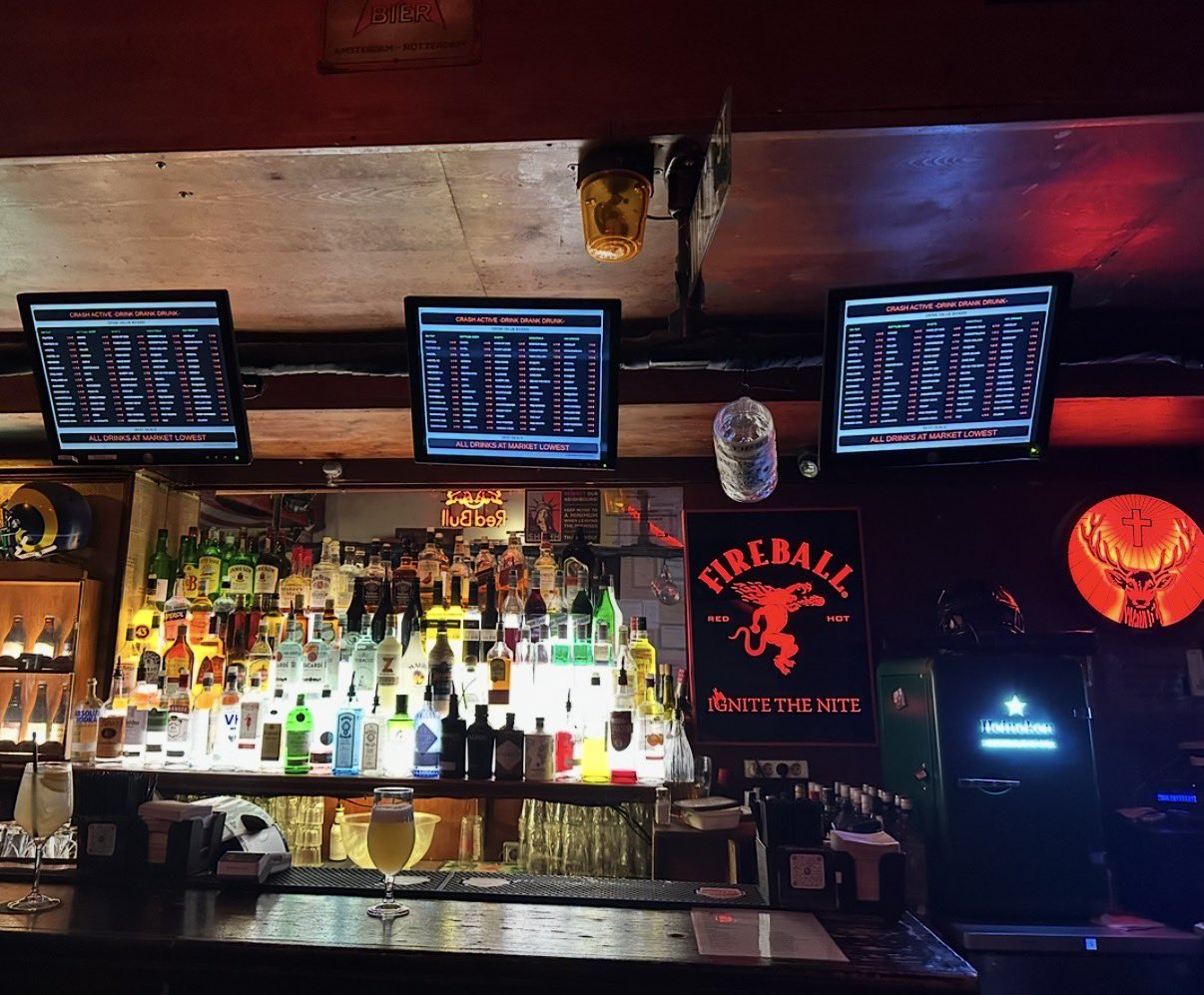
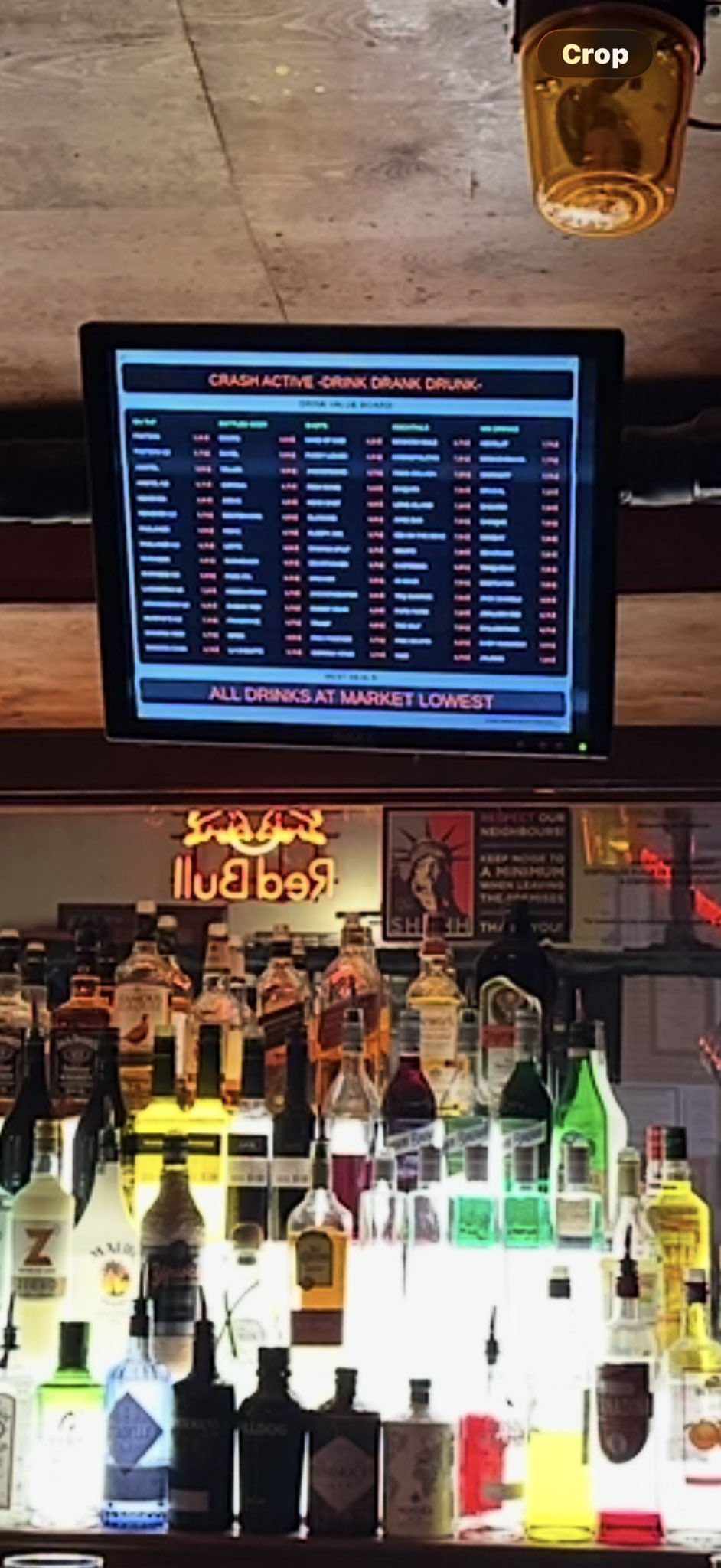
Was recently at a bar where drinks were dynamically priced,
i.e. the more people bought a particular drink, the more expensive it became (price would then decayed over time towards a floor).
Fascinating to watch a few market mechanisms play out in a bar:
People ventured outside their usual orders in search of cheaper alternatives, often discovering new favorites in the process.
Others treated rising prices as signals of quality, happily paying premiums to try expensive drinks they’d never had before.
More experienced drinkers behaved like value investors, picking up underpriced drinks they already knew were good while everyone else chased the popular ones.
Price discovery, information leakage, herding, and utility trades all unfolded over rounds of drinks.
More bars should try this.


Ernest O retweeted

bombshell report from the OCC out today confirming what we all suspected:
between 2020 and 2025, based on a review of 100,000 complaints, America’s largest banks systematically denied banking to lawful businesses based on political and reputational considerations rather than objective financial risk, effectively appointing themselves arbiters of which industries deserved access to the financial system. digital assets was specifically named as one of the six most affected industries.
TLDR: we weren't imagining it. OCP2.0 was real.

Ernest O retweeted

I spent 48 hours in SF hanging out with billionaires, data labs and AI founders and execs running $1B to $100B companies.
My observations:
1. Sooo MANY stories of data brokers making like $2M a WEEK selling company data to labs. I can't tell if it's the beginning or a bubble, and I kept wondering which niches are left. Digging into it actively.
2. At dinner, someone asked the table, "If a new model drops next month, does your company get better or worse?" HALF the table went quiet! I think that's the best question to ask about any AI startup right now.
3. The bar people talk about now is hitting $1B in revenue in 12 months (I guess that's the new unicorn?). What I didn't hear much about is retention. AI revenue can come in fast and leave fast, and I think we're going to see a lot of stories of AI companies with huge revenue and terrible retention.
4. It's pretty clear we're living through the reinvention of the computer. The model is the CPU, the harness is the operating system, and skills and plugins are the apps. Thinking about it that way makes it easier to see where the whitespace is.
5. We're maybe 12 months from an agent that can watch you work for a week and then do your job without any instructions. The screen recording plus agent memory plus local model combination makes this possible right now.
6. Agent harnesses feel like the new GPT wrappers, in a good way, especially vertical ones. The best teams I talked to treat the model as swappable. One founder walked me through routing different models to different jobs: one for taste and visuals, a cheaper one for the everyday stuff, another for text.
They use prompts they can move across models over fine-tuning, and A/B test the output on what users actually do with it: do they edit it, export it, share it? A vertical harness is basically four things: the connectors for that industry's data, evals written by people who know the work, rules for what the agent can and can't touch, and a clean screen for a human to review. The model is maybe 20% of it.
7. There's a lot of reverse engineering going on/cloning going on more than I've ever seen. People are decompiling software and rebuilding it with agents, and someone showed a suite of like 10 apps that are worth $5B+ each all that he cloned open source. Me and everyone are still thinking through what it means when software gets this easy to copy.
8. My guess is the value moves to data. If the software can be rebuilt quickly, what's worth paying for in a legacy SaaS company is the years of customer data and workflows inside it. Some SaaS companies are secretly data companies.
Gets me thinking about how do you truly value data for this saas companies? Like if we were buying these dying saas companies at 2x ARR before (as example), maybe there is a better metric. Idk, just thinking out loud here.
9. It feels like a good chunk of legacy software won't make it to the agentic era, especially anything built around people clicking through a lot of screens.
10. Every company I talked to wants to pipe its internal data into one place and expose it to agents through MCP. Then they look at the data and realize it's a mess: five versions of the same customer, old Slack channels, PDFs nobody can search. Cleaning that up feels like a big consulting opportunity!
11. A lot of founders are building the basic building blocks for agents: APIs, data layers and tools. Some of the companies I saw barely have a UI because the main user is an agent. I really believe the startups that build primitives to this agentic era will do extremely well. Building blocks is the best way to think about it.
12. Labs can get plenty of training data, but it's harder to get real examples of agents failing inside companies. Whoever has those logs has something valuable.
13. Someone running a big consumer company told me the next fight is over memory. The model that remembers the most about you wins, and the smartest model matters less than people think.
14. Physical AI came up a lot. Astra I think was the first model that got people into AI can actually do CAD, and I think a lot of people are thinking what does vibe manufacturing really look like. The line I keep thinking about came from a robotics founder: the hardest problems in AI are deployment problems now, not research problems. Their robots work on their own, call a human when they get stuck, and every one of those calls becomes training data.
15. Cybersecurity companies are having a moment and are actually cool companies to build now, especially the ones that clean up after a breach. Every agent with access to your systems is a new door into your company, and a lot of those doors were left open.
16. Some startups are worth more dead than alive now. A shutdown company with 5 years of Slack, email and code can get paid for licensing all of it. I wouldn't be surprised if founders start factoring that into when they shut down.
17. People are starting to talk about monetizing the agent web. It feels really early, but when the most popular user of the internet is an agent, what startups should you be building?
18. I think agent insurance is coming. Once an agent makes an expensive mistake, insurers will want audits before they cover anyone.
19. Several people said the hire they want most is someone with taste who can write evals. The models are getting good at generating ideas, so the hard part is judging which ones are good.
20. New trend I observed: startup raises VC, uses venture dollars to become a creator, startup fails, founder falls back on being a full-time creator and incubates other products bootstrapped.
21. Getting SIGNIFICANT distribution is HARD right now. Founders are sponsoring buses, buying billboards like crazy and throwing parties with famous DJs to get noticed. Kinda feels dotcom era in that sense.
Attention is what's scarce! The growth guy going viral sharing his UGC strategy from Wispr Flow is a good example. It's the sauce everyone wants, and I truly believe there are probably only 50 people on the planet who know how to scale these types of businesses efficiently in this era.
Always good to get that dose of SF. I felt sooo lucky to have such an incredible trip during such an incredible time in building businesses. Surreal in so many ways.
Happy to be home and locked in.
Until next time!


Ernest O retweeted

Margaret Hamilton, who led the 100-person team that wrote the onboard software for the Apollo missions, has died. nyti.ms/3U9IrTj

Ernest O retweeted

A French high school teacher suggests that a phone ban helped lead to riots legrandcontinent.eu/fr/diman…

Ernest O retweeted

Had to explain it to a few folks, apparently it helps understanding the argument better.
- Elliptic cryptography (used in almost all blockchains) is built on clever tricks and fancy math assumptions, an engineering analogy would be self-stressed structures
- AI labs breaking math assumptions left and right lately, might break elliptic crypto too (maybe already did!)
- Better use something dumb and straightforward, more like solid concrete bricks, like hash-based cryptography
Coincidentally it would also be post-quantum safe but it's not the point.

Today I call upon the blockchain industry to calmly begin planning for "bunker mode". My personal recommendation is to set in motion a controlled mass migration of assets to fresh addresses, i.e. addresses whose pubkeys remain hidden behind a hash.
Holders, starting with large and sophisticated ones, should consider moving the bulk of their funds to addresses that have never signed a transaction. And when they do sign one, they should also move remaining funds to a new address (possibly generated from the same seed phrase).
Don't rush. While I believe there is cause for action a rushed migration would do more harm than good. Don't panic either. Moving assets to protected addresses is a simple, preventative step which does not require new cryptography or new wallets.
IMO it is now reasonable to brace for the possibility that ECDSA breaks before qday, in the worst case in months not years. By "break" I mean fast private key recovery (e.g. in one week) on available hardware (e.g. a large GPU cluster).
Recent days have been humbling for human mathematical intuition. Long-held, unquestioned hypotheses have fallen. This includes the n log(n) bound for integer multiplication and the 3SUM conjecture. In hindsight, May's unexpected disproof of the Erdős unit distance conjecture was our warning shot.
Yesterday's OpenAI drop made it clear that mathematical superintelligence is upon us. They say there are weeks where decades happen. We are about to live through weeks where centuries of mathematical progress happen. Could our magic 64-byte ECDSA signatures be too good to be true? Was it just security through obscurity all this time?
Elliptic curves feel especially vulnerable to superintelligence. Curves carry rich structure, with room for fancy tricks like Schoof, Frobenius, pairings. (By contrast, hashes are designed to minimise algebraic structure.)
Separately, as Ewin Tang can attest, an efficient quantum algorithm sometimes foreshadows an efficient classical one. We should be open to the possibility of a classical counterpart to Shor that breaks elliptic curves and RSA at once.
Also noteworthy is the striking under-representation of cryptographic breakthroughs among the 722 mathematical results OpenAI published. I've witnessed first-hand the US government censoring academic quantum cryptanalysis results. Backroom interventionism is my base case.
I urge large, sophisticated actors to lead by example. Project11's "risq list" (bitcoin-risq-list.projecteleven[.]com) is a great tracker of exposed BTC pubkeys. Binance, Bitbank, Robinhood, Bitfinex, and Tether have an opportunity to harden their cold storage. Next month I'll address institutions in London in a live Q&A (forum.ethereuminstitutional[.]org/london-2026).
Again, please do not rush. Wallets holding under 50 BTC enjoy partial cover from "Satoshi's shield", i.e. his 20K exposed addresses that hold 50 BTC each. Load-bearing signers like oracles and L2 security councils should consider rotating ECDSA pubkeys with every signed message and/or multi-signing with a hash-based schemes like SPHINCS.
Exiting bunker mode safely will require post-AI cryptography. My inclination is to go all-in on hash-based cryptography and avoid structured mathematical assumptions entirely, whether from curves, lattices, or isogenies. A single battle-tested hash (e.g. from the SHA or BLAKE families) yields plausible post-AI security.
The Ethereum roadmap on strawmap[.]org fully embraces hash-based cryptography with end-to-end formal verification as a response to the quantum threat. Those timelines must now be revisited and accelerated in light of mathematical superintelligence. I'll be pushing for maximum defensive acceleration.
Ernest O retweeted

🇸🇬 This is the time to meet in Singapore!
@laszlo__szabo @darshanvaidya @donaldchua @aviekhoo @sengsengwill @x_poussin and more will be there for @token2049 Singapore next week, plus side events.
Always happy to talk about the future of digital asset infrastructure.
Want to meet the team? DM us directly or book a meeting below 👇
4d3s1.share.hsforms.com/2NuR…


Ernest O retweeted

La vérité, c'est que le niveau de vie retraités en France est quasiment le même que le niveau de vie des actifs 👇
La France est une anomalie en la matière, en comparaison de pays similaires.
Ces pays ont plutôt un niveau de vue des retraités à 80-85% des actifs 👇
Il faut favoriser l'augmentation du niveau de vie des actifs, mais cela passe aussi par contenir l'augmentation générale des dépenses de retraites, donc réforme des retraites de 2023 à maintenir (au moins), et desindexation partielle et temporaire de certaines pensions de retraites.

Ernest O retweeted

Ok, we now have the actual text of the Greenland deal (whitehouse.gov/briefings-sta…), so we can say how it compares to the existing 1951 arrangement and who, between Trump and Denmark, lied the most in their framing of it.
Long story short - which may surprise some - the Danes lied the most: Trump is pretty much correct in saying that this new deal grants the US control of Greenland.
Let's look into what changed compared to the 1951 deal.
1) This is now a permanent arrangement: whereas the existing 1951 deal only lasted as long as NATO existed, this one "does not have an end date and may only be amended by mutual consent."
It even survives a hypothetical future independence of Greenland: in that event, Denmark and Greenland must ensure that the independent Greenlandic state "affirmatively assume[s] all of the rights and obligations of the Kingdom of Denmark specified in this Agreement."
2) In the 1951 agreement, the US could set up bases only where both governments agreed, and only on the basis of NATO planning. The new deal locks in three bases: the US can "modernize and expand its activities" at Pituffik, its only base in Greenland until now, and "shall be allowed to establish an additional Defense Area at Narsarsuaq and Mestersvig." Further bases beyond these 3 can be justified by the defense of "the American continent," a US interest rather than a NATO one.
Also, quite subtle but this is interesting: Article IV(iii) says that "the United States may establish additional defense areas in Greenland" and that consultations are then held "to decide implementation details based on mutual agreement." What this means is that the principle of a new base is automatically granted and only the implementation details require agreement.
Article VII also gives the US "the right to raise concerns regarding construction, or change of use" of any building near a US base, after which the parties decide together what to do. Which means that the US has a say over civilian planning around its bases.
3) On US military movement across Greenland, the wording change between the 1951 agreement and this new one is quite funny.
The 1951 text said (Art. V(3)): the US "may enjoy... the right of free access to and movement between the defense areas through Greenland, including territorial waters, by land, air and sea," but only "in accordance with general rules mutually agreed upon and issued by the appropriate Danish authority in Greenland."
The new one says: "the United States of America shall enjoy... the right of free access to and movement between the Defense Areas through Greenland, including the Territorial Waters, by land, air and sea."
That's it: "May" becomes "shall," and the US military movement no longer has to follow rules "issued by the appropriate Danish authority in Greenland." The US also gets something new on top: "undersea access to and movement within the Territorial Waters," i.e. submarines.
4) Non-NATO exclusion: non-NATO states are barred from military installations or a persistent presence in Greenland unless all three parties approve, giving the US an effective permanent veto. The 1951 deal had no equivalent clause.
5) Investment screening: this is entirely new. "States or investors from a state that is not a member of NATO, a NATO partner, or an EU member state" (i.e. Russia, China, India, the Gulf States, etc.), "shall not be allowed to have (i) control, (ii) significant influence, or (iii) access to non-public information...within Particularly Sensitive Sectors or Activities in the territory of Greenland (including the Territorial Waters), unless agreed between the Parties."
Again, it basically means that the US has a permanent veto over who can invest in strategic sectors in Greenland, as far as non-NATO or EU states are concerned.
6) Lastly, in stark contrast with the 1951 deal, the framing of the deal changes significantly: this new deal is largely framed around the US.
The 1951 agreement existed only "for the benefit of the North Atlantic Treaty Organization." The new one lists the defense of "the American continent" as an objective, celebrates "the irreplaceable role" of the United States military as well as "the United States' indispensable historical and ongoing contributions to the security and defense of Greenland," and names the establishment of Trump's "Golden Dome" missile defense system as a key goal.
So, to sum up:
- The US secured a permanent military foothold that even an independent Greenland would inherit whether it likes it or not
- The US now has veto power over any non-NATO military presence in Greenland, and over who can invest in its strategic infrastructure and resources (beyond NATO and the EU)
- Denmark signed away its say over the principle of new US bases, with only the right to discuss the "implementation details"
- Danish authorities no longer set the rules for US military movement across the island
- And all of it is now justified by the defense of "the American continent"
I don't know in which universe this even remotely "recognizes the sovereignty and territorial integrity of the Kingdom and the Greenlandic people's right to self-determination," as Danish PM Mette Frederiksen put it (stm.dk/en/press/press-releas…).
Yes, the preamble of the text cynically "reaffirms" Danish sovereignty but, in my book, when you let a foreign country put bases on your soil, move its troops without following your rules and veto who else can come in, in perpetuity, after it spent two years threatening to take you by force, the word for that is anything but "recognized sovereignty" 🤷

Looks like what happened was:
Trump: "We're going to buy Greenland!"
Denmark: "Absolutely not, Greenland is not for sale! But you can have it for free"
(I'm aware that Denmark is saying they kept "sovereignty" over it, but not sure what that word means when another country has permanent veto power over who can invest on your territory and occupies the place militarily)