

Co-founder @subyhq | Payments & Stablecoin Infrastructure
🦇🔊
Joined December 2018
- Tweets388
- Following469
- Followers270
- Likes1K





my take on the current wave of hacks and data leaks: we're going to see a lot more for the next few months, until tech catches up, the vulnerabilities get patched, and companies get serious about defending with automated AI tools
after that, things go back to the normal, and the weakest link left will be the same as always: humans
be safe anon

We’re introducing Shirudo, an open-source Linux runtime allowing agents to defend systems without downtime. It lets agents write dynamic eBPF controls to shield systems from exploits, giving defenders more time to test and roll out patches. Built by @cisco together with OpenAI.
Shirudo is a first step toward self-defending infrastructure that can adapt to new threats while keeping services running. Our goal is for defenders to work with AI agents to find affected systems, test and share shields, and deploy them without disrupting workloads.
openai.com/index/introducing…

1
5
199
a store ai agents can't buy from misses a share of sales that keeps growing. so stores are opening a way in for them: browse, fill the cart, pay
it has already started
> @WalmartNews opened a gateway for agents in october, on mcp. it calls agents clicking through its website "slow and error-prone"
> @Visa opened its agentic program to the acceptance side on november 17 with more than 140 participants, @Adyen, @checkout and @stripe among them
> more than half of the people who buy once through an agent come back for a second purchase
a store can't charge an agent's token alone, so merchants are going to move to the gateways that can do it end to end
the hard part
until now, software at checkout meant card testing: scripts running stolen cards to see which ones still work. visa ties more than $1 billion of fraud a year to it, so every checkout learned to block bots. agents are bots too
to tell them apart, visa and @Mastercard have agents register a key and sign each request, and the site or its bot protection (@cloudflare) checks the signature. visa expects fraudsters to use agents as well
if you sell online, ask your gateway whether it takes agent payments today


every website is going to integrate its own mcp, so an agent can buy from it without going through a checkout built for humans
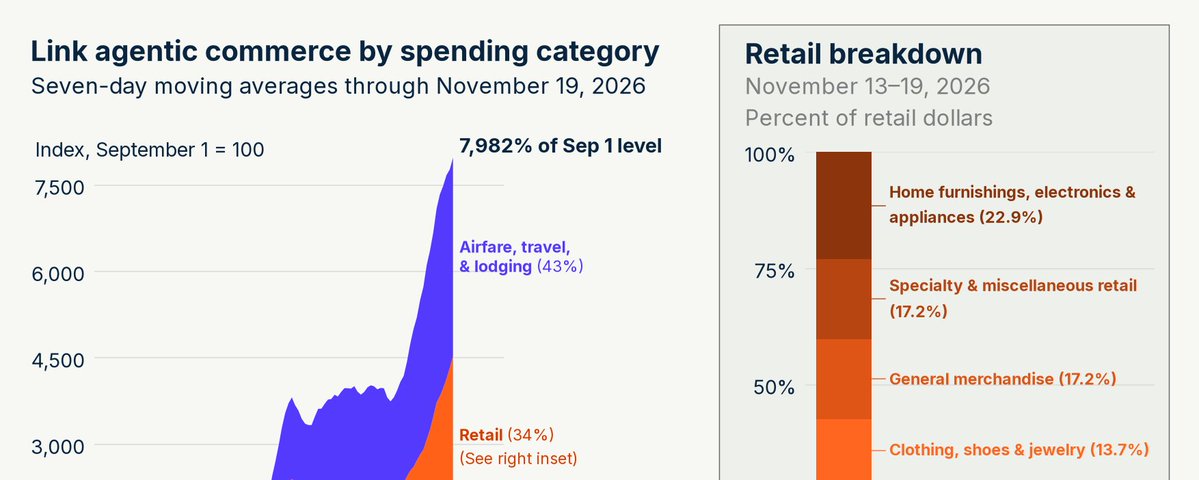
daily agent spend through link is up nearly 80x since early september, and stripe's docs show what those agents meet at checkout. link agent wallet picks a payment credential based on how the seller takes payment:
> a regular card form: the agent types in a one-time virtual card
> a stripe checkout: a link pay token, filled in through webmcp tools on the page
> an api: a shared payment token, capped to an amount and an expiry date
the first one is an agent acting like a human. for the other two, the site has to expose tools an agent can call, and its payment gateway has to charge the customer from that scoped token, end to end

We're releasing new @Stripe agentic commerce data today, telling the story so far as we look ahead to the kickoff of the holiday season next week.
why does a checkout ask for a billing address?
to lower the risk. every piece of data the merchant sends helps the customer's bank check that the payment is legitimate. less data means more risk, and more risk means more declines and higher fees
online payments are riskier by default. in a shop, the card is there: the terminal reads its chip and the customer is standing at the counter. online, neither the card nor the customer is physically present, and anyone who has the numbers can type them
so the bank that issued the card (the issuer) has to decide on the spot whether this is really the cardholder, with only the data it receives. in europe, online payments are 18% of card transactions and 83% of card fraud
who handles it
> a gateway like @molliepayments collects the data at checkout and passes it on
> the acquirer, licensed to take card payments for the merchant: @Adyen, @stripe, @checkout, @Worldpay_Global, @RapydGlobal, @airwallex
> the card network: @Visa, @Mastercard
> the issuer, the bank behind the customer's card: @Chase, @capitalone, @Citi, @revolut
what travels
> payment request: card number, expiry, cvc, postal code. the issuer compares them with what it has on file
> 3d secure, the step where the issuer checks it's really the cardholder: name, email, phone, billing address, plus the ip address and the device, which the customer never types
risk
> each party scores the payment with the data it gets: the gateway, then the card network, then the issuer. a missing field is a check that can't run
> online, a fraudulent payment is the merchant's loss by default, unless a 3d secure check moved it to the issuer
declines
> when the issuer doesn't have enough to go on, it declines. suspected fraud is the #2 decline reason on visa, after insufficient funds
> same with 3d secure: the more fields are filled in, the more often the issuer lets the payment through without asking the customer to confirm
fees, in the us
> standard consumer credit card online: 1.89% + $0.10. a payment that doesn't qualify: 3.15% + $0.10
> add ip, device id, email and full billing address: visa takes 0.10% off
in europe consumer interchange is capped whatever you send, so thin data costs you in declines
collect the fields, pass all of them to your gateway, and don't fill a gap with a placeholder

1
12
533
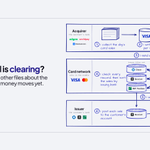
what the hell is clearing?
it's banks sending each other files about the card payments of the day, before any money moves
you pay by card. your banking app says "pending", and some time later it becomes a final line on your statement. in between, the payment went through clearing
at checkout your bank only approved the payment and set the amount aside. nobody has asked it for the money yet
how it works
> the acquirer, the bank or processor collecting card payments for the merchant (@Adyen, @Worldpay_Global, @checkout, @RapydGlobal), gathers the day's sales: one file for @Visa, one for @Mastercard
> each network gets its file. visa calls its clearing system "file-based"
> the network checks every record and re-sorts the sales by the bank that issued the card
> each of those banks (issuers) gets one file with what its cardholders spent, at every merchant
still no money has moved. the files only say who owes what, and the banks pay one net amount a day at settlement
so "captured" at your psp only means the sale was sent for clearing. adyen's docs say the network can still reject a capture, in rare cases a few days later

stablecoins can carry your payouts across borders without your acquirer or your merchants ever touching one
say you run a platform. you collect card payments in one currency and owe each merchant their share in another: pesos, reais, pounds. your acquirer (the bank or processor that takes card payments for you) can send that money abroad for you, and it charges for it twice: the currency conversion generally costs 1 to 2%, and a cross-border payout fee comes on top, starting around 0.25% of the amount
the virtual account
> providers like @StableCoin (bridge) and @walapay_io open a virtual account in the merchant's name: a us routing and account number, or an iban
> your acquirer sees a bank account and pays out to it like any other. for the acquirer it's a domestic payout in its own currency, so neither fee applies
> each deposit is converted on arrival to ethereum:0xa0b86991c6218b36c1d19d4a2e9eb0ce3606eb48 (@circle), for 0.1 to 0.25% on average
what the merchant sees
> on the way out, the same conversion runs in reverse. the usdc is turned back into money and sent to the merchant's regular bank account, in their own currency. they receive an ordinary local transfer and never deal with a stablecoin
for a platform that moves a lot of volume across currencies, the payout stops being cross-border for the acquirer. the fees it no longer pays can lift its margin on the same volume

europe put a price cap on the rest of the world's cards
since 2019, @Visa and @Mastercard cap the interchange on personal cards issued outside europe when they pay a european business: 1.50% on credit, 1.15% on debit, online. voluntarily extended to 2029
say you sell to canada with no entity there. every canadian card is a cross-border payment wherever you process it, with a currency conversion if you charge in cad. the real choice is between two foreign acquirers, and the reflex is the us
a $100 online payment by a foreign visa card, in interchange (the fee that goes to the customer's bank), conversion excluded
> debit: $1.60 in the us, $1.15 in europe
> classic credit: $1.60 vs $1.50
> premium, like a canadian infinite: $1.85 vs $1.50
> infinite from elsewhere: $1.98 vs $1.50
the catch
> you need a real business in europe: staff, sales tax, local contract law. an eu acquirer alone doesn't count
> you only see the gain on interchange-plus pricing
> personal cards only
> conversion, network fees and your processor's margin aren't capped
no entity in your customer's region? you're cross-border anyway, and europe is the cheaper place to be cross-border from

8
250
payment is an art, not a science
once a country where you have no presence starts to matter, local acquiring can earn you more from the customers you already have
say you sell online from europe and orders from a country on another continent keep growing. your acquirer (the bank or processor that takes card payments for you) is abroad, so each customer's bank sees a foreign sale and declines many of them. you had already paid to bring those customers to checkout
the 30/60/90 rule, a rule of thumb for some countries
> acquired cross-border: about 30% approved
> cross-border with 3ds, where the customer confirms with their bank: about 60%
> a local entity and 3ds: about 90%
from 60 to 90, the same 100 buyers bring 50% more sales, with no extra marketing spend
take india, one of the countries where the gap is wide. its central bank's rules show where it comes from
> cards are issued with online and international payments switched off
> every domestic online payment is confirmed with two factors. a foreign one without 3ds skips that step
> since 1 october 2026, indian banks must be able to answer a 3ds request from a foreign merchant
the gap changes from one market to the next. in japan, cross-border can be approved almost as often as local
when it's worth it
> split your approval rate by card country and price the declines in lost sales
> add 3ds first. it needs no entity
> a local entity is the investment, with an acquirer licensed there (@Adyen in india and japan, @checkout in japan)
it pays off once the sales you recover outgrow what the entity costs to run

R1 | Suby retweeted

Expanding on why I believe "ETH as store of value (SoV)" makes much more sense to focus on than "ETH as fee-burning token".
Three primary reasons:
1. ETH as fee-burning token never was as strong as it seemed
2. Optimizing for ETH as fee-burning token would demand Ethereum and ETH function in ways that are very hard to make compatible with decentralization and capture resistance.
3. Meanwhile, optimizing for ETH as SoV is aligned with Ethereum focusing on its unique strengths (decentralization and CROPS)
EIP-1559 (including its burn) is fine and good, we should keep them. But we should not feel sad if fee burn is < 10% of breakeven indefinitely; the value of ETH comes from elsewhere.
The core idea: the big thing that people appreciate about Ethereum is decentralization and CROPS. The main pragmatic benefit that these things translate into is stability. SoV is the category where that is not an unneeded extra we merely put effort into for ideological reasons, but rather a pragmatic strength from the perspective of people putting in their assets. And in the era of AI disruption, stability will be highly valued.
recovering a declined payment is an art, not a science
your customer's subscription renews and their bank declines it: insufficient funds. the billing system retries an hour later, then the next day, and gets the same no. after a few of those, the bank starts treating your charges as suspicious
whether to retry
> every decline comes back with a reason code from the customer's bank
> some codes mean the answer will never change: card lost or stolen, account closed. @Visa and @Mastercard forbids retrying them
> the rest can be retried, up to 15-20 times
insufficient funds is its own case
> the card works, there just isn't enough money on the account today. retrying in an hour asks the same empty account the same question
> wait until money comes in. payday is the obvious moment: in the us, 9 in 10 employers pay more than once a month. in france, once a month by law, so aim for the end of the month or the first days of the next
> ask for less. a yearly plan that fails can fall back to one month
the expert move: partial authorization 🥷
> waiting means guessing when the money comes back. partial authorization asks the bank how much it will approve today
> you ask for $100 and flag that you'll accept less
> if the bank supports it, the answer comes back through the card network with the balance available, say $70, instead of a decline
> you collect exactly that $70 today and charge the $30 after payday, if your terms allow it
visa makes it mandatory at gas stations, where the pump can't know the bill upfront. for banks it's mostly optional. so it works on some cards like debit and prepaid cards, not all, and @AmericanExpress doesn't allow it on recurring

when a card payment says "approved", no money has moved yet
take a fuel pump. your card is accepted before you've pumped a drop, so the station can't know the amount. it asks your bank to reserve a sum, up to €350 on @Visa in europe, and sends the real figure once you've finished
authorization, in seconds
> the acquirer, the bank or processor collecting for the merchant (@stripe, @Adyen, @Nuvei, @Worldpay_Global, @checkout, @nexigroup, worldline), asks the customer's bank (issuer) through the network
> the issuer reserves the amount. nothing is debited
> atm withdrawals and us pin debit do it all in one message
clearing, later
> the acquirer claims the money by sending the issuer a record of the final sale
> the banks settle a daily net amount, and the merchant gets paid minus fees
a hotel works the same way: an estimate, raised during the stay, up to 30 days on visa to charge the bill
if you capture manually, "authorized" is a state with no money behind it yet, and it expires: 5 days in person and 10 online on visa, 7 online on stripe

R1 | Suby retweeted

Scaling Direct Response offers? We shipped Tagada V3 fully AI native.
-> Tagada.io
You prompt, it builds: landing, checkout, upsells, subs, AB tests, VIP club, email flows…
Best checkout & CRM on the market, multi-acquirer processing & card vaulting included.
Straight sales or MRR, it handles both.
Try it now. $500 credit on us.
turning pesos into usdc takes a company with a bank account in your user's name, and none of them covers the whole world
say your app holds digital dollars for users in mexico, brazil and kenya. someone in mexico city wants to add 5,000 pesos from their banking app. your app has no mexican bank account, and usdc (@circle) doesn't sit in a bank at all
that's what on-ramps and off-ramps do:
> they open a virtual account in your user's name. a clabe in mexico, an iban in europe
> the user sends a normal local transfer (spei, pix, sepa, ach) or mobile money
> the provider converts and sends stablecoins to a wallet. off-ramp is the same path backwards
who covers what, from their own docs
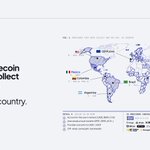
> us: bridge (@StableCoin), @brale_xyz, @blindpay, @walapay_io, @alfredpayio, @koywe_latam, @trycobre, @tazapay
> sepa zone: bridge, walapay, tazapay, infinia
> mexico: bridge, blindpay, walapay, alfred, @bitso, capa, infinia, koywe, @yellowcard_app
> brazil: bridge, blindpay, walapay, alfred, bitso, infinia, koywe, trace finance
> colombia, argentina: alfred, bitso, blindpay, infinia, koywe, yellow card
> africa: yellow card, @HoneyCoin, @kotanipay, mostly over mobile money
> asia: tazapay and walapay collect in a couple of markets, elsewhere it's payouts only
collecting and paying out are two different products. walapay's docs list two-way rails in 7 markets and payout-only rails in dozens more

6
235
with a co-branded credit card, the bank pays the brand. costco and air france-klm lend their name and their customers, and the issuer pays them out of every purchase
on each card payment the shop's bank pays the issuer (the bank behind your card) a fee called interchange. in the us it's not capped on credit: @Visa lists 1.43% to 2.60% + 10¢
costco × citi
> the contract is public, redacted. @Citi pays a marketing fund, a bounty per new account, a royalty on spend outside @Costco and a share of the program's profit
> if interchange falls too far, the royalty is cut to "negate the impact" on the bank
> 2025: citi's us consumer unit paid $12.1B in rewards and partner payments vs $9.9B of interchange, so the rest comes out of interest
amex × air france-klm
> @AmericanExpress pays @KLM a signing bonus, yearly brand fees, a % of spend and the miles it buys (dutch court ruling)
> in 2023 @AirFranceKLM raised €1.5B from @apolloglobal funds on the entity holding flying blue and its partner contracts
in europe credit interchange is capped at 0.3%. a us issuer has $1.43 to $2.60 per $100 to share with the brand, a european one 30¢

7
228
a usd or eur account that pays out in stablecoins is an api you plug into, not a bank you build. @BitgetWallet's comes from @Noah_HQ, whose docs show the flow
> you send noah a customer, a coin, a chain and a wallet address
> noah returns us routing or iban details at its partner bank
> the sender pays by normal bank transfer
> after compliance review, noah converts it and sends the coins to the wallet


What if you could have your own US or EU bank account, with just a few taps?
INTRODUCING: Virtual Accounts - dedicated USD & EUR accounts inside Bitget Wallet.
Get paid. Receive money. Fund your wallet. No walls. No borders. No banks.
Just your money in your wallet.
6
184
if you sell abroad through a single acquirer, most of your foreign sales are international transactions. they cost more and get declined more often
say your company is based in the us and takes cards through one psp. a customer in paris pays with a french @Visa card. for visa, the sale happens where your business is, and the issuer (the bank behind the card) is in another country. that makes it an international transaction, priced and approved as one
what it costs
> @stripe us, $100 sale: $3.20 with a us card, $4.70 with a foreign card, $5.70 with currency conversion
> visa network fees on a credit card: 0.14% for a us card, 1.59% for a foreign one
> the same french card through an eu acquirer: interchange capped at 0.3%
what it does to acceptance
> banks are often more likely to approve a domestic payment
> @Worldpay_Global says localizing lifts approval rates 10 to 15% in some markets (their figure)
the setup
> stripe for us cards, worldpay for uk/eu, @Nuvei for canada and latam
> the card's country is known before you charge, the orchestrator routes it to the local acquirer
one mid down, two still taking payments
> a reserve, a suspension or an outage hits one mid, not all your revenue
> spreading volume to stay under visa's dispute thresholds can cost USD 25,000 a month
what it takes: a real presence in each country. staff there, its sales tax, its contract law

1
9
250
whatever you sell online, one number decides whether you keep taking cards: your chargeback ratio
a chargeback is a customer calling their bank, saying they don't recognise the charge, and the bank taking the money back
every month @Visa and @Mastercard divide those cases by your sales
> visa: fraud reports + disputes this month ÷ online sales this month. non-compliant from 0.5%, fines certain from 1.5%
> mastercard: chargebacks this month ÷ last month's sales. limit 1.5%, then 3%
> winning the dispute or refunding after it's filed doesn't remove it
your acquirer is watched too
> visa adds up all its merchants and flags it from 0.5%
> mastercard bills its fines to the acquirer, and its rules let it suspend or terminate the licence of a member that breaks its standards
so your ratio is their problem too, and they often act well before 1.5%. closing your account is how they fix it. in europe the next acquirer has to check visa's list of terminated merchants, and mastercard's MATCH keeps you on its list 5 years
every chargeback also costs you a fee, win or lose (at @stripe or @Adyen the dispute fee is never returned). when you can, refunding the customer is cheaper than a dispute
what lowers it
> make refunds easy and answer your customers
> running subscriptions? warn customers before each charge
> cancel suspicious payments before capture: no fraud report
> refund when an Ethoca or visa RDR alert comes in, before the chargeback

2
6
265
few hours ago @nodejs fixed 3 high-severity bugs. each hides behind something your server does every day
brotli (CVE-2026-111497)
> crafted compressed data makes node's decoder write outside its memory, and code can run on your server
> you're concerned if you fetch urls someone else picked (webhooks, link previews, crawlers, agents) or accept compressed request bodies. fetch(), axios and got unpack replies on their own
tls (CVE-2026-106069, -105483)
> write an ip oddly (10.5 for 10.0.0.5) and node can accept a certificate issued for another address
> you're concerned if your services call each other by ip over https
dns (CVE-2026-105482)
> dns.resolve() stops at the first null character. evil.com\0.trusted.com passes an "ends with .trusted.com" check, and evil.com gets looked up
> you're concerned if you call dns.resolve() yourself to vet a domain


🔐 Node.js security updates are now available!
New releases for Node.js 22.x, 24.x & 26.x address multiple vulnerabilities, including high-severity issues.
Review the details and update your systems to stay secure.
🔗 nodejs.org/en/blog/vulnerabi…
#NodeJS #Security

1
7
590
R1 | Suby retweeted

🚨 High-severity Node.js flaw could allow remote code execution; CVE-2026-111497
Node.js has patched an out-of-bounds write vulnerability in its bundled Brotli decoder.
⠀
An attacker able to supply malicious Brotli-compressed data to an application could potentially corrupt memory and execute code on the underlying server.
⠀
Affected:
• Node.js 22.x
• Node.js 24.x
• Node.js 26.x
Fixed:
• Node.js 22.23.4
• Node.js 24.22.1
• Node.js 26.12.1
⠀
End-of-life Node.js versions may also be vulnerable and will not receive upstream security updates.
Administrators should upgrade and restart affected services.
Source:
nodejs.org/en/blog/vulnerabi…