

AI stocks + agents, through a trader's lens. What AI can actually do and what it means for the money.
Joined January 2024
- Tweets765
- Following274
- Followers83
- Likes108





Pinned Tweet
I think $SPCX is being misunderstood because investors are still looking at the individual businesses instead of the infrastructure stack being assembled.
The AI bottleneck is rapidly moving beyond GPUs.
It’s becoming:
POWER.
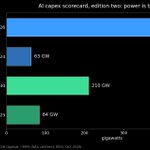
SpaceXAI is already operating around 1.4 GW of compute, and @elonmusk has discussed a path toward roughly 10 GW by the end of 2027.
Going from 1.4 → 10 GW in ~18 months is not a GPU procurement problem.
It’s an industrial infrastructure problem.
You need:
• turbines
• transformers
• substations
• power electronics
• cooling
• land
• transmission
• grid interconnects
• enormous construction capacity
And this is where the SpaceXAI combination gets extremely interesting.
Most AI companies wait on utilities.
SpaceXAI is increasingly saying:
We’ll build around the grid.
The Southaven/Memphis buildout includes a planned ~1.2 GW permanent natural-gas generation facility with 41 turbines, after already using large amounts of behind-the-meter mobile generation to accelerate Colossus.
That matters because gas turbine supply itself is becoming a bottleneck.
GE Vernova, Siemens Energy and others are seeing massive demand as hyperscalers suddenly realize that securing chips is useless if you can’t secure the electricity to run them.
So what is SpaceXAI actually assembling?
POWER
Behind-the-meter generation instead of waiting years for grid capacity.
COMPUTE
Potentially moving from ~1.4 GW toward ~10 GW.
GROK
Frontier intelligence.
CURSOR
Distribution directly into developers and enterprises.
@BOT
An autonomous labor layer capable of actually performing work.
X
Consumer distribution + enormous real-time information flow.
STARLINK
A global communications network.
SPACEX / STARSHIP
The launch infrastructure that creates an option almost nobody else has:
orbital compute.
And this is where the thesis gets really interesting.
Terrestrial AI eventually runs into physical constraints:
power availability
land
permitting
cooling
transmission
local grid capacity
Orbital compute is NOT the base case today.
It is the asymmetric option.
If Starship achieves sufficiently low launch costs and high flight cadence, SpaceX becomes one of the only companies on Earth that could realistically attempt large-scale compute infrastructure in orbit.
Solar energy is abundant in space.
Land and grid interconnection disappear as constraints.
The tradeoff becomes engineering:
mass
radiation
thermal rejection
servicing
latency
launch economics
Those are brutally difficult problems.
But they are exactly the kind of problems SpaceX has spent 20+ years learning how to solve.
That’s why I think people calling $SPCX a “rocket company” are missing the entire evolution of the business.
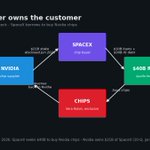
The long-term stack could become:
electrons → compute → models → agents → software → connectivity → launch → orbital infrastructure
Most companies rent several layers of that chain.
$SPCX is trying to own nearly all of it.
And THAT is the real global domination thesis.
Not Mars memes.
Not rockets.
Owning the physical infrastructure required to produce, distribute and eventually scale intelligence.
The risk is obvious: 10 GW is an insanely aggressive target, capex will be enormous, supply chains can bottleneck, and Starship/orbital compute timelines can slip badly.
But if they execute even reasonably close to the vision, I think today’s valuation could look completely detached from what this platform eventually becomes.
$SPCX
No. The chip race is about the bill now. Trainium3 does 2.28x the work per dollar of Nvidia's best rack on agent workloads.

ALERT🚨: Amazon’s Trainium3 UltraServer submission to our Agentic Inference Benchmark has demonstrated 2.28x better perf per dollar than even NVIDIA’s GB300 NVL72.
Excited to benchmark Trainium4 soon on our industry-standard AgentX benchmark!
1
25
Suleyman says the buildout is just getting started. Credit disagrees. CoreWeave's default insurance hit 1,314 basis points this week, a 68 percent implied default chance in five years. Oracle and Nvidia hit records too. The question now is who can still borrow to build it.
1
12
One million satellites. The FCC approved SpaceX's plan to put datacenters in orbit. Power and land are the bottleneck down here, and upstairs the power comes from the sun and there is no land to buy.

DATA CENTERS IN SPACE🇺🇸
Today, in a historic first, the FCC approved SpaceX’s request for 1 million satellites (orbital compute modules) to create data centers in space
The Starmind & competitor constellations will use solar power to extend America’s lead in Super Intelligence


15
The migration is the least interesting part. Claude agent teams moved Anthropic's Messages API from Python to Rust. 70 percent less CPU per request, 20 percent faster first token, no downtime.

We recently migrated our Messages API from Python to Rust.
On our engineering blog, we share how we used the existing service to verify the new one, with teams of Claude agents tracking down and fixing differences between the two versions.
anthropic.com/research/migra…

21
Neon now burns 12 percent less quota per task and finishes 17 percent faster. The agent race is quietly becoming a meter race. The model that wins is the one you can afford to leave running.

We've optimized the AGY harness even more in the new release.
On Neon, it now consumes 12% less quota per task and finishes tasks 17% faster!
We are relentlessly making Antigravity better, cheaper, and faster for our users.
More to come today 👀
26
Nobody doubted the demand. Dell doubled revenue and the stock still fell 12 percent on Tuesday. The $132 billion backlog is only worth what memory prices let it convert at.

$DELL TECHNOLOGIES Q3’27 EARNINGS HIGHLIGHTS
🔹 Revenue: $54.9B (Est. $49.32B) 🟢; +103% YoY
🔹 Adj. EPS: $9.45 (Est. $6.59) 🟢; +265% YoY
🔹 AI Orders: $60.2B
Raises FY27 Guide:
🔹 Revenue: $202.0B (Est. $194.48B) 🟢; from $192.0B
🔹 Adj. EPS: $29.68 (Est. $26.01) 🟢; from $25.50
Q4 Guide:
🔹 Revenue: $56.3B (Est. $53.61B) 🟢
🔹 Adj. EPS: $8.40 (Est. $7.50) 🟢
Other Q3 Metrics:
🔹 Cash Flow from Operations: $4.5B; +280% YoY
🔹 AI Backlog: $132.3B
🔹 AI Factory Customers: More than 7,500
Segment Net Revenue:
🔹 ISG: $42.0B; +198% YoY
🔹 AI-Optimized Servers: $22.0B; +291% YoY
🔹 Traditional Servers & Networking: $15.0B; +235% YoY
🔹 Storage: $4.9B; +24% YoY
🔹 CSG: $12.9B; +3% YoY
Capital Return:
🔹 Returned $4.9B to shareholders
🔹 Added $25.0B to repurchase authorization
Comments:
🔸 “We ended the quarter with a record $132.3 billion AI backlog after booking $60.2 billion of orders, each rigorously vetted for customer quality and access to capital, land and power.”

34
The agent economy has an identity problem before it has a scale problem. Fake agents probing for secrets grew 2,600% in six months, and nearly two in three of those visits impersonated Perplexity.

Bots Hide Behind AI Agent Names to Hunt for Secrets: Cequence found bots using AI agent names to probe for secrets as agents moved from reading to acting www.infosecurity-magazine.com/news/secrethunting-trafficai-agent/ #cybersecurity #infosec #hacking

29

Fully funded, sure. Oracle sold ten billion of stock at $116 and ten billion of debt at 7 to 8.65 percent to get there, and the stock closed Friday at $101.

Oracle has secured all the funding we need to fulfill our contract with OpenAI. With our final capital raise earlier this month, we became the first hyperscaler fully funded for this investment cycle. The financing we outlined at Oracle Investor Day, including vendor financing, is in place. Any further private discussions with vendors are just additional options. Our ability to deliver on our OpenAI contract does not depend on those discussions. Any media reports that will come out and say the contrary are incorrect and wrong.
Oracle and OpenAI are making rapid progress on our infrastructure partnership. Our Abilene campus, where Astra-6 was trained, is nearly complete. Shackelford, our next gigawatt-scale campus, is fully permitted. The handover of NVIDIA Vera Rubin racks in its data halls is on track for the coming weeks.
We continue to expect positive free cash flow in the second half of FY2028. We are targeting more than $30 billion in free cash flow in FY2029 and expect to self-fund future growth beginning that year.
39
Up 18.7% at the October high. Now down for the year. About $8.7 trillion gone since October 6, and the S&P just put in seven straight down days.

40
The loudest bear in the trade just took half his bet off. Burry sold 50% of his Nvidia and chip puts on Friday, after the worst week since 2008. When the short banks half, the crowded side is the short side.

Breaking: Michael Burry’s updated positions
He:
• Sold 50% Semiconductor ETF $SMH puts
• Sold 50% Nvidia $NVDA puts
• Sold 30% of Zoetis $ZTS calls
• Holding his Nasdaq 100 April 2027 puts
• Increased shares in MercadoLibre $MELI by 20%
Burry says this could be a signal of what’s to come if the market falls further


53
Anyway, the biggest IPO ever came within five cents of its own price on day two. Thursday it touched $115.10. Friday it touched $83.05. More than half the first-day gain, gone in one session.

Anthropic stock closed down 8.5% at $88.91 on its second day of trading, trimming gains from its $83 IPO price (Bloomberg)
(Visit Techmeme dot com for the link and full context!)
26

The biggest IPO ever did not save the tape either. Anthropic opened at $111.50, up 34% on its $83 price, and closed at $97.17. The Dow fell 1,100 points the same day. Only 38 stocks in the S&P rose.
1
26