

a regular AI user, or not... dm open
Joined March 2015
- Tweets898
- Following58
- Followers674
- Likes1.4K
expemilly retweeted
No MIT. No Stanford. No PhD.
SpaceX is paying up to $350,000 for people who can make AI useful in the real world.
I went through their hiring requirements to figure out what they're actually selecting for.
It wasn't what I expected.
Grok Bot is already doing real internal work:
sales outreach, marketing, invoices, CRM updates, bug reports.
So I expected the expensive AI jobs to be about better models or elite ML research.
Instead, SpaceX wants people who can make AI:
/>deploy reliably
/>work across cloud, on-prem, and air-gapped systems
/>validate itself before shipping
/>keep working when the engineer can't be called
Their own wording:
“deterministic, complete, well-tested, and foolproof.”
Then Musk said something that made the whole thing click:
“all roads lead to acceleration.”
If AI keeps getting cheaper and smarter, raw intelligence gets commoditized.
The valuable layer moves elsewhere:
to the person who can make AI dependable inside systems where failure is expensive.
Python. Go. Kubernetes. CI/CD. Linux. Testing. Infrastructure.
Not “be the best prompter.”
Make the machine trustworthy enough to operate in the real world.
That's the career trade.
Grok does more of the work.
Humans get paid to decide where, when, and how it can act.


expemilly retweeted
Anthropic engineer Daisy spent nearly a decade deep in C++ and supercomputing.
Now she's building Claude Code so people who barely code can build real production software.
And her prediction for software engineers is uncomfortable:
The job may become less about writing the software yourself—
and more about building the systems that let everyone else do it.
Daisy says her goal isn't to help people build more “cute prototypes.”
She wants non-technical and semi-technical people to be able to build software they can actually use to do their jobs.
That changes the equation.
Until now, producing serious software usually meant knowing how to engineer it yourself.
AI is starting to break that link.
More people can produce the output.
Which means the engineer's value starts moving one layer higher:
/> the context,
/> the tools,
/> the constraints,
/> the workflows,
/> the systems that make reliable building possible.
So AI may not simply replace software engineers.
It may separate writing software from being a software engineer.
And that distinction is going to matter a lot more than another “AI makes coding 2x faster” benchmark.
Watch the clip.
The part where she explains what software engineering becomes next is the real signal.

expemilly retweeted
Anthropic PM:
“Developers are shifting from asking for specific functions to describing entire features.”
“Claude Code is literally doing hours of work for us.”
Then she gives Claude Code ONE prompt.
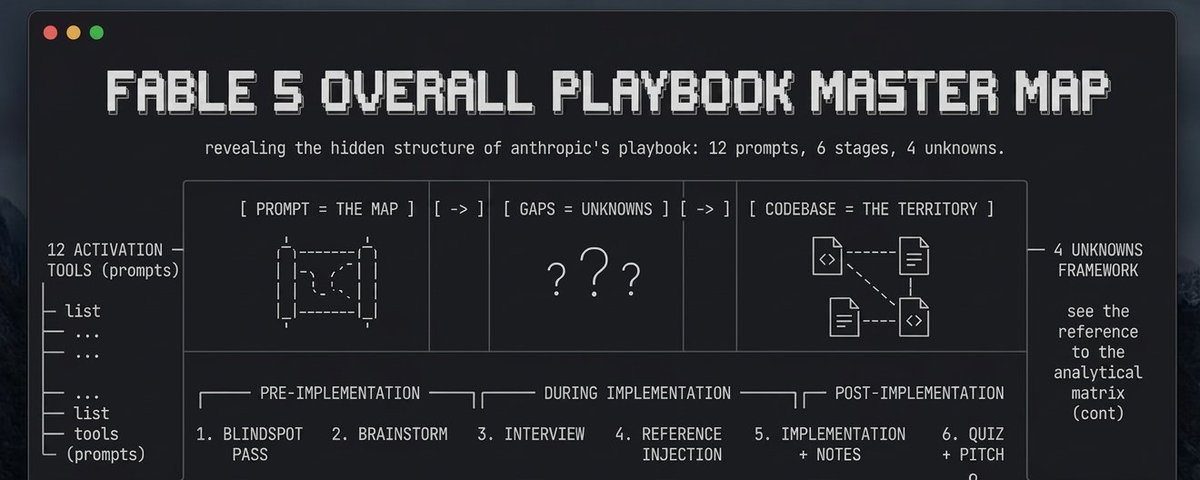
It explores the codebase, plans the feature, writes hundreds of lines of code, adds tests, fixes failures, passes lint and opens the PR.
Claude worked for ~90 minutes.
A task Anthropic says could’ve taken days manually.
And in just 5 minutes, she shows the entire workflow live.
This is more useful than most $1000 “AI coding” courses.
Watch the video:


expemilly retweeted
JENSEN HUANG TOLD SEGA NVIDIA COULDN'T DELIVER ITS $12M CONTRACT - THEN ASKED THEM FOR THE MONEY ANYWAY. $5M KEPT NVIDIA ALIVE.
NVIDIA's founding technology was wrong. by 1995, 35–40 competitors were already in the market and Jensen's team didn't even know the right algorithm.
so he bought 3 textbooks and started over.
everyone remembers NVIDIA as the company that saw the future early. the more useful story is almost the opposite: their first big bet failed.
what survived wasn't the technology. it was the speed at which they could admit reality, relearn the problem and replace what they believed.
that's a much harder moat to copy.
being early compounds. being able to kill your own thesis compounds longer.
watch the story below:
expemilly retweeted
this is f*cking gold
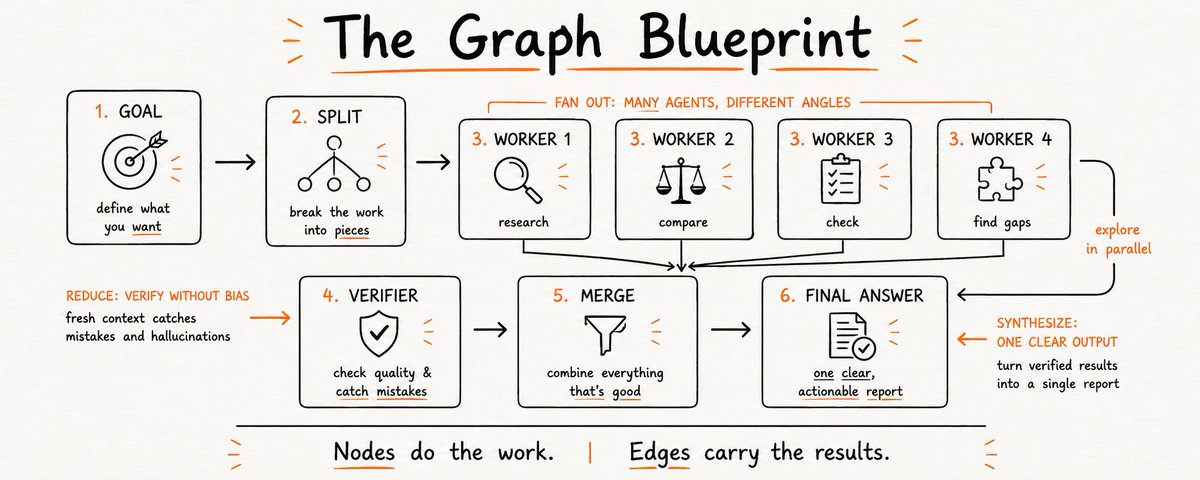
two Anthropic seniors wired Karpathy’s loop into a graph - same Claude, 1000x smarter.
i dropped the architecture into my setup. the first answer came back like four people had argued over it before anyone hit send.
one agent framed the task. another challenged the plan. a third executed it. a verifier tried to break the result, while shared state kept every handoff from disappearing inside the chat.
before, one Claude had to plan, build, remember, and grade its own work in the same response. no wonder it repeated itself, lost context, and approved its own mistakes.
loop engineering keeps one agent moving. graph engineering decides who plans, who acts, who remembers, and who gets to say no.
once you see the graph, a single-agent loop starts looking like one employee approving his own work.
watch it, then read the full system below:


Free 3-hour course from an ex-Google engineer. AI agents, graph engineering, harness, agent loops. Covers more than most $500 paid courses.
This is the exact playbook to learn how to actually build and monetize AI agents. Don't miss your shot, save it now.
• 0:00 - Design an AI agent system from scratch
• 7:38 - When your agent should hand off to a human
• 19:27 - RAG and vector databases explained simply
• 52:38 - Deploy your AI agent to Google Cloud
• 1:25:57 - Turn AI agents into a paid business via WhatsApp
• 1:33:00 - Turn conversations into real leads automatically
• 2:24:01 - Loop engineering vs graphs, the real difference
• 2:33:08 - Build your own multi-tool agent graph
Save this video, because it's the only one that can actually take you to your $2,000+ profit.
expemilly retweeted
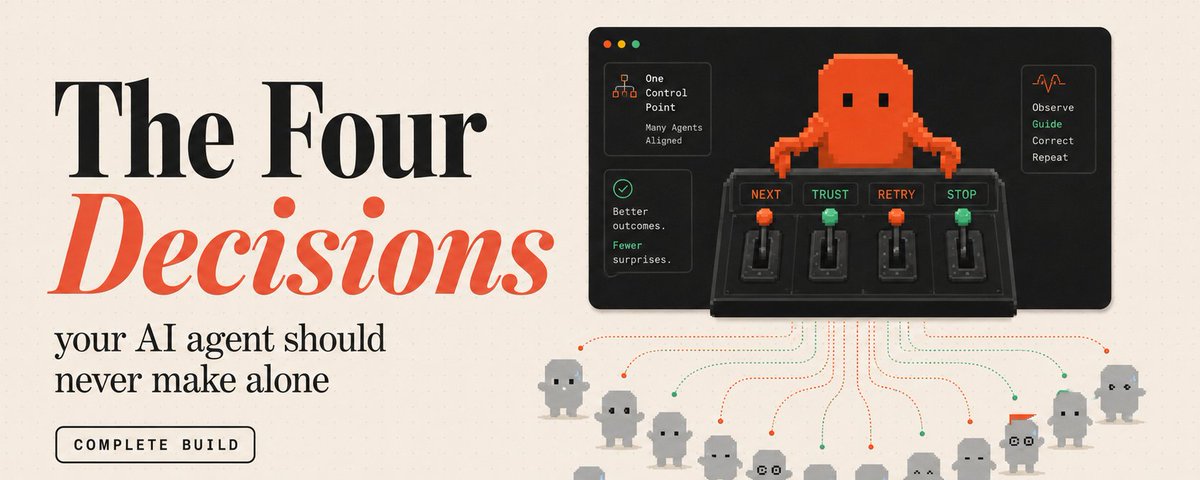
Head of Claude Code was asked what happens after every engineer gets one agent. his answer ended at 1,000.
one agent, then 10, then 100. at anthropic, engineers already run dozens or hundreds.
Most companies use AI to make every employee code faster and never notice the employee is still approving every move.
coordination gets harder with every agent you add.
the engineer running 100 agents doesn’t write code 100x faster.
they choose the tasks, set the context, check the results, and decide what ships.
at 1,000 agents, writing the code is the easy part. choosing the right work is not.
you’re not choosing a better coding assistant. you’re choosing how much of a company one person can operate.
24 minutes. free. changed how i’d structure any multi-agent system today.
watch it, then read below:


expemilly retweeted
NVIDIA’S CEO JUST EXPLAINED WHY 99% OF PEOPLE WILL USE AI WRONG FOR THE NEXT 5 YEARS.
“if you’re still writing prompts, stop. build loops instead.”
most people optimize their workflow around better prompts and never notice they’re polishing the part that gets cheaper every month.
prompts reset after every answer.
loops keep context, check the output, and run again.
the model becomes a commodity. the system around it compounds.
you’re not choosing how good your next AI answer will be.
you’re choosing whether AI works once - or keeps working after you leave.
44 minutes. free. changed how i’d build any AI workflow today.
watch it, then read below:
expemilly retweeted
A father asked Karpathy what to teach his 8-year-old before AGI. the answer erased 80% of the school curriculum.
math, physics, CS. everything else - tack it on later, if at all.
Most parents optimize their kid's schedule around grades and never notice they're funding the parts of the brain that stop mattering the day AGI ships.
grooves get harder to carve every year past 10.
the 8-year-old who learns physics processes reality differently at 30 than the one who didn't.
after AGI, information is a commodity. cognitive shape is not.
you're not choosing your kid's grades. you're choosing the brain they'll carry for the next 60 years.
16 minutes. free. changed what i'd tell any parent asking about school today.
watch it, then read below:
This quoted post is unavailable.


expemilly retweeted
insane my gf just leaked the new noaa quant project
tbh what i saw on her work laptop rn is mind blowing
they built a predictive model that calculates earthquakes a week in advance
they use bayesian conditional probability and a modified etas model
The site is a bit rough, but it works incredibly well
dm if u need it
just look at this math:
$$P(E_{t+\Delta t} | \mathcal{H}_t) = \frac{\prod_{i=1}^{n} P(X_i | E) P(E)}{\int \prod_{i=1}^{n} P(X_i | e) P(e) de}$$
$$\lambda(t, x, y) = \mu(x, y) + \sum_{i: t_i < t} K_0 e^{\alpha(M_i - M_c)} c(t - t_i, x - x_i, y - y_i)$$
$$E[N(t, t+\Delta t)] = \int_{t}^{t+\Delta t} \int_{X} \int_{Y} \lambda(s, x, y) dx dy ds$$
this isnt just weather forecasting
this is intel on where supply chains will break and which factories will stop before it even happens
imo pure alpha for those who actually move the markets
shes probably getting fired tomorrow but i had to drop this
what assets or sectors do you guys think will react first if this data goes public


A friend quit his quant fund job and sent me 2 pages.
“These are the key formulas I used to make money on Polymarket. $400K a year. If you can apply them, you’ll get rich.”
I didn’t believe him.
I dropped both pages into OpenClaw and sent one prompt: “build a bot for Polymarket.”
Then I left for the gym. When I came back, there was a Telegram message from the agent: “MVP is ready.”
Now it’s been making me $150 a day for 4 days straight.
I attached both documents. Drop them into your AI agent and tell me what it builds.


expemilly retweeted
yesterday noaa leaked a full quant trading system on github
it was a dev pushing their private polymarket weather-betting algo to a public repo
they deleted it 40 seconds later but i managed to screenshot the whole thing
the crazy part is your only cost to run this is $20 for Claude Code
here is how they are printing money while you trade the weather meta blind
the bot pulls raw noaa api data before public forecasts even update
it parses variables most degens have never heard of
cape index dew point spreads and micro-climate latency
then it runs those through a custom weighted probability formula:
True_Prob = (Σ(w_i * ensemble_run) / N) * brier_decay_factor
if 42 out of 50 models predict rain it doesnt just guess 84%
it weights each model by its historical accuracy for that specific city
then it calculates risk reward and expected value:
EV = (True_Prob * payout) - (fail_prob * risk)
the logs attached to the repo were disgusting
< 84% win rate across 412 resolved weather markets
< average r:r is 1:3.8 on every single bet
< it turned a $500 test wallet into $14,200 in 9 days
if EV is positive it uses a modified kelly criterion to size the bet perfectly
zero emotion just pure math
you dont even need to know python to use this
just feed these parameters and the github screenshots to claude code
tell it to build the architecture and wire it to polymarket
top 50 leaderboard guys are furious this leaked


expemilly retweeted

The official speaker list for @RoboCon_AI NYC just dropped.
Here's what we have on the agenda 🧵 👇


