Failing To Success Podcast (@f2success) header
Failing To Success Podcast (@f2success) profile picture

#1 Business Podcast for Founders & CEOs! "Failing to Success" | Hosted by Chad Kaleky | Growth Strategy Session: https://xitter.gq/t.co/V2N8iCspoD

Joined March 2023
Photo by Failing To Success Podcast (@f2success)Photo by Failing To Success Podcast (@f2success)Photo by Failing To Success Podcast (@f2success)Photo by Failing To Success Podcast (@f2success)Photo by Failing To Success Podcast (@f2success)Photo by Failing To Success Podcast (@f2success)Photo by Failing To Success Podcast (@f2success)Photo by Failing To Success Podcast (@f2success)Photo by Failing To Success Podcast (@f2success)Photo by Failing To Success Podcast (@f2success)
We have mastered the art of AI ad creatives and are building multi-million dollar pipelines as a result
1
10
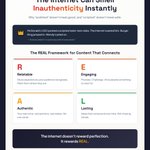
McDonald's CEO got roasted after posted a video taste-testing their new burger. He looked scripted. The internet can smell inauthenticity INSTANTLY. "Polished" doesn't mean good. "Scripted" doesn't mean safe. That's why we use the REAL Framework: Want the full framework?
12
How to Build a Personal Brand in 2026: 1. Define ONE niche 2. Pick 3 content pillars 3. Track posts for 90 days 4. Use proof hooks over promises 5. TOFU 4x, MOFU 2x, BOFU 1x per week The 90/20 rule: 90% of views come from 20% of posts. Find that 20% and double down.
21
How to Secure Your AI Agents (Before They Get Hacked) Here's the 5-layer security stack I use for OpenClaw Clawdbot agents: 1️⃣ Network Isolation 2️⃣ Firewall Everything 3️⃣ Token Authentication 4️⃣ Continuous Monitoring 5️⃣ Principle of Least Privilege
1
1
43
Your content reaches 10% of the people it could. You spend hours creating a post. You publish it on X. Maybe 500 people see it. But that same post? → Could reach 2,000 on LinkedIn → 5,000 on TikTok → 3,000 on YouTube Try it free → content-reach-calculator.ver…
17
Most experts are reaching less than 1% of their potential audience. I built a free calculator to show you exactly how big the gap is. Takes 30 seconds. Try it free: content-reach-calculator.ver… Reply with your results 📷
8
I Bought a Rolex for $10,000 – Was It Worth It? Using ChatGPT in Real world scenarios is the way of the future. Those who make use of this resource will have a competitive edge in all aspects of life. How to Buy a Rolex - Real Buyer's Guide 2025 youtu.be/WebfbFqg_T0
1
1
36
You know what Tesla’s factories burning down won't affect? The fact that I’m still buying the stock. Every time a car gets keyed, every time the headlines scream disaster, and the price dips— I’m smiling. Because I don’t see panic. I see opportunity. That dip? That’s my entry point. That’s future wealth on sale. While the masses flinch, I lean in. While everyone else scrolls headlines, I’m placing bets. Because your fear— it funds my next vacation. Still asking how to make money? Maybe start by changing how you see risk.
1
72
Everyone has an idea. But ideas are cheap. Execution gets all the praise. But validation is what separates a hobby from a business. The biggest lie is thinking you need to "build it" before you test it. You don’t need code. You don’t need a product. You don’t even need a logo. What you need is a signal. Proof that someone, somewhere, cares. Because when real people raise their hand—click, comment, sign up, or DM—you’ve struck gold. That’s not just an idea anymore. That’s traction. And traction is the first sign you're building something that matters. Before you build anything, ask yourself—have I tested it with the real world?
1
83
Trump’s tariffs won’t stop me from hiring a skilled editor in Pakistan for $4 an hour. While everyone panics about rising costs, I’m building leverage. I delegate globally. I enhance locally. That $4 edit? I send it through AI to polish it even more. Now I’ve got a studio-quality video at a fraction of the cost. No office. No full-time team. No excuses. You don’t need a $10,000 camera. You need resourcefulness. We live in the most connected, automated, scalable era in human history. So why aren’t you building something?
1
136
Most executives don’t have a time problem. They have a focus problem. 📊 This is how high-performing leaders split their time: 🔹 35% Strategy 🔸 30% People 🔵 20% Learning ⚙️ 15% Execution But most operators? They're stuck spending 80% of their week doing the work instead of designing the system. 👉 Are you building the business—or just running it? Drop your ideal time split below👇
36
Most e-commerce sellers dread them. I turned them into an opportunity. ReturnsEZ helped sellers process returns faster. They knew why products were coming back. We gave them the data to prevent it from happening again. That saved them money. But that wasn’t all. I had a physical returns facility. So we told sellers, “Ship your returns to us.” We’d receive the items, repair or repurpose them, sell them online, and send the seller a cut of the profit. Now I wasn’t just in software. I wasn’t just in logistics. I was in data. I was showing sellers trends. I was helping them reduce refunds. I was liquidating the product for them. And I owned the software and the supply chain. When you combine real-world infrastructure with a scalable software layer— you don’t just build a business. You build an ecosystem. What overlooked headache could you turn into a data-driven opportunity?
15
How I Became a Millionaire in My Twenties — The Bedding Hustle We started buying truckloads of overstock bedding from Macy’s. Comforters, linens, sheets—brand names with damaged packaging. A full truck cost us about $10,000. We’d sort everything. The pristine items went online. Amazon. eBay. Walmart. The rest? We took to the flea markets. Sold them for $20 a pop—no questions asked. What couldn’t be sold online became fast cash on the weekends. Each truck would turn into around $40,000 in revenue. Do that ten times, and your $100K becomes $400K. After labor and overhead, we’d clear $200,000 in profit. The play wasn’t flashy. It was simple. Scalable. Repeatable. You don’t need venture funding. You need a good deal, a place to flip it, and the grit to keep doing it.
25
At around $3 million in revenue, we had grown to a team of 18 people. Managing that many personalities, expectations, and directions became chaotic. That’s when I discovered a method called the Painted Picture. I’d sit down, close my eyes, and imagine a dinner— three years in the future. I’d write a story in present tense, as if I were sitting with my team, celebrating everything we had accomplished. “We just landed a $5 million contract.” “We now have 10 retail stores across the Southeast.” “We’re building something we’re proud of.” Then I’d read it aloud to the entire team. Print it. Distribute it. Hang it on the walls. Every quarter, I’d write a new version— updating it with what we’d achieved and where we were headed. It helped everyone see what I saw. And more importantly, it aligned everyone around a shared future. What’s your vision three years from now? Have you shared it with your team yet?
14
How I Became a Millionaire in My Twenties — The Walmart Returns Hustle We found a vendor who sold us pallets of Walmart returns for around $800 each. Every night, we’d grab 3 pallets. Once we had about 25, we’d ship the full truckload to ourselves. Each truck cost roughly $20,000. After sorting, testing, and flipping everything, we’d turn that $20K into $60K–$80K. Then we scaled. As many trucks as we could manage per year. 10 trucks a year meant around $600K in profit. We got so efficient that this became one of our core inventory streams. It helped push us to $4 million in top-line revenue. All from mastering one simple question: How do we turn trash into cash at scale?
30
How I Became a Millionaire in My Twenties—By Flipping Broken Ice Makers By now, I had my own refurbishing factory. We were fixing all kinds of electronics. Then I spotted a new opportunity— Pallets of broken Igloo countertop ice makers selling as salvage for $5–$10 each. I bought a few pallets just to test. We broke them down. Found 6 common failure points. We could fix 4 out of 6. So we salvaged parts from the unfixable ones to repair the rest. I convinced the supplier to sell them by the truckload at $5 each. Soon, the warehouse was filled with thousands of ice makers. We set up an assembly line of repairs. Average cost per unit: $30 with labor. Resale price: $100 on Amazon, eBay, Walmart. The return was incredible. We cleared around $300K in profit. Then the factory caught on. They realized— “If these are so broken, why are they buying so many?” They took the repairs in-house. That supply chain ended overnight. The window closed, but the gains were made.
16
Imagine filling up your F-150 for just $10. Every night, I plug my electric truck in at home and wake up fully charged— for less than the cost of lunch. Meanwhile, friends down the street hand over $150-$200 at the pump for gas or diesel. We don’t debate electric vs. gas. I just ask one simple question: “How much does it cost you to fill up?” Their reaction is always the same: "Holy crap. Maybe it’s time to think about an EV." What would it take for you to make the switch?
43
How I Became a Millionaire in My Twenties—The Walmart Loophole We were buying refurbished electronics directly from Amazon and Walmart. And I found a loophole. Walmart had old listings for products with thousands of reviews—but the products were discontinued. So I used their backend to migrate those reviews onto a refurbished version I was selling. Same product. New listing. Thousands of built-in reviews. It looked trusted. It looked popular. And orders exploded. We were getting thousands of sales overnight. Eventually, Walmart patched the system— But not before we cleaned up. It worked because we moved fast, saw the angle, and took the shot.
23
How I Became a Millionaire in My Twenties—By Flipping Returns at Scale After the smartphone hustle, I started asking— What else can I repair and resell? That’s when I found Sohnen Enterprises. They had a refurbishing factory in Mexico and contracts with Walmart, Amazon, Turtle Beach. Truckloads of returns—cameras, laptops, headphones. I started buying them in bulk and flipping them online. That became the start of my first large-scale business. Within a couple years, revenue passed $2 million. But then came the problem—competition. Anyone could buy from the same vendor. Margins got thin. Cash flow got brutal. So I made the next move: Buy returns direct from Amazon, Walmart, and other retailers. Instead of fighting for leftovers, we went straight to the source. That pivot changed everything.
34