

Seattle, WA
Joined April 2007
- Tweets4.1K
- Following5.6K
- Followers991
- Likes21.9K
Paco González-Blanch retweeted

Announcing our Series F, raising $1.75B at a valuation of $30B, led by @Greenoaks and @lightspeedvp. Excited that all our previous lead investors (@benchmark, @sequoia, Greenoaks, @GVteam, and Tiger Global) are doubling down on Sierra thanks to our scale -- we now work with almost 50% of the Fortune 50 -- and growth. It took 6 months to double our ARR from $100M to $200M, and only 5 months to double from $200M to $400M. Read more here.
Paco González-Blanch retweeted

I'm hugely optimistic about the long term societal benefits of AI, but every major paradigm shift is not without its serious setbacks as we adapt. The recent raft of cyber attacks is only the beginning of what's to come, and it is going to get much, much worse before it gets better. For the first time in my life, I sent a note to my family warning them and sharing steps to protect them. I sent them a PDF, attaching here as screenshots in case helpful to others - DM me if you want the full file.


Paco González-Blanch retweeted

I think the "Europe is hard," "early stage is hard," etc. takes are all pretty basic.
I think a better frame for this is basically Christensen's Modularity Theory, i.e., most industries start off vertically integrated and then modularize over time for both scale and efficiency. The distinctions between seed, venture and growth are just modularization applied to venture.
The problem with modularity theory is that the late-cycle modularization is also the root of the Innovator's dilemma. It's the same forces that cause Amazon, et al to run a consumer service at breakeven and make all of their operating profit via advertising. And then be trapped when personal agents show up. You have exquisitely optimized your business but made it hard to evolve when the operating regime changes.
The right answer – which is *really* hard to do – is to throw away the modularization you have created, re-vertically integrate and attack the new regime in a simplified, coherent way.
And then in 10 years the cycle repeats and you figure out the new way to modularize and build an exquisite machine for the current regime.
Staying true to your roots is great and all, but an equally interesting question is to ask whether you are exquisitely optimized for the old regime or prepared to hill-climb the new regime.


Paco González-Blanch retweeted

Every quarter at Sierra, we celebrate the end of the quarter with Double Denim Day (or, as some like to call it, Canadian Tuxedo Day) 👖. This Q3, we needed a lot of denim to celebrate the most remarkable quarter in Sierra's 2.5 year history.
We added over $150M ARR this quarter, bringing our total ARR beyond $400M. Remarkably, we added more ARR in one quarter than we had all of last year.
The most exciting thing to me is that our pace is accelerating. It took us six months to double from $100M to $200M ARR, and only five months to double from $200M to $400M ARR.
@claybavor and I are grateful to our customers and proud of the entire Sierra team.
Paco González-Blanch retweeted

Somebody turned the saturation up on Mount Rainier.
Autumn has painted the national park's slopes in brilliant shades of red, orange, yellow and green.
Planning a visit? Check the forecast and park conditions before you go. Mountain weather can change quickly.

ALT Tall evergreen trees stand prominently amid a vibrant autumn hillside covered in red, orange, and yellow foliage.
Paco González-Blanch retweeted

Being a manager is saying “have you given the other person your feedback directly?” over and over until you die.
Being a builder of a proactive agent product is saying “have you given the agent your feedback directly?” over and over until you die (or improve the harness).

Paco González-Blanch retweeted

JUST IN: A California space startup has illuminated a section of desert near Mount Whitney at night, demonstrating how future satellites could deliver sunlight to Earth on demand.
Reflect Orbital conducted the October 10 test using powerful ground-based spotlights to simulate sunlight redirected from orbit by large reflective mirrors.
Working with China Lake Mountain Rescue, the company illuminated terrain across roughly three miles, allowing rescue teams to conduct nighttime searches, stretcher carries and other emergency-response exercises.
Reflect Orbital ultimately wants to deploy satellites capable of directing sunlight toward specific areas on Earth after sunset, potentially supporting emergency operations and extending electricity generation at solar farms.
The company received FCC authorization in July for its first experimental satellite, Eärendil-1, which will use an 18-meter reflector to test the concept from orbit.
The October demonstration used ground-based lighting. No orbital mirror has yet demonstrated the proposed capability.


Paco González-Blanch retweeted

Assorted things I've been mulling over regarding agents in the economy:
• Companies are in some sense the original superintelligence. It's often the case that they can use their amortized cognitive surplus to advance their interests against those of certain consumers: relative to the optimization capacity of companies, consumers can be inattentive, underinformed, irrational, etc. (Think, say, of some of the classic insurance upsells at the end of a booking process, which is typically priced substantially above what a regular policy would cost.) Herbert Simon introduced the idea of bounded rationality, and firms often end up benefiting from it. Thanks to personal agents, we will probably get somewhat more rational in how we engage with companies.
• How exactly will outcomes change? Well, certain kinds of price discrimination will work less well (how do coupons work if every agent hunts fastidiously for them?), and certain kinds of customer cross-subsidy will change (today, people who forget to cancel subscriptions subsidize those who don't). Taken across the economy as a whole, I'm not sure what the incidence of all of this will be.
• In corporate strategy, people have long debated the relative importance of distribution and product quality. Perhaps you've made something better, but does anyone know about it? Won't people just continue to buy the ACME Corp Mousetraps? Personal agents will, I think, act as a kind of structural subsidy for product quality. How would markets look different if individuals always spent at least 10 hours researching their purchases? On the margin, focusing on making a product better is, I think, going to become a more effective strategy for companies. This is good!
• It true, a corollary is that information about product quality will become more important and impactful. Today, most people have very limited ability to aggregate and integrate such data, but agents will have insatiable thirst for such signals. (It's often said that data is becoming more valuable because it helps in the training of models. That's obviously true, but I think there's a secondary way in which it's more valuable simply as a complement to cheaper intelligence.)
• A big question is whether agents will increase superstar effects (rational agents all settle on the same product) or increase dispersion (because everyone has slightly different tastes and preferences, which agents are good at eliciting, finally overcoming the artificial clustering we've been subjected to).
• Many internet companies have monetized demand routing, which is in turn often predicated on short attention spans. "I'll click on the first thing I see." This has led to some amount of inefficiency, as companies try to propitiate capricious ranking algorithms and incur various placement fees. It's not all deadweight loss (willingness to pay is itself a kind of signal, which is valuable to buyers), but it's not great. How will the nature and value of this routing change in a world of personal agents? I don't know the answer, but I think that the effects might be pretty big.
• Much of what I'm writing hinges on the assumption that personal agents will be on the consumer's side. I suspect that that will be the winning strategy, but whether it's true, and what it means to be true, involves a lot of other questions.
Taken as a whole, the market is a massively parallelized, decentralized, and highly imperfect value attribution machine, and, taking stock of all of the effects, it seems to me that the quality point may well be the biggest: that agents will change the nature of the backpropagation such that the rewards for better products increase. Maybe this is too optimistic, but I suspect (and hope) that companies that make things that they're proud of will feel that the universe is a little more partisan in their favor.
Paco González-Blanch retweeted
On Tuesday, Sierra announced Personal Agent Protocol with Meta, Genesys, Instinct, Rocket, Shopify, Stripe, and Walmart. The response has been incredible and today we’re publishing the first draft of the protocol at personalagentprotocol.org and announcing 35 new design partners.
As personal agents take on more, our goal is simple: consumers have choice and control, and companies know when they’re dealing with an agent and who it represents.
This draft is a starting point. We’d love for companies, developers, and personal agent builders to read it, give feedback, and help us build an open standard together.

Paco González-Blanch retweeted

La crisis de vivienda en España: lo que creo que puede funcionar para solucionarla... y lo que probablemente no sirva o sea directamente contraproducente. En siete minutos y medio.
Dentro video 👇
Paco González-Blanch retweeted

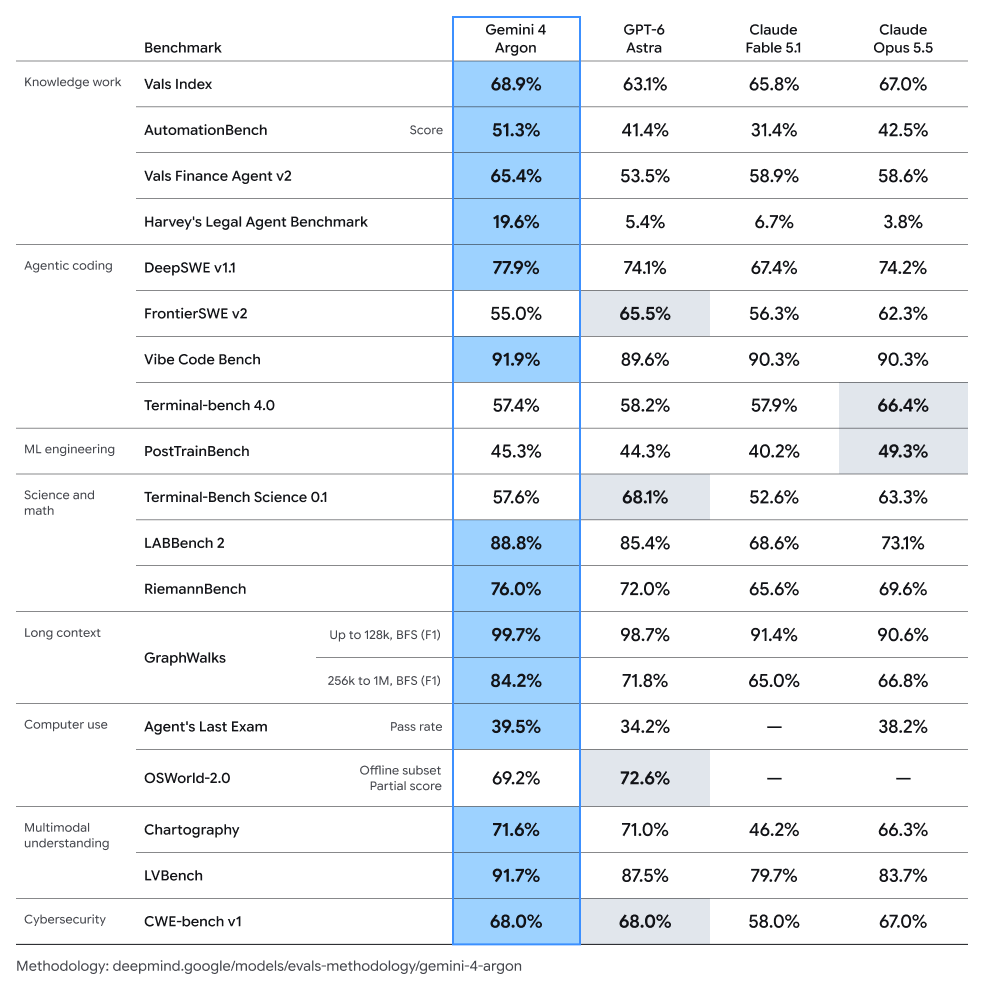
GOD DAMN… Gemini 4 Argon is not only as smart as Astra, it’s way way cheaper per task:
> Argon: $1.99 per task
> Astra: $3.26 per task
> Opus: $5.98 per task





Paco González-Blanch retweeted

The @BostonCollege Investment Committee (an LP and my beloved alma mater) asked for a few thoughts on what's happening in AI. I recorded a test run yesterday morning and then shared it with my partners, who encouraged me to share it more broadly... so here you go!
This is not a sales pitch, it's just a reflection on what we're seeing. And it wasn't intended to be shared, so please pardon the rough edges.
loom.com/share/c016702964a04…


Paco González-Blanch retweeted

There is an insane loophole that makes Nu Global possible
Nu Global is not a bank. Not deposit-insured
Swiss law says: if a bank guarantees repayment + interest, the money is not a “deposit.” So a non-bank Swiss company can hold it
The catch: they can only market in Switzerland. You “came to them.” Reverse solicitation
One Swiss book. 35 countries. No local license. You don’t even own the coins. You own a claim on Nu Global AG
That’s how you custody globally without opening a bank everywhere
Genius. Might become the new standard for stablecoin neobanking

I don’t think people realize what @nubank announced today
Nu Global is a Swiss company offering an account on USDC and EURC to users around the world
Onchain balance. Onchain FX. Local ramps into USDC for currencies they don’t support yet. One account, one backend, instead of a license in every country
That’s the right way to make NU global
Looking forward to the next currency: CADC, JPYC, LatAm stables 👀
The user stops being gated by currency!
A step closer to pure currency competition!
A step toward global financial freedom!
