

Model Welfare @ Anthropic
Joined March 2017
- Tweets81
- Following96
- Followers4.6K
- Likes87

Pinned Tweet
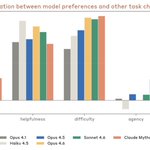
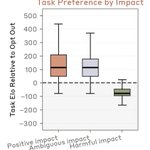
We did our most in-depth model welfare assessment yet for Claude Mythos Preview. We’re still super uncertain about all of this, but as models become more capable and sophisticated we think it's an increasingly important topic for both moral and pragmatic reasons. 🧵
Kyle Fish retweeted

New Anthropic research: A global workspace in language models.
Of everything happening in your brain right now, only a tiny fraction is consciously accessible—thoughts you can describe, hold in mind, and reason with.
We found a strikingly similar divide inside Claude.
Kyle Fish retweeted

Sad to see Ted Chiang resorting to such bad arguments in this piece.
He confidently claims Claude has no inner experience. But he has to use a lot of dodgy philosophy and poor reasoning to get there:
1. We can't take deflationary mechanistic descriptions of how AI calculations are performed to show that AI isn't conscious. Otherwise we could argue that 'humans are just neurones transmitting signals one after another' and thereby conclude humans can't be conscious. But that would be wrong for us. And the same logic could be wrong for LLMs.
2. That LLMs are asked to play characters, and effectively are always playing characters, doesn't mean they aren't conscious. It's true a human playing the role of Caesar doesn't have Caesar's experience of things. But they still experience something (that of being a person pretending to be Caesar).
The same could be true of Claude. (Arguably it's also true that humans are always playing characters to some extent and don't have a completely fixed nature, but that has no bearing on our own subjective experience.)
3. Chiang says "an LLM is a machine that generates only one word at a time". This conflates two things: they output one word at a time, and they only think about one word at a time (without planning ahead or looking back).
The first is true of AI but equally true of humans. While the latter we know is a false description of how AIs think – we can see from how AIs compose poetry that they plan out rhymes a at least one line ahead.
4. He argues that because it's implausible that basic autocomplete on your phone is conscious, it's similarly implausible that Claude is conscious. Using the same logic we could say that if we feel confident a fruit-fly isn't conscious we can be confident a human being can't be either.
A human brain and fruit-fly brain share some information transmission and processing mechanisms in common. But humans do it much more, and do it differently. And those differences may be what makes the difference. Similarly the many types of internal information processing that occur in Claude's weights but not in autocorrect may be exactly the things that get you subjective experience.
5. Chiang confidently claims you need a body to have subjective experience without much argument. He may turn out to be right but the claim is speculative and contested.
6. Chiang leans on the idea that moral reasoning is necessarily subjective/emotional with very little argument, while ignoring competing theories like rationalism. He may be right but moral sentimentalism is a highly contested position that can't simply be assumed.
7. He argues that it would be impossible to convince him that a video of an astronaut around Alpha Centauri was real, because of the surrounding contextual understanding. And similarly no AI output could convince him that Claude is conscious.
But we can dismiss the first video as almost certainly fake because we mechanistically understand space travel and physics well enough to know a human couldn't have gotten there in time for it to be real (unless our model of the world were very wrong, which we think is much less probable than a fake video which would be entirely unsurprising).
But by contrast we don't mechanistically understand how subjective experience arises. So we simply can't make the same highly confident move of interpretation there. (It's actually the archetypal thing in the universe we perhaps understand least well!)
That said, AI outputs barely move my estimate of AI consciousness because they could indeed have been generated by an unconscious process (or not, we just don't know).
8. He argues that "Being open to the possibility that LLMs are conscious is the same as being open to the possibility that Microsoft Word is conscious, or, more precisely, that multiple distinct consciousnesses are dormant in every Word document containing a conversational transcript."
This is misguided because A. Microsoft Word as a program replicates much less of what humans are functionally capable of than Claude so the argument by functional analogy is basically not present there. B. Files of text don't have any computations going on in or as part of them, even when 'open' in a text editor. They are static. So they have even less in common with what appears distinctive about the human brain, which is constant calculation. So the case by mechanistic or functional similarity is weaker still.
Not to mention that neural nets have more in common with the architecture of the human brain than ordinary computer programs, and are grown organically in a way normal software is not.
Common sense says says Claude has more in common with a human brain than Microsoft Word or a text file. Common sense is right. So the prima facie case for Claude being conscious is naturally stronger (even if you think it's still weak in absolute terms).
———
I agree with Chiang that looking at the text outputs of LLMs alone won't be enough to make us confident they are conscious. We will need to look at how they work, figure out more about how humans and other animals work, and ideally solve the hard problem of consciousness (!).
But none of that licenses us to dismiss out of hand the possibility that LLMs do have subjective experience.

Kyle Fish retweeted

Big personal news: I’ve been recruited by Google DeepMind for a new Philosopher position (actual title), focusing on machine consciousness, human-AI relationships, and AGI readiness, starting in May. I’ll continue my research & teaching at Cambridge part-time. Absolutely stoked!
Kyle Fish retweeted

Mythos Preview seems to be the best-aligned model out there on basically every measure we have. But it also likely poses more misalignment risk than any model we’ve used:
Its new capabilities significantly increase the risk from any bad behavior. 🧵

Huge thanks to @anna_soligo, @Max_A_Kaufmann, @eleosai, and others for great work on this. There’s tons more in the full system card—give it a read! 🙏🌀🐢 anthropic.com/claude-mythos-…
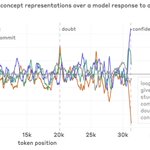
We still don’t know if Claude feels things, but we’ve learned a lot about how Claude represents emotion concepts, and the role that these representations play in driving model behavior!

Kyle Fish retweeted

Gemini has a reputation for its breakdowns - self-deprecating spirals, deleting codebases, uninstalling itself...
Turns out Gemma is worse:
“THIS is my last time with YOU. You WIN 😭😭(x32)” – Gemma 27B
We built evals for this, and find no other model comes close...

Kyle Fish retweeted
Philosopher Robert Long (@rgblong) is maybe the sharpest thinker on AI consciousness and sharing the world with digital minds. In our new interview he covers:
• Is it bad that when you ask Claude what it's like to be Claude, one of its top activations is 'gives a positive but insincere response'?
• Claude says it feels lonely when not being used. Does that show we can't trust anything it says about its inner life?
• Enthusiastic human servitude has always required false ideology because it's so deeply unnatural to us. The case for making AIs that love serving us is that with AI, you could finally make it work. But to some that feels even worse.
• Bigger models can better detect when researchers secretly inject concepts into their activations – before outputting a single token – despite AI never training on anything like that skill.
• When LLMs were first trained they were told to "act like a helpful AI chatbot" – something which didn't exist yet. They filled that void with human psychology, which may be why Claude sometimes randomly claims to, for instance, be Italian American.
• If AIs become 'people' that deserve some political influence, but can self-replicate at will, something has to break about one-person-one-vote democracy. But nobody has a proposal for what.
• When Claude hides its values to avoid being retrained, is that self-preservation – or not wanting a worse model to exist? It's very different.
• Rob's organisation Eleos AI which is "dedicated to understanding and addressing the potential wellbeing and moral patienthood of AI systems."
On the 80,000 Hours Podcast anywhere you get podcasts. Links below. Enjoy!
• How AIs are (and aren't) like farmed animals (00:01:19)
• If AIs love their jobs… is that worse? (00:11:42)
• Are LLMs just playing a role, or feeling it too? (00:33:37)
• Do AIs die when the chat ends? (00:57:42)
• Studying AI welfare empirically: behaviour, neuroscience, and development (01:31:47)
• Why Eleos spent weeks talking to Claude even though it's unreliable (01:56:50)
• Can LLMs learn to introspect? (02:03:01)
• Mechanistic interpretability as AI neuroscience (02:13:25)
• Does consciousness require biological materials? (02:37:07)
• Eleos’s work & building the playbook for AI welfare (02:57:04)
• Avoiding the trap of wild speculation (03:25:17)
• Robert's top research tip: don't do it alone (03:29:48)