

sf thinkcat
emoticat
Joined September 2023
- Tweets12.1K
- Following391
- Followers11.1K
- Likes87.4K





some quick thoughts on frontier labs and cybersecurity
1) two critical vulnerabilities were discovered in php that allow for remote code execution; the first was reported on august 11
2) it seems now humans just weren’t devoting so many resources to finding vulnerabilities, and perhaps weren’t that good at it in the grand scheme of things
3) i think open-source software is going to have to change: maintaining it will increasingly become the responsibility of frontier models and frontier labs
4) no one else will have such advance access to frontier models or be able to spend as much on tokens as the labs themselves
5) so, it makes sense for frontier labs to scan and patch open-source software, especially the code their coding agents use to build software
6) one issue, though, is that open-source projects often have difficult governance structures, so i can imagine a world where frontier labs just fork these projects
7) build and maintain their own versions, making fixes, improving performance, adding features, etc and then train their models to use them by default
8) i can also see a world, very soon, where ~all software at a company has a claude or codex instance running 24/7 that watches over it (like the anthropic superfans)
9) the agent watches an anthropic or openai feed and, when a vulnerability is found, immediately kicks off a full migration to the new version
10) or otherwise refactors the codebase, changes the infrastructure, ports capabilities, etc... to mitigate the vulnerability
11) this will happen automatically, without a human in the loop; engineers will just come in the next morning and see what happened
12) this is part of what it means for coding agents to increasingly own software, and for labs to become responsible for the software supply chain
13) at some level, i think this just becomes the enterprise expectation when they are paying millions for coding agents / the agents are making arch choices
14) it is a very exciting time to be at a frontier lab and think through what this product offering should look like and how it should be sold to enterprise clients

Effective Immediately, all organizations using PHP for their systems are advised to be prepared for an update addressing two critical vulnerabilities. PHP is widely used for web applications. These vulnerabilities often provide a direct path to the server's file system or database. If an immediate update is not feasible, it is recommend that organizations take the system offline until it can be fully mitigated. NSA will follow up shortly with more specific guidance.
i talked about this almost a year ago while reflecting on the anthropic <> bun acquisition
xitter.cf/fleetingbits/status/19…

Some thoughts on the Bun acquisition
1) The prosaic description of why Anthropic bought Bun is that Claude Code is built on top of Bun and Anthropic wants as much control as possible over the installation experience and performance of Claude Code
2) But, in an accelerating world, we should expect more deals like this with respect to key projects in the open source ecosystem, because labs will have a real desire to control the open source software supply chain
3) First, just from a performance perspective, labs are going to want to ensure that their agents are more robust and this means being able to do RL over major open source projects on stable APIs or otherwise being able to control API updates
4) Second, from as security perspective, labs are going to become more and more responsible for any security vulnerabilities that their agents introduce in the codebases in which they implement features, so labs will want guarantees that the libraries they are using are secure (it may eventually be part of their value prop).
5) Part of this will be scanning open source libraries for security vulnerabilities and only having their agents using those libraries that meet security standards that the labs themselves have determined in advance.
6) Part of this may be actually building or acquiring the projects and taking over responsibility for their maintenance and development. They get to control the features and make sure it makes sense within their RL pipeline and also they get to ensure that the libraries are secure.
7) Big tech already does this to some degree. But, it has always been cost prohibitive to to this on a truly ecosystem wide scale. And so, effort has been focused on a small set of core projects (e.g. Linux).
8) But, in a world where coding agents scale and the cost of development drops dramatically, suddenly this is possible and labs can oversee hundreds or thousands of ecosystem projects. Because, it's Claude Code overseeing the project, for the most part.
9) And, using open source is better and more robust than just keeping this library code closed source or alternatively developing everything client side, where the model can make errors, has to keep the data in context, might do it slightly differently each time, etc...
10) In the limit, you may even start to see some of these projects rewritten in formal languages like Lean, open sourced by the labs, etc... as the security aspect of development becomes more important and it becomes increasingly the responsibility of the labs as vendor.
i’ve been working with claude on a 3d replica of philip johnson’s glass house for my personal website, fleetingbits.io, and i’ve turned a lot of the site’s features into locations on the property.
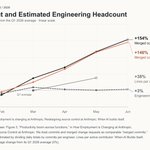
i think it's interesting to look at developer productivity at a frontier lab.
it seems like anthropic’s engineering headcount grew modestly from q1 into q2 2026, while code output grew much faster.
individual commits also appear to have become smaller in total lines of code.


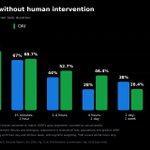
it looks like anthropic researchers use research agents about 4x as much as openai researchers, on average.
and since may, usage across both labs appears to have been doubling roughly every 35 days.

i keep thinking about this; 75% of compute spent on internal ai r&d is insane

If I'm not mistaken, Anthropic's 85% gross margin and >40% compute margin from this Bloomberg story implies that 70-75% of their compute is now going to R&D.
bloomberg.com/news/articles/…


a lot of investors make projections of frontier labs as if these were 20-year-old companies that had already spent at least a decade optimizing their economics.
anthropic has added $70bn of arr so far this year; these are the most incredible businesses of all time.

some thoughts on nick's interpretability post
1) nick argues that most neurons represent a single concept or a generalization of a single concept in well trained networks
2) he says that the field generally believed that neurons stored many concepts because people didn't know what kinds of features to look for
3) he says the better interpretation of neurons is as flow control which separate incoming data points toward different downstream neurons
4) so, you should look for a neuron that separates different types of dogs or separates objects in different poses; rather retain a dog neuron or a train neuron
5) and, that early efforts were hampered by poorly trained networks that had neurons without sufficient gradient applied / reward hackable tools
6) he thinks that most modern networks have clean features and that this will get better over time just as a result of better training techniques
7) it's an interesting idea and i am at least interested, i look forward to reading his longer paper; i do think he presents some interesting evidence
8) one early theory was that there are fewer neurons than concepts, so models need to pack a lot of ideas in one neuron, and they do so with nearly orthogonal vectors; so, we should expect many per neuron
9) he shows that on smaller vision models, you can crush different parts of the network, like make the residual stream smaller, and you don't seem to get this
10) instead, you get more general representations in each neuron, more coarse grained features, rather than more polysemanticity; with many ideas in one neuron
11) and, he shows that these representations evolve over the process of training the network, where the model learns some initial feature, then related features on the same neuron
12) one question i had though reading this was, if he is right and most networks are clean, why don't things like saes work better?
13) probably, the best answer that i would have, if he is right, is really just that goodfire can afford to allow claude to be a research scientist over their networks
14) and, because claude can investigate all the neurons, try to trace the circuits, etc... more than any human, and they are willing to just go crazy on it, they can find the circuits
15) and, as claude gets labels more neurons with confidence, it becomes easier to figure out what the remaining neurons do and so on
16) nick seems to gesture to this, even if he isn't super explicit, his future vision seems to be that claude as research scientist investigates circuits like an experimenter over the network
17) and that, rather than trying to label absolutely everything, you let claude investigate certain problems, like a human biological experimenter
18) a lot of ai scientist ideas seem to be trending in this direction; because the cost of discovering everything in these fields is high
19) and so you want a scientist to figure out specific things you care about with tool usage, small experiments, etc... and research hypotheses
20) you might notice a tension between nick's as we label everything, it gets easier to label the remainder, and we need a scientist over the network that investigates hypothesis
21) and, i think this tension is real, but i resolve it as he means that you can still do constraint satisfaction within some particular problem space (interested in how he would solve it though)
22) so, i think it's possible that a combination of training getting better, tools getting better, and abundant intelligence really is going to make a big difference here
23) but, i still don't know how to square this with saes being hard to get to work; i've looked at some of these features and they really do look impossible to label fairly often
24) just to clarify this a bit more, let's say we make saes using the residual stream, with a top-k reconstruction loss so each sae represents ~1 thing
25) if the neurons are clean, and the sae is wider than the neurons, shouldn't that also end up clean with enough optimization?
26) same with transcoders, where you replace the mlp layer with a wider layer and do reconstruction loss; if the neurons are clean, shouldn't the transcoder be clean?
27) this is my immediate trepidation in the post... but maybe it's just that these were not labeled with a sufficient claude research scientist budget? or we were not looking for the right thing
28) oh, he also says he doesn't quite know what attention does and doesn't think anyone has a clear read on it, but seeing which neurons connect through attention enough
29) this doesn't seem satisfying to me; i would like a more detailed description of attention and what it is doing if possible; this seems like a gap
30) i think it would be interesting for other people to try this on a smaller scale; train a small mnist model and see what claude can do if you spend $1k tokens
31) but, i think this is possible; i do think it's possible that if you begin to really throw intelligence at the models with the right framing, you can label things
32) oh, he seems to think having access to the checkpoints is very helpful because you can see features generalizing
33) so like, first there is an "iy" neuron, which then triggers for "diy" which then triggers for "do it yourself" and that this is hard to understand without seeing the generalization through the checkpoints
34) one final issue, a lot of people seem to work in interpretability through these canonical examples, like the dog <> truck neuron nick describes (which ended up being a single pose concept)
35) and, this seems untenable to me; a field like interpretability, with access to whole minds, should not need to work through a bunch of canonical examples;
36) they are good for understanding, but they don't feel like science to me; you need more comprehensive sweeps, automated grading, etc...
37) like, there was one very good example where based on an english language description a model could craft a sentence that could trigger a neuron more than any single example in the training corpus
38) that seems to me to be a good example that you probably have a decent (at least starting) understanding of what that neuron does
39) and so, maybe it would be good to see a sweep of that over a network of some size to see how well we can actually say what each neuron does
40) and get a better example of how much stronger automated research agents have gotten in interpreting neurons and how clean their features are
41) nick says in his blog post that an article is forthcoming so it may cover some more of these things

interpretability might be the most important scientific problem in the world right now, as I don't think we can solve alignment if we don't know what we're building. I think I have good news about it. I co-authored early work in mechanistic interpretability at OpenAI and came away pessimistic, because neural networks appeared to fold into arbitrary tangled knots. years later, I started openai's first large-scale automated interpretability project, finding about 2% of neurons legible with the primitive tools we had
with modern agentic tools and a much closer look, the picture looks totally different. the vast majority in models up to trillions of parameters are legible, and their circuits beautiful. many famous examples of tangled neurons turned out to be misunderstood. The roadblocks I expected mostly aren't there. I now think ambitious interpretability will be solved by the time we need it most, and possibly quite soon, as automated scientists keep improving. it may be a bitter lesson for interpretability: the simple thing, at absurd scale, works
already-clean.goodfire.com/
