

Senior Economist @ChicagoFed. PhD @DukeEcon. Interested in Macroeconomics, Financial Economics, Optimal Policy and Computational Methods.
Chicago, IL
Joined January 2013
- Tweets104
- Following599
- Followers724
- Likes326






Alessandro T. Villa retweeted

Super interesting!
"AI, Expectations, and Optimal Interest Rates" by Alessandro Villa.
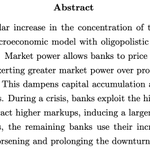
"An AI productivity boom can warrant lower nominal rates even when most gains are anticipated. I derive analytical representations of optimal rates under commitment and discretion in an economy with sticky prices and wages and hand-to-mouth households. Holding the realized productivity path fixed, I vary expectations. Anticipated gains raise the natural rate, but below-target inflation supports real wages and keeps nominal rates lower. Surprises leave the natural rate unchanged, calling for cuts. After surprises, expected redistribution toward hand-to-mouth households calls for deeper rate cuts to sustain savers’ spending. Raising rates requires more anticipation when wages are stickier relative to prices."
chicagofed.org/publications/…

Alessandro T. Villa retweeted

Should entrepreneurs pay lower taxes than workers?
In a new paper with Pino, Nicolas, and @forket86, we study optimal taxation with multidimensional skills and show that in GE substantial tax breaks can be optimal for marginal entrepreneurs tempted to become workers.

New CEPR Discussion Paper - DP22092
Taxing Entrepreneurs and Workers: A Linear Optimization Approach for Multidimensional Screening
Nicolo Ceneri @NYUStern, Giuseppe Lopomo @DukeU @DukeFuqua, @forket86, Nicolas Werquin @ChicagoFed
ow.ly/eu4z5101iQW
#CEPR_PE #EconTwitter

Alessandro T. Villa retweeted

Excited to be organizing the Chicago Fed conference on AI and the economy next week!
Great lineup: Lawrence Schmidt, @DimitrisPapan20, @AlthoffLukas, @TaniaBabina, @avicgoldfarb, Christos Makridis, and me.
Join us at the @ChicagoFed!
cvent.me/4DEKoK
Alessandro T. Villa retweeted

We are hiring! Come and join the Department of Economics at @IEuniversity .
We are hiring three new Assistant / Associate professors of (Macro)Economics.
The application deadline is November 15th!
Here is the call:
econjobmarket.org/positions/…
Alessandro T. Villa retweeted

The @MFRProgram, which I lead at the University of Chicago Booth School of Business, is currently hiring Research Professionals.
We’re recruiting for two positions: one starting this fall and another starting next July. If you’re interested in joining our research team, please apply here:
uchicago.wd5.myworkdayjobs.c…
#EconTwitter #Macroeconomics #Finance #FinancialEconomics #MacroFinance #PreDoc #PreDoctoral
@predoc_org @UChicago
Alessandro T. Villa retweeted

Very nice and related to our work with @serdarozkanEN on the inflationary effects of the AI capex boom:
stlouisfed.org/on-the-econom…


Advances in artificial intelligence appear to be driving faster productivity growth, which has important implications for how central banks set interest rates. Together with Gadi Barlevy, @JonasDMFisher, and Will Pennington, we use a theoretical framework to show that if productivity gains are anticipated, monetary policy may need to tighten to prevent overheating, while unanticipated gains could justify lowering rates. Ultimately, the response of monetary policy depends on whether productivity growth is expected or comes as a surprise, highlighting the nuanced relationship between technological progress and monetary policy.
chicagofed.org/publications/…
#EconX #EconTwitter
Alessandro T. Villa retweeted

New CEPR Discussion Paper - DP21934
Causal State-Dependent Local Projections
Joel David @ChicagoFed, Raffaella Giacomini @EconUCL @ucl, Xiyu Jiao @uniofgothenburg, Weining Wang @BristolUni
ow.ly/Lfyq50ZNmie
#CEPR_MEF #EconTwitter

Alessandro T. Villa retweeted

Had a fantastic time teaching a mini-course on 𝗠𝗮𝗰𝗵𝗶𝗻𝗲 𝗟𝗲𝗮𝗿𝗻𝗶𝗻𝗴 𝗳𝗼𝗿 𝗗𝘆𝗻𝗮𝗺𝗶𝗰 𝗘𝗰𝗼𝗻𝗼𝗺𝗶𝗰 𝗠𝗼𝗱𝗲𝗹𝘀 at @DukeEcon!
Thanks to @DanielYiXu @dix_rafael @CosminIlut David Berger for hosting.
🚀All slides+code are available here github.com/yangycpku/Machine…

Alessandro T. Villa retweeted

New paper is out! We connect the saving glut of the rich to the shift in the way the US finances redistribution: From imflation (unfunded) to debt backed from future taxation (funded) – at Stanford, CA
New CEPR Discussion Paper - DP21912
Fiscal Policy and the Saving Glut of the Rich
@Francesco_Bia @JohnsHopkins, @LeonardoMelosi @EUI_EU @EUI_ECO, Nicoló Ceneri @nyuniversity, Alessandro Villa @forket86 @ChicagoFed
ow.ly/k9hp50ZKnyI
#CEPR_MEF #CEPR_MG #EconTwitter

Alessandro T. Villa retweeted
New CEPR Discussion Paper - DP21912
Fiscal Policy and the Saving Glut of the Rich
@Francesco_Bia @JohnsHopkins, @LeonardoMelosi @EUI_EU @EUI_ECO, Nicoló Ceneri @nyuniversity, Alessandro Villa @forket86 @ChicagoFed
ow.ly/k9hp50ZKnyI
#CEPR_MEF #CEPR_MG #EconTwitter

Alessandro T. Villa retweeted
Very happy that my 𝐃𝐞𝐞𝐩𝐇𝐀𝐌 paper with @JiequnH and Weinan E appears as a lead article at QE!
It’s been almost five years since our first @arxiv draft. Many thanks to everyone who helped us along the way, especially @glviolante for numerous discussions and support!


Alessandro T. Villa retweeted
Gadi Barlevy will become the executive vice president and director of research at the Chicago Fed, starting in June. For more than two decades, he has been a leading researcher at the Chicago Fed, serving currently as senior economist and economic advisor. bit.ly/49Iw2dp

Alessandro T. Villa retweeted
This is my overall take on research: follow your calling. Write a paper that only you could have written.
Each of us is a unique, complex individual. We have our own experiences, knowledge, curiosity, interests, fears, loves, and traumas. These rich personal idiosyncrasies, if well channeled, can translate into a new angle on any topic.
If it’s a question someone else could have answered, in a way someone else could have done it, written as someone else would have written it, LET SOMEONE ELSE DO IT. That is not your calling.
There is something out there, in the space of all knowledge to be gained, that only YOU could have taught the world. Your mission is to find that and teach us. And I, honestly, look forward to that.

Alessandro T. Villa retweeted
Interested in becoming a research assistant? Join our research team on April 17 for Fed Life Unlocked – a virtual event focused on what life is like as an RA here at the Chicago Fed. bit.ly/4tgErw5

Alessandro T. Villa retweeted
⏰⏰Apply by next Monday (Apr 6) for ML for Macro & Finance Summer School in Beijing!
• HA basics+computation (Maliar)
• Deep Eqm Nets (@comp_simon & Kübler)
• DeepHAM+SRL (@ben_moll & me)
• Continuous-time method (Payne & Gopalakrishna)
Daily tutorials: from theory to code🚀

🚨🚨Application open: PKU-Zurich PhD Summer School on 𝐌𝐚𝐜𝐡𝐢𝐧𝐞 𝐋𝐞𝐚𝐫𝐧𝐢𝐧𝐠 𝐟𝐨𝐫 𝐌𝐚𝐜𝐫𝐨 & 𝐅𝐢𝐧𝐚𝐧𝐜𝐞
📍Beijing, July 6–10
Coherent lectures by @ben_moll @comp_simon Weinan E, Kubler, S Maliar, Payne, Gopalakrishna & me. Apply by April 6 forms.gle/c28uSndiUvqXtmm56

Alessandro T. Villa retweeted

sites.google.com/umn.edu/min…
📢 Call for Papers! The MN Workshop in Macroeconomic Theory is now accepting submissions. Conference runs July 29–31 at the University of Minnesota, featuring 14 discussions. Submit your paper by April 24. #MacroEcon #CallForPapers

Alessandro T. Villa retweeted

A guide for students of economics: Ten statements that demonstrate that someone does not understand modern economics or what an equilibrium is, and that you can safely ignore everything else they say.
1. “Equilibrium means the economy is stable or at rest.”
Many assume that an equilibrium is a peaceful state with no forces at play. Instead, an equilibrium is just an arrangement of actions and expectations over time that are mutually consistent. It can be locally unstable, explosive, or fragile. Nothing in the definition of equilibrium implies stability.
2. “Equilibrium implies optimality or social efficiency.”
Equilibrium is often conflated with efficiency, but equilibrium merely reflects decentralized consistency, not welfare maximization. Market power, externalities, incomplete markets, nominal rigidities, and frictions routinely produce inefficient equilibria. I often teach a first-year macro graduate course, and not a single one of the equilibria I define is efficient.
3. “Equilibrium is a unique outcome.”
Many often expect models to have one equilibrium. In reality, multiple equilibria arise naturally in dynamic, strategic, and incomplete-market environments. Models of coordination failures, self-fulfilling expectations, bubbles, overlapping generations, and liquidity traps all hinge on the existence of equilibrium multiplicity.
4. “Equilibrium requires perfect foresight or perfect information.”
Equilibrium does not assume agents know the future. In fact, equilibria are often stochastic. The definition of equilibrium only requires that beliefs are consistent with the (perceived) stochastic laws of motion implied by the model. Bayesian learning, noisy signals, ambiguity, and subjective uncertainty all fit well within an equilibrium framework, provided beliefs converge to an internally consistent (but possibly incorrect) distribution.
Bonus point: equilibria are compatible with agents having diverging beliefs that never converge to a single Dirac distribution.
5. “Real economies are rarely in equilibrium, so the concept is unrealistic.”
Equilibrium is not meant to describe the daily state of the world. It is a conceptual device used to understand the outcome of our models under the assumptions we make. Also, see point 1 above.
6. “Equilibrium requires agents to be fully rational in a psychological sense.”
Equilibrium only assumes internal consistency: agents optimize given preferences and constraints. It does not assume realism about human cognition. We can and do define equilibria in models with behavioral biases, bounded rationality, inattention, or rule-of-thumb behavior. We only need to ensure that the resulting actions and beliefs are mutually compatible.
7. “Equilibrium eliminates dynamics or learning.”
Equilibrium is sometimes misinterpreted as a static state in which nothing evolves. In fact, many equilibria are sequences of probability distributions over states driven by shocks, policy rules, and endogenous responses. Learning dynamics (Bayesian updating, adaptive rules, experience-based expectations) can occur within equilibrium if the evolution of beliefs is self-consistent.
8. “Equilibrium renders expectations unimportant.”
A common misconception is that equilibrium mechanically determines outcomes. In reality, expectations are often central: they determine investment, consumption, asset prices, and policy responses. Many equilibria differ only in their expectations. This is why communication, credibility, and forward guidance matter even in fully rational models.
9. “Equilibrium excludes policy intervention.”
Some interpret equilibrium as a laissez-faire concept. In fact, equilibrium analysis is the foundation of modern policy evaluation. Fiscal, monetary, and regulatory interventions work through equilibrium responses (prices, wages, interest rates, quantities) and must satisfy equilibrium conditions to be credible. Equilibrium is a tool for policy design, not a barrier to it.
10. “Equilibriums…”
Aequilibrium is a Latin neuter noun of the second declension, which forms a nominative plural in “a”. It is composed of aequus (equal; the same root as equality or equity) and libra (balance or scales or the name of several currencies over history).
A final thought: “equilibrium” is a term of art. Its meaning in economics differs from its use in the natural sciences or in everyday language. Terms of art are ubiquitous across academic disciplines, and the first act of intellectual diligence when one starts studying a discipline is to learn what they mean.

Alessandro T. Villa retweeted

Kellogg School of Management PhD Candidate Xiaojie (Alan) Liu’s research interests are Macroeconomics, Monetary Economics, Economic Growth. Learn more about @xiaojieliu1993 & other Northwestern Job Market Candidates at economics.northwestern.edu/j…
