

Data Engine for Physical AI https://xitter.gq/t.co/mtftu1rEyH
Joined September 2025
- Tweets82
- Following10
- Followers1.4K
- Likes75

Ego-Oscar has been accepted to @wacv_official
Excited to announce that Ego-Oscar has been accepted to @wacv_official.
We’ve had lots of people reach out to us for help since we open-sourced this, and we're glad it's become a strong foundation for teams to tinker with the underlying hardware stack for human-to-robot transfer.
FPV Labs retweeted

The next big egocentric dataset might not need a $10K headset.
Ego-OSCAR is an open-source head-mounted stereo-inertial capture system built for under $200, combining synchronized global-shutter stereo, a 6-axis IMU, onboard encoding, and real-time feedback. The goal is simple: make large-scale first-person data collection cheap enough to crowdsource.
FPV Labs retweeted

Opensource hardware is the way to go. Love to see it!

🚨 New Open Source Release
Today we are releasing Ego-OSCAR, an open-source head-mounted stereo-inertial capture device for egocentric data collection in the wild, together with a corresponding dataset of 550 hours captured across 100+ environments.
Egocentric data is still an active research problem, and we believe an open and accessible foundation will empower everyone to participate, experiment, build, and contribute to this space.
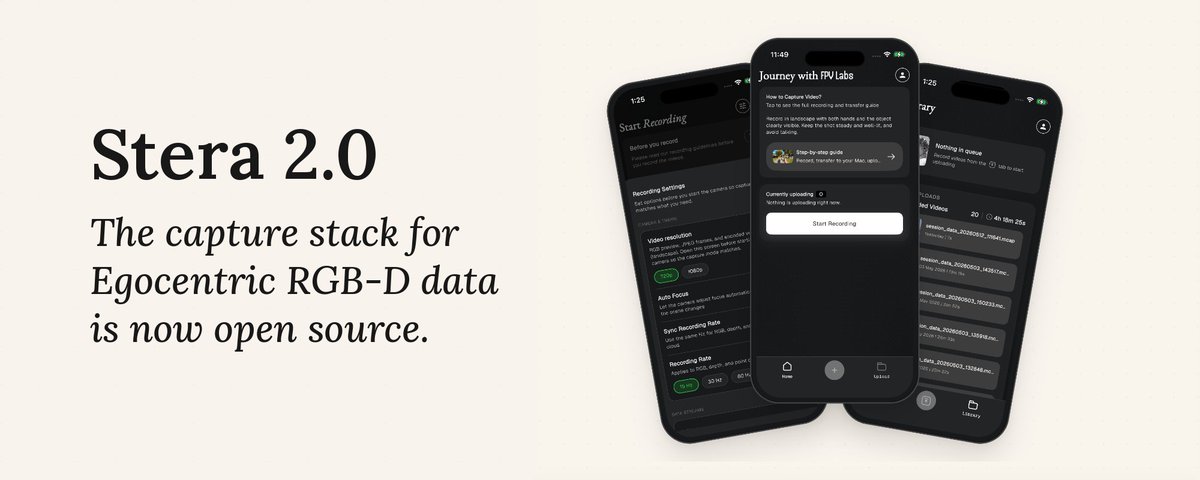
This continues our past efforts, where we open-sourced Stera, a full-stack capture and processing pipeline for RGB-D data. Ego-OSCAR builds on that lineage and offers a fully open-source stereo-inertial capture stack for anyone working on human-to-robot transfer.
We make three core contributions today with Ego-OSCAR:
1. An open-hardware capture device with full CAD, wiring, and assembly documentation, with a complete bill of materials under USD 200 and using commercially available components and 3D-printed parts.
2. An open-source capture pipeline (recording daemon, IMU sampler, time-sync tooling, watchdog firmware).
3. The Ego-OSCAR-550h dataset, approximately 550 hours of egocentric stereo video per camera with synchronized IMU, released to validate the device at deployment scale.
Everything is open-source, including the hardware designs, capture pipeline, firmware, and the downstream dataset.
Read the full blog at: fpvlabs.ai/essays/ego-oscar
FPV Labs retweeted

Open-source egocentric hardware
and 550+ hours dataset collected with it.
🚨 New Open Source Release
Today we are releasing Ego-OSCAR, an open-source head-mounted stereo-inertial capture device for egocentric data collection in the wild, together with a corresponding dataset of 550 hours captured across 100+ environments.
Egocentric data is still an active research problem, and we believe an open and accessible foundation will empower everyone to participate, experiment, build, and contribute to this space.
This continues our past efforts, where we open-sourced Stera, a full-stack capture and processing pipeline for RGB-D data. Ego-OSCAR builds on that lineage and offers a fully open-source stereo-inertial capture stack for anyone working on human-to-robot transfer.
We make three core contributions today with Ego-OSCAR:
1. An open-hardware capture device with full CAD, wiring, and assembly documentation, with a complete bill of materials under USD 200 and using commercially available components and 3D-printed parts.
2. An open-source capture pipeline (recording daemon, IMU sampler, time-sync tooling, watchdog firmware).
3. The Ego-OSCAR-550h dataset, approximately 550 hours of egocentric stereo video per camera with synchronized IMU, released to validate the device at deployment scale.
Everything is open-source, including the hardware designs, capture pipeline, firmware, and the downstream dataset.
Read the full blog at: fpvlabs.ai/essays/ego-oscar
1/ Announcing Vidur, an end-to-end system to generate fine-grained action labels on raw robot and human videos. Vidur leads across all metrics on WGO and EgoExoLearn Bench across temporal segmentation, semantic precision, semantic recall, and end-to-end action-label quality 🧵

7/ FPV Labs is opening up early access to Vidur for robotics labs, researchers, and data labs

1
4
414
Ever since we released Stera, the question we kept hearing was the same: Is an iPhone’s tracking actually good enough? So instead of arguing about it, we decided to test ARKit poses against ground truth.
We benchmarked an iPhone Pro running ARKit against a 24-camera Vicon optical motion-capture system (sub-millimeter accuracy at 200 Hz), across eight sequences spanning motions that dominate real egocentric tasks like walking, manipulation, fast motion, in-place and aggressive rotation, height change, and more.
Across all eight sequences, absolute trajectory error (ATE) ranged from 6.0 to 12.5 cm while translational RPE remained under 5 cm throughout.
Our takeaway - the barrier to high-fidelity egocentric data might be lower than everyone assumed. It doesn’t require a research-grade rig or a device most people will never own. It can be collected with commodity hardware, substantially lowering the barrier to large-scale data for robotics.
The full numbers, details of every sequence, and how we measured them against ground truth are in the essay below 👇
To learn more, read our full essay and paper:
Full essay - fpvlabs.ai/essays/how-accura…
4
1,403
Can a commodity smartphone replace a $10,000 data rig?
We're presenting MobileEgo Anywhere at ICRA 2026 - open infrastructure for collecting hour-long egocentric trajectories on commodity hardware for downstream robot policies.
📍 Strauss 3 | 🕒 3:00 - 4:00 PM today
Come say hi 👋

🚨 New Paper (ICRA Workshop, 2026)
MobileEgo Anywhere: Open infrastructure for long-horizon egocentric data on commodity hardware.
Existing robotics egocentric datasets are limited by short episode durations and rely on gated hardware.
We release a framework designed to facilitate the collection of robust, hour-plus egocentric trajectories on a commodity iPhone.
Our approach builds on years of work treating in-the-wild human demonstrations as a first-class robot training substrate. Would really value critique from organizers and speakers whose work has deeply influenced our work here - @JitendraMalikCV @danfei_xu @yuewang314 @yukez
1
1
930
ICRA Workshop - icra-beyond-teleop.github.io…
Open source dataset - huggingface.co/datasets/fpvl…
Full paper: arxiv.org/abs/2605.05945
791