
Mathematical optimization and Julia enthusiast
Joined August 2016
- Tweets84
- Following250
- Followers127
- Likes692

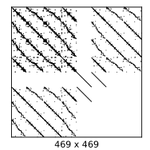


Here we have used exclusively Automatic Differentation (with a custom adjoint as hard to parallelize). Finite-difference parallelize well on GPUs, but we preferred to stick to AD for exactness! It could be worthwhile to compare with Knitro/FiniteDiff indeed.
1
I have a remarkable 2 and would recommend it. The reason why? It runs on linux and I can just use ssh to transfer PDF to the tablet, without relying on a cloud
1
Thanks for sharing! I am always impressed by the impact chemical engineers have had on nonlinear optimization 🙂
Congratulations! I discovered Plasmo in 2017 at the first jump-dev, and it has been very influential for the end of my PhD. Looking forward to see what comes next!
2
At #JuliaCon2022, we presented a method to evaluate sparse derivatives on GPU, using @JuliaLanguage
frapac.github.io/pdf/JULIACO…
10
At #iccopt2022, the talk focused on a parallel algorithm to condense and solve large-scale KKT systems on GPU. The method is now implemented inside the MadNLP solver!
frapac.github.io/pdf/ICCOPT2…
2
13

Yes, code is available on github: github.com/exanauts/Argos.jl…
We are planning to do an official release once the package is properly documented 🙂
1
Kudos to our reference Knitro+MATPOWER for its excellent performance on the CPU (very hard to beat)
1
1
The implementation uses @JuliaLanguage, together with the nonlinear solver MadNLP and the AD library ForwardDiff.jl. Not forgetting the excellent KernelAbstraction.jl as a portability layer.
1
Two take-away messages: (i) the fewer degrees of freedom, the more efficient is the reduction algorithm (ii) sparse Autodiff streamlines very well on the GPU
1
The idea is to exploit the available degrees of freedom in the problem and reduce the KKT system to a dense matrix, easily factorizable on the GPU. If you evaluate the callbacks on the GPU, you get a GPU-ready interior-point algorithm
1
With my collaborators @SunghoShinSS, Michel Schanen, Adrian Maldonado and Mihai Anitescu, we propose in arxiv.org/abs/2203.11875 a novel reduction algorithm to solve the optimal power flow problem almost entirely on the GPU
1
4
How easy is it to solve large-scale nonlinear optimization problem solely on the GPU? Not trivial, but doable if you exploit the problem's structure to condense the KKT system to a dense matrix

