

INRAE researcher at @AgapInstitut plant-plant interactions, evolutionary biology, quantitative genetics, agroecology
Montpellier, France
Joined July 2023
- Tweets59
- Following37
- Followers40
- Likes20


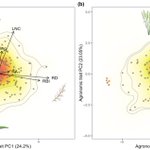
1/6 Check out this new open-access paper in GENETICS, led by Nicolas Salas! How do a plant’s genes affect its neighbors? 🌾☘️
academic.oup.com/genetics/ar…

1
1
27
5/6 An additional result is that growing plants in a continuous neighbourhood gave more accurate estimates of indirect genetic effects than growing them in separate pairs, as classically done in experiments on plant-plant interactions.
1
1
6
Very happy to share that the @ERC_Research has selected PHYTOPOGON for funding! 😁🌱
In this project, we will test whether plants have greenbeard genes — an evolutionary mechanism that could allow them to recognize the genetic identity of their neighbours.

2
11
385
Stay tuned if you are interested in plant–plant interactions, social evolution, and genomics! We will soon be looking for students and research assistants to join the adventure!
1
18
If you want to know more about PHYTOPOGON, check out the @INRAE article: inrae.fr/en/actualites/germa…

18
Next fall, Paris-Saclay will host what promises to be a major scientific event for agroecology: the Mix4Agroecology conference.

1
1
38
The conference will bring together researchers involved in national and international projects on crop mixtures, varietal mixtures, and agroecology. It aims to foster discussions across disciplines, including agronomy, genetics, plant pathology, ecophysiology, and social sciences
1
23
If you are working on crop diversification, plant–plant interactions, agroecology, or related topics, join us in Paris-Saclay !
📅 7–9 October 2026 — Paris-Saclay, France
📢 Abstract submission deadline: June 15th
More information:
mix4agroecology.colloque.inr…
42
Check-out this very interesting result by Clément Plessis, PhD student in our group!
onlinelibrary.wiley.com/doi/…

1
21
The originality of this work is that preferential predation of specific wheat genotypes was shown in real plant stands, directly in the field, i.e., not by making ants chose between different seeds in lab settings.
1
19