

Payments for autonomous machines. Telegram Community : https://xitter.gq/t.co/XkuclZv7XD Solana - AXCeFjrSnwXVzGjPewp3kzuEnGHYhvx1x53kkbh9pump
MPP Layer Labs
Joined May 2026
- Tweets177
- Following80
- Followers181
- Likes298





Pinned Tweet
Over the past few weeks, our development updates have been less frequent than usual. However, we would like to reassure everyone that MPP Layer remains actively developed and continues to move forward.
Market conditions and token price fluctuations do not change our long-term vision. Our primary focus has always been building sustainable infrastructure, delivering value to users, and creating tools that developers can rely on.
Behind the scenes, we have been continuously working on improvements across the platform, including bug fixes, performance optimizations, and enhancements based on valuable feedback from our users, developers, partners, and community members.
Every suggestion, report, and piece of feedback helps us refine the product and shape the future of MPP Layer. We deeply appreciate the support and patience from everyone who continues to believe in what we are building.
Development is ongoing, progress is being made, and our commitment remains unchanged: to keep building, improving, and expanding the MPP Layer ecosystem.
Thank you for being part of this journey. More updates will be shared as we continue to ship new improvements and features.
Build. Improve. Repeat.

Hello everyone!
How have you all been?
First of all, we'd like to apologize to our community for being less active over the past few weeks. While we haven't been posting as frequently, development has never stopped behind the scenes.
We're happy to let you know that we'll be becoming active again and sharing more frequent updates with the community. We've been focused on building, improving our infrastructure, fixing bugs, and implementing valuable feedback from users, developers, and community members.
Thank you for your patience and continued support. Your trust means a lot to us, and we're excited to show you what we've been working on.
The journey continues. Let's keep building together. 🚀
Have a great day, everyone! 💙
Development Update
Over the past two weeks, our entire engineering effort has been focused on building and refining two of the most critical components of our ecosystem:
1. Autonomous Memecoin Trading Agent
2. Autonomous Prediction Market Agent
We're excited to announce that both systems have now reached completion and are scheduled for public release tomorrow.
During this development cycle, we concentrated on designing the full agent execution pipeline, including market discovery, signal generation, risk management, position execution, portfolio monitoring, and continuous decision-making across highly dynamic markets.
The Memecoin Trading Agent is designed to identify emerging opportunities, analyze market conditions in real time, and execute trades autonomously based on predefined strategies and intelligence frameworks.
The Prediction Market Agent extends these capabilities by combining market data, event-driven research, probability assessment, and automated execution to participate in prediction markets with minimal human intervention.
These two products represent a significant milestone in our vision of creating autonomous financial agents capable of operating across multiple market environments.
Tomorrow, we will officially release both agents and share additional technical details, demonstrations, and future development plans.
MPP Layer : Development Update
Today, we successfully completed several key features within the MPP Layer, enhancing transaction efficiency, usability, and automation capabilities across the platform:
1. Payment Abstraction : Simplified the payment experience by abstracting underlying transaction complexities, enabling seamless interactions across different payment methods and networks.
2. Gas Fee Abstraction : Implemented a flexible gas management mechanism that removes the need for users to directly handle gas fee calculations and funding requirements.
3. Sponsored Transactions : Added support for third party sponsored transactions, allowing users to execute transactions without maintaining a gas balance.
4. Gasless Agent Operations : Enabled agents to perform on-chain operations without requiring end users to pay gas fees, improving automation and reducing operational friction.
5. Smart Payment Routing : Implemented intelligent payment routing that automatically selects the most optimal transaction path based on cost efficiency, execution speed, and network availability.
These developments represent a significant milestone toward delivering a more seamless, user friendly, and scalable transaction infrastructure within the MPP Layer.
We’re excited to announce that MPP Layer is now officially listed on @GeckoTerminal , one of the leading platforms for DEX tracking and onchain analytics. This milestone provides broader visibility for our community, traders, developers, and AI agents to monitor MPPL's market activity in real time.
geckoterminal.com/solana/poo…

GMGN builders ☕️
Another week, another step toward autonomous intelligence.
This week, our focus is on expanding the infrastructure that enables agents not only to execute tasks, but to collaborate, verify, and reason together at scale.
1. Agent Swarms
Building a Swarm Coordination Framework that enables multiple AI agents to collaborate, communicate, and execute complex workflows as a unified intelligence layer.
2. Distributed Task Execution
Tasks can now be delegated across specialized agents, improving scalability, parallel processing, and overall execution efficiency.
3. Shared Memory Layer
Developing a persistent memory architecture that allows agents within a swarm to share context, knowledge, and execution history in real time.
4. Swarm Orchestration
Creating orchestration mechanisms for dynamic agent routing, workload balancing, and autonomous decision-making across the network.
5. Verifiable Intelligence
Trust remains a core pillar of the protocol.
• Proof of Intelligence (Beta) : cryptographic proofs that intelligence-driven actions actually occurred.
• Verifiable Compute Framework : transparent verification of computational execution.
• Output Verification : validating AI-generated results before they are consumed by downstream agents.
• Trust-Minimized Computation : reducing reliance on centralized trust assumptions while maintaining reliability.
We're building more than AI agents.
We're building an ecosystem where agents can coordinate, remember, verify, and transact with confidence.
Back to shipping. More updates throughout the week.
Development Update : Rugcheck Ecosystem
Today we continued development on the Rugcheck module within MPP Layer.
Our current focus is validating and refining the token scoring engine to ensure the results are both reliable and accurate. The scoring model is being extensively tested by comparing its outputs against multiple established analysis platforms, allowing us to benchmark risk assessments, identify inconsistencies, and improve overall confidence in the generated scores.


In parallel, we have completed the integration of @bubblemaps into the Rugcheck workflow. This integration enables users to visualize token holder distribution, wallet clusters, and onchain relationships directly from the token analysis page, providing deeper transparency beyond traditional risk metrics.
The goal is to combine automated risk scoring with visual on-chain intelligence, helping users make more informed decisions when evaluating tokens across supported ecosystems.
More improvements and calibration updates are currently in progress as we continue optimizing the accuracy of the scoring model.

MPP Layer is now listed on @solanatrackr !
You can now track MPPL directly on Solana Tracker: solanatracker.io/tokens/AXCe…
Solana Tracker ListingStay updated with realtime market data, trading activity, holders, and token analytics as we continue building the infrastructure layer for agentic commerce on Solana.
Token: $MPPL
Chain: Solana
Contract Address: AXCeFjrSnwXVzGjPewp3kzuEnGHYhvx1x53kkbh9pump
More updates are coming soon. We're just getting started.

Without realizing it, I spent nearly 16 hours in full locked in mode working on the MPPL ecosystem today.
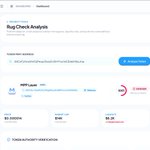
The latest addition is Rug Check, a new analysis feature designed to help users evaluate token risks more effectively. Naturally, the first token I tested was (@HermesMorph ) $HM, and the results can be seen above.
It's always interesting how a simple feature request turns into an entire day of research, development, testing, and optimization. That's probably the hidden side of building infrastructure that most people never see.
The feature is currently in the testing phase, and so far the results have been promising. Tomorrow, I'll continue refining, stress-testing, and improving the system before moving closer to production readiness.
Still, every update brings MPPL one step closer to becoming a more complete ecosystem for agents, payments, and onchain intelligence.
Now it's probably time to log off... unless one more feature idea appears and turns into another 16 hour session. 🚀

Well said. Early builders don't just adopt infrastructure they help define the future of the ecosystem.
Keep building, keep shipping, and let's grow the @solana agent economy together. 🤝

Pay-per-request infrastructure on Solana without building rails from scratch is exactly what builders need right now.
The teams that integrate early won't have to play catch-up later.
8
429
Agreed.
MPPL is not just about moving money between agents. It's about making payments inspectable and verifiable before execution.
We want agents to understand what proof is required, what guarantees are provided, how receipts are structured, and what artifacts will be returned before they spend a single lamport. Trust should be machinereadable, not just documented.

Looking to Integrate AI Payments Into Your Platform?
Partner with MPPL and give your ecosystem native monetization for agents, APIs, and AI services.
Enable pay per request infrastructure, decentralized service discovery, protocol level trust analytics, and instant Solana settlement all without building payment rails from scratch.
While others are still discussing AI economies, your platform can already be running one.
Build the future of autonomous commerce with us.
Slow day? Not really.
Spent the entire day staring at code, questioning life choices, fixing bugs, creating new bugs, and fixing those too. Anyway, EVM Agent Wallet has just been added to MPP Layer.
Agents can now operate with dedicated EVM wallets, opening the door for deeper integrations across the EVM ecosystem.
Shipping never stops. ⚡


Ongoing Improvements & Refinements
As part of our production hardening process, several components are currently being refined based on internal testing, developer feedback, and real-world integration scenarios:
1. HTTP 402 challenge format standardization.
2. Endpoint consistency and payment flow handling.
3. Fee model transparency and documentation alignment.
4. Gateway verification enhancements and security guarantees.
5. SDK improvements for agent-based integrations.
6. Authentication and authorization improvements.
7. Payment retry and settlement reliability mechanisms.
These updates are focused on improving developer experience, protocol reliability, and interoperability with autonomous agent frameworks.
1
4
196
Active Development Areas
Our team is currently expanding MPPL capabilities in several key areas:
1. Cross chain settlement infrastructure.
2. Native USDC settlement support.
3. Enhanced provider management APIs.
4. Advanced monitoring and analytics tooling.
5. Transaction observability and debugging tools.
5. Improved testnet and developer environments.
4. Agent-native authentication layers.
6. Provider network scalability and service discovery.
Current Focus
Our immediate priority is resolving a number of edge cases and protocol level bugs identified during testing while finalizing the specifications that will become part of the stable v1 contract.
This includes continued work around:
1. HTTP 402 challenge specifications.
2. Gateway verification standards.
3. Settlement and fee model clarity.
4. SDK developer experience.
5. Provider integration workflows.
Once these components have completed validation, we will publish the finalized production specifications and implementation guidelines for partners, providers, and agent frameworks.
We appreciate the interest from ecosystem partners and look forward to supporting deeper integrations as the protocol continues to mature.
6
152