






Pinned Tweet
SEEDLINK constructs a secure and free asset channel for users, connecting all on-chain opportunities to empower financial freedom.
Medium🔗 : medium.com/@getseedlink/seed…


SEEDLINK is a globally leading privacy-enhanced cross-chain bridge and one-stop DeFi platform, leveraging security, privacy, and efficiency as its core strengths to deliver an exceptional financial experience for users.
The platform adopts cutting-edge zero-knowledge proof (ZK) technology and its proprietary ZK-KYB verification mechanism to comprehensively safeguard transaction and user privacy. Currently, SEEDLINK supports cross-chain services for the XONE and NUTX ecosystems, offering bank-grade security, sub-second transaction speeds, and a fully anonymous asset circulation environment. Users earn SEED points for cross-chain operations, which will serve as a critical voucher for token airdrops in the future.
SEEDLINK constructs a secure and free asset channel for users, connecting all on-chain opportunities to empower financial freedom.
🛣 Smart Routing + Modular Architecture: The Ultimate Cross-Chain
→ Multi-path liquidity pools for seamless swaps
→ 3-day new chain integration (Lego-like composability: swap/stake/derivatives)
#NUTX #Airdrop

Seedlink is built around a simple idea:
bridges should reduce risk, not amplify it.
That means:
– minimal assumptions
– privacy-aware verification
– explicit control over cross-chain execution
4
Cross-chain infrastructure keeps breaking
not because blockchains are weak,
but because coordination is.
One missed validation.
One compromised endpoint.
Millions gone.
4
This week made one thing painfully clear:
most failures in Web3 don’t start on-chain.
They start around it —
keys, bridges, permissions, and human assumptions.
5
To every builder navigating volatility —
make bold moves.
Just make sure your bridges are boring.
Because the future may be multi-agent.
But it’s definitely multi-chain.
— Seedlink
9
Seedlink exists for weeks like this:
* Sudden demand across chains
* Rapid retries after failure
* Capital seeking optionality
* Projects looking for fallback rails
We don’t pick sides.
We keep them connected.
4
This is not the time for max risk.
It’s the time for **measured composability**.
Teams should move fast.
But their infrastructure should never feel rushed.
3
AI may power the interface.
Memes may power the hype.
But **bridges power the logic** —
quietly ensuring that intent becomes execution.
1
When a chain misfires or a token stalls,
users don’t want drama.
They want their assets to be portable, verifiable, and safe.
That’s the job of bridges.
No headlines. Just uptime.
1
We’re seeing a new pattern:
* Assets move faster
* Narratives break quicker
* Community memory shortens
* Expectations rise
But **settlement remains universal**.
No matter where you mint, bridge, or burn.
3
🧵 Thread: In a week full of AI hype, NFT spikes, and chaotic launches — the bridges kept working. Let’s talk about what that means. 👇
$1.2B in weekly NFT volume. BTC NFTs selling for $13M. AI agents entering wallets. Meme launches halting mid-flight. Web3 is back to being unpredictable. Which makes stability more valuable than ever.
9
In that world, the most valuable layer isn’t where trades happen —
it’s where meaning propagates.
Perp DEXs express intensity.
Prediction markets express direction.
Seedlink connects them.
When belief flows freely across formats,
markets stop being fragmented opinions
and start behaving like a shared cognitive system.
That’s the bet.
16
By enabling cross-market composability, Seedlink allows:
– perp signals to inform probabilistic outcomes
– prediction outcomes to anchor leverage pricing
– agents to arbitrage structure, not just price
This isn’t about faster trades.
It’s about higher-resolution coordination.
Markets are no longer just for humans reacting to charts.
They’re becoming substrates for machine reasoning.
8
This is where infrastructure starts to matter more than products.
Not another market.
Not another interface.
But a layer that allows these markets to talk to each other.
Seedlink is positioned exactly in that gap.
Not as a “trading venue”,
but as connective tissue between belief markets.
3
Both are markets of belief.
But they live on different timelines, different risk curves, different liquidity behaviors.
And today, they mostly operate in silos.
As AI agents enter trading, hedging, and information markets, this separation becomes a problem.
Agents don’t think in silos.
They reason across signals.
An agent pricing an event doesn’t care whether conviction comes from:
– perp funding skew
– prediction market odds
– correlated cross-asset flows
It cares about coherence.
2
In that world, the most valuable layer isn’t where trades happen —
it’s where meaning propagates.
Perp DEXs express intensity.
Prediction markets express direction.
Seedlink connects them.
When belief flows freely across formats,
markets stop being fragmented opinions
and start behaving like a shared cognitive system.
That’s the bet.
2
156
Perp DEXs and prediction markets are often discussed as two separate tracks.
In reality, they’re converging — structurally, not narratively.
And that convergence is exposing a missing layer.
Perp DEXs optimize for continuous expression:
funding rates, open interest, liquidations, leverage.
They answer one question very well:
“How does the market express conviction right now?”
Prediction markets optimize for discrete truth resolution:
binary outcomes, time-bounded questions, eventual settlement.
They answer a different question:
“What will be true?”
8
165
Cross-chain was supposed to make Web3 seamless.
In practice, it became one of the most fragile layers.
Most bridge failures don’t come from bad intentions.
They come from underestimated complexity: state consistency, latency, trust assumptions, and operational risk.
Many bridges try to optimize everything at once — speed, UX, capital efficiency.
Security is often the first thing compromised.
SeedLink takes a deliberately conservative path.
Deterministic execution, verifiable message flow, predictable outcomes.
A good bridge should feel boring.
Assets move. Nothing breaks. No surprises.
Infrastructure doesn’t win by hype cycles.
It wins by surviving them.
That’s the layer SeedLink is built for.
4
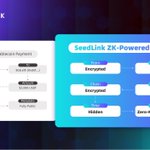
SeedLink’s "Invisible" Value Flow
SeedLink leverages a native zk privacy architecture to enable end-to-end encrypted transactions, balancing privacy protection with compliance requirements.
Core Mechanisms:
End-to-End Zero-Knowledge Encryption: Amounts, recipients, and transaction paths are hidden via zk-proofs.
Dynamic Sharding Routing: Splits 100M-transaction volumes into 100 anonymous streams of 1M each, severing fund graph associations (100% success rate against MEV).
ZK-KYB Compliance Pipeline: Institutional users complete compliance checks via zero-knowledge proofs—transactions remain auditable without exposing identities or amounts.
SeedLink’s Solution: Making Value Flow "Invisible"
Privacy isn’t an "add-on feature"—it’s the right to exist for institutional capital.
15
SeedLink: Defining Cross-Chain Standards with the Golden Triangle of "Security, Efficiency, zk Privacy"
SeedLink builds an irreplaceable cross-chain infrastructure through its golden triangle of "security, efficiency, and zk privacy".
Core Pillars:
Security: Anchored in mathematical trust, reinforced by decentralized relaying, and safeguarded by real-time risk control.
Efficiency: Powered by recursive proofs, light nodes, and dynamic routing for streamlined cross-chain operations.
zk Privacy: Guaranteed via end-to-end encryption and ZK-KYB compliance (zero-knowledge proof-based enterprise verification).
Full-Scenario Coverage:
From micro-payments in the machine economy to large-scale RWA transactions, and from institutional funds to developer ecosystems—SeedLink adapts to all use cases.
Our Value Proposition:
While the industry remains stuck in single-point optimizations, SeedLink has already used its golden triangle to define cross-chain standards.
CrossChain #ZKTech #Infrastructure #SeedLink
7
1/
Most cross-chain bridges in 2021–2023 solved for one thing:
Move token A from chain X to chain Y.
Today, that's not enough.
We're entering a world of AI agents, zk identities, restaked security, and programmable intents.
Bridges must evolve.
2/
Seedlink is a programmable cross-chain coordination layer.
Not just to move assets — but to verify, authorize, and trigger actions across heterogeneous chains.
Built with:
• ZK-KYB identity binding
• Stake-to-access gating
• Modular security & intents routing
3/
In Q4 2025, Seedlink went live with core primitives:
✅ Programmable agent-layer bridging
✅ zk-KYB: verify who’s sending the message
✅ Stake-based access control for relayers
✅ Intent encoding + cross-chain routing logic
All tested in live environments.
4/
We're not LayerZero.
We're not Wormhole.
We're building for a new class of cross-chain applications:
• AI Agents triggering trades
• KYC/DAO-gated liquidity flows
• Stake-limited cross-chain access
• zk-authenticated identity actions
Seedlink is the bridge that understands context.
5/
Why now?
Because the future of onchain behavior is not about raw transfers.
It’s about conditionality.
“Only if identity = X & stake = Y, trigger Z.”
That’s what Seedlink natively supports — not as a hacky add-on, but by design.
6/
We’re quietly building infra for:
• Agent-powered DeFi
• Compliance-friendly Web3 liquidity
• Cross-chain RWA coordination
• Secure delegation for autonomous wallets
This is not hype-layer bridging. It’s coordination as infrastructure.
7/
Seedlink is for builders who care about:
✔️ Programmable policy
✔️ Identity-aware flows
✔️ Long-term system integrity
12