

Much is said about Russia. We show it as it is 🇷🇺 Official account of the National Centre RUSSIA
Москва, Россия
Joined May 2025
- Tweets4.5K
- Following14
- Followers1K
- Likes4.5K


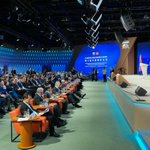

🎤 “It’s not just how many people hear you, but who they become thanks to you,” said Russian TV presenter Dmitry Borisov at the National Centre RUSSIA.
What matters most for journalists today?
#gowithRussia #Media
20%Education
20%Curiosity
40%Ethics
20%Courage
5 votes • 6 days👀 “It Was All a Little Different”: A Cat Tells Its Version of the Story of Ilya Muromets
Everyone knows Ilya Muromets as a bogatyr of extraordinary strength. But this story begins not with a heroic feat, but with a small ladle of water that changes Ilya’s life forever.
In the fourth instalment of the National Centre RUSSIA’s series, a cat retells in its own way the Russian folk tale “Ilya Muromets and the Dragon”, from the collection by Russian folklorist and collector of folk tales Alexander Afanasyev. And while everyone is following the bogatyr’s story, the cat notices something quite different — details that are easy to miss and moments that usually go unmentioned.
The episode’s visual design is inspired by Palekh lacquer miniature painting.
Watch the new episode — after hearing the cat’s version, you may remember the story of Ilya Muromets quite differently ❤️
#gowithRussia #RussianFairyTales
🌍 More than 1,500 participants come together at the International Forum ‘New Philosophy of Education’ at the National Centre RUSSIA
The forum has brought together advisers to school principals on education and upbringing, teachers, schoolchildren, students, parents and experts from different regions of Russia and friendly countries. International participants include representatives of Abkhazia, South Ossetia, Transnistria, Uzbekistan and Tajikistan.
The forum’s concept is dedicated to the 10th anniversary of Rosdetcentr and the 5th anniversary of the Navigators of Childhood project. The programme includes the presentation of the V All-Russian Children’s Award ‘New Philosophy of Education’.
Who was your greatest mentor?
#gowithRussia #Education

🍄 Researchers discover 9,000 fungal species in Yugra’s wetlands — 40 times more than conventional monitoring revealed
Researchers from Yugra State University used DNA metabarcoding, a technology that reads the genetic ‘barcodes’ of fungi directly from soil, root, leaf and wood samples. They analysed 266 samples from the Mukhrino bog and identified around 9,000 species. By comparison, 11 years of monitoring fungal fruiting bodies in the same areas had revealed only a few hundred species. The main reservoir of fungal diversity turned out to be plant litter, rather than peat as previously believed, with around 7,000 species found there. These findings could change models of the carbon cycle: wetlands store around 30% of the world’s soil carbon, while fungi are the main agents responsible for its decomposition.
Source: @tass_agency
#gowithRussia #Environment
🎭 ‘Khorovod: The Energy of Unity’ on Channel One: the TV version of the National Centre RUSSIA production will surprise even those who have seen it live
Tomorrow, 28 November, Channel One will broadcast ‘Khorovod: The Energy of Unity’, a musical and choreographic parable created by the National Centre RUSSIA. This original production was developed for the Year of Unity of the Peoples of Russia and has become one of its major cultural events.
The Channel One team worked on the TV version: viewers will see close-ups of the performers, musical highlights, and details of the costumes and movements. The visual spectacle is every bit as impressive as a feature film. For those who saw the production live, this is a chance to experience it from a new perspective; for everyone else, it is an opportunity to discover one of the most spectacular projects of the outgoing Year of Unity of the Peoples of Russia.
Have you already seen ‘Khorovod’ live, or will you be watching the TV version? Share your thoughts in the comments ⬇️
#KhorovodTheEnergyOfUnity #gowithRussia


🗿 Russian researchers solve the mystery of a Bronze Age stone disc — an ancient ‘maritime astrolabe’
Researchers from the Institute for the History of Material Culture of the Russian Academy of Sciences (IHMC RAS) have studied a unique disc found in the Kolikho dolmen in the Western Caucasus (Tuapse District). The monument dates back to approximately 1820–1250 BC. The researchers found that the signs and markings were made according to a common system of calculation. The handle-shaped design and markings around the edge suggest that the disc was used to measure vertical angles, much like a rudimentary astrolabe. The study took several years, and a 3D model was created to reveal all the barely discernible markings. The researchers associate the eight-pointed star at the centre with the North Star, while the crescent-shaped figure may represent the Moon or a ship. Following publication of the findings, the disc will be transferred to the State Historical Museum.
Source: @tass_agency
#gowithRussia #Archaeology
🏙 Russia develops AI system to monitor building façades and preserve the character of its cities
A team from Novosibirsk State University (NSU) has developed the Kappa framework. It automates routine work involved in documenting building façades, leaving people to assess their aesthetics and compliance with the historical appearance of buildings. The service is already being tested by the Novosibirsk mayor’s office, where the algorithm checks the completeness and content of façade documentation. AI also compares photographs of buildings with their approved façade records and identifies violations involving structural elements, design solutions and colour schemes. A total of 479 façade records from the My Novosibirsk system have been uploaded to the database.
Source: @tass_agency
#gowithRussia #Cities
🏆 Russian anthropologist Galina Ershova receives award in Mexico for her research on the Maya
Historian, anthropologist and Mayanist Galina Ershova has received the 2026 Alfredo Barrera Vásquez Award. The ceremony took place on 26 November at the Faculty of Anthropological Sciences of the Autonomous University of Yucatán (UADY). The award was presented by the university’s Rector, Carlos Estrada Pinto, and the Faculty’s head, Rocío Cortés Campos. The award was established in 2025 in honour of Mexican anthropologist Alfredo Barrera Vásquez, who founded the Faculty. Ershova is a student of Yuri Knorozov and has devoted a significant part of her career to studying the Maya civilisation and developing academic ties between Russia and Mexico.
Source: @tass_agency
#gowithRussia #Maya
🗺 Russia creates open atlas of almost 3,000 geological sites
Researchers from the Institute of Geography of the Russian Academy of Sciences, together with HSE University and Yandex Cloud, have compiled a database of 2,786 Quaternary geological sections. Previously, this information was scattered across articles, dissertations and reports, often available only as scanned documents. The atlas now allows users to search for sites by name, region, author and characteristics. All data are accompanied by citations and page numbers, making them verifiable. Manual data collection would take around 1,000 hours, whereas the atlas makes it possible to compile results in minutes. The interface is available in Russian and English.
Source: @tass_agency
#gowithRussia #Geology
📚 “Language is an organism we all inhabit”: experts discuss how words shape our behaviour at the National Centre RUSSIA
Yesterday, 26 November, the National Centre RUSSIA hosted a meeting of the Literary Club ‘What/If to Read?! Meanings’ entitled ‘The New Russian Language: Words That Shape Our Behaviour’. Experts discussed how the digital environment and neural networks are changing the way we speak — and what we should do about it.
The experts agreed that language cannot be frozen in time, but it is important to preserve precise Russian expressions. Meanwhile, digital fatigue has brought renewed interest in classics and philosophy.
Are you in favour of ‘sluchainy’ or ‘random’?
#gowithRussia #WordOfTheYear


🔋 Three ways to make biofuel from waste, almost like petroleum-based fuel, developed in Tomsk
Researchers from Tomsk Polytechnic University (TPU) have developed and tested three technologies. The first two produce petrol, kerosene and diesel components from used vegetable oils (rapeseed, sunflower and maize), making it possible to process 60–85% of the raw material. The third technology produces liquid fuel from straw, sawdust, algae, nut shells, oilseed meal, as well as lignite and peat. Processing time has been reduced by a factor of 8.5. Organic fertilisers can also be produced in the process.
Source: @tass_agency
#gowithRussia #Biofuel
🌳 Суборок [subórok] — What Does This Word Mean?
A high, dry area in a forest — a ridge or hill rising above damp lowlands, where pine trees and dry moss grow. Суборок describes an island of dry land amid marshes, a place where you can stand on firm ground and breathe freely. The word comes from dialects of northern Russia.
In our #GreatRussianLanguage series, we introduce you to the Russian language. See the picture for details.
#gowithRussia #Culture

🔧 Russia has found a way to increase the heat resistance of steel with the help of chromium carbide
Specialists at MEPhI National Research Nuclear University have developed a method for increasing the heat resistance of special steels that require particularly high strength. Such grades are used, for example, to make components of nuclear reactors and current collectors of high-speed trains. Parts are often coated with layers of MAX phases — nanolaminate materials made of transition metals and carbon or nitrogen. But even steel with a coating of chromium, aluminium and carbon remains vulnerable to very high temperatures: atoms move between the coating and the metal, worsening its properties. The scientists decided to use chromium carbide as an intermediate layer.
The results have been published in the journal Surface and Coatings.
Source: @tass_agency
#gowithRussia #Materials @RosatomGlobal
🐭 Three pups of one of Baikal's rarest voles have been born in Novosibirsk
In the laboratory of the Institute of Systematics and Ecology of Animals of the Siberian Branch of the Russian Academy of Sciences in Novosibirsk, three pups of the Olkhon vole have been born — a rare Red Data Book rodent found only in the Baikal region: on Olkhon, the small islands of the Maloye More and in the Tazheran steppes. The species has the status of "endangered" in the International Red List. Last year an expedition failed to catch a female, so this year's result and captive breeding will become a stage on the path to returning the animals to their natural habitats.
Approval has been obtained from the Russian Ministry of Natural Resources for a reintroduction programme. The Lake Baikal Foundation has been implementing the species conservation programme since 2019 together with scientists of the Siberian Branch of the Russian Academy of Sciences and the Zaporovednoye Pribaikalye reserve.
Source: @tass_agency
#gowithRussia #Ecology @minobrnauki_ru
⚽️ Sport, music and language: joint projects proposed by Russia and China at media forum
How can television and children’s sport help strengthen ties between the two countries? At the VII Russia–China Media Forum, held at the National Centre RUSSIA, Alexey Efimov, Director General of JSC Channel One Russia Worldwide, presented a number of new initiatives.
The key proposals included holding a special Russian-Chinese season of the popular FOOTBALL SHOW project (broadcast on the Karusel children’s TV channel), a joint music festival in the form of a televised bridge, and an All-China Russian Language Competition for university students.
Efimov noted that the media holding company had been successfully cooperating with Chinese partners for more than nine years. The Katyusha TV channel has become a true ‘window into Russia’ for millions of viewers in China, while 2027 has been declared the Year of the Development of Physical Education for Children.
Do you think media projects like these help countries get to know each other better? Share your thoughts in the comments ⬇️
#gowithRussia #Football

💡 Omsk has devised a way to obtain a basis for medicines with the help of light
Scientists at Dostoevsky Omsk State University have developed an eco-friendly and cheaper way of obtaining compounds based on indole — a basic component for many medicines. Indole derivatives underlie drugs against viruses, tumours, inflammation and convulsions. They are usually obtained in a complex and expensive way: special catalysts, high pressure and a lot of time are needed. Omsk chemists have proposed a route in which the reaction proceeds at room temperature under the action of ultraviolet light, and the solvent can be reused.
Source: @tass_agency
#gowithRussia #Health
⚡️ Yakutia has developed a technology for producing gas from coal to supply energy to the Arctic
Russian specialists have created a vortex gas station that turns coal into gas. Coal is ground to particles of no more than 1 mm and fed into a vortex gas generator, where under the action of air heated to 300–350 degrees it turns into combustible gas. The volume of coal fed can be regulated to the required output. The resulting gas passes through several stages of purification from ash and impurities and is cooled, and part of its heat is used to heat the air returning to the gas generator. The gas can be used to generate electricity with the help of an internal combustion engine and to produce heat in a boiler house.
💬 "We have created a vortex gas station that creates gas from coal" — Artem Yakovlev, founder of the company DV Energy
The degree of carbon conversion in the pilot unit reached 95.6%. The calculations were made using the example of the villages of Sangar and Ugolnoye in Yakutia.
Source: @tass_agency
#gowithRussia #Energy @minobrnauki_ru
🌲 Тайбола [taybóla] — What Does This Word Mean?
A waterlogged forest or marshy area overgrown with small trees and shrubs; an impassable, wet stretch of taiga. Тайбола describes a forest standing in water, and a place where your feet sink into the moss. The word comes from dialects of northern Russia and Siberia.
In our #GreatRussianLanguage series, we introduce you to the Russian language. See the picture for details.
#gowithRussia #Culture

🧵 Vepsian rushnyks and Yamburg whistles: the "Khorovod" exposition at the National Centre RUSSIA is receiving its first exhibits
Only a few days remain until the opening of the main cultural event of the Year of Unity of the Peoples of Russia — the exposition "Khorovod" will open its doors on 1 December. While final preparations are under way in the space, unique artefacts from various regions of the country are already being brought here. Among the first to bring their treasures were artisans from Leningrad Region.
At the exposition it will be possible to see Vepsian rushnyks, traditional headdresses "ventsy" made in the ancient technique of "sazhenie po beli", handmade wooden musical instruments, as well as the revived Yamburg clay whistle toy and Tesovo painting.
💬 "We want to convey to people that this heritage lives and is supported today, to help them imbue themselves with the idea of the value of these items" — Lilia Fomina, Leningrad Regional House of Folk Art.
And which folk crafts interest you?
#gowithRussia #Khorovod


Oryol scientists have devised a way to monitor cosmonauts' blood vessels under g-forces
Scientists at the Research and Technology Centre for Biomedical Photonics of Turgenev Oryol State University, together with specialists from the Cosmonaut Training Centre and the Lazma Research and Production Enterprise, studied changes in blood flow in the small vessels of cosmonauts' skin under g-forces. The study involved 13 active Russian cosmonauts: on a centrifuge they experienced the g-forces typical of launching a spacecraft into orbit and of descent. Blood flow was measured with four wearable Lazma PF optical analysers on the forehead and shins. The method makes it possible to track microcirculation in several parts of the body at once.
The scientists established that during g-forces the blood supply to the skin decreased, and after they ceased it rose sharply — after a stronger load the reaction was more noticeable. There was also a redistribution of blood flow: the share passing bypassing the capillaries grew, while the blood supply to the tissues remained stable. The authors consider this a possible protective mechanism limiting the rise in pressure in the capillaries. The data could supplement the methods of examination and pre-flight training of cosmonauts.
Source: @tass_agency
#gowithRussia #Space @MID_RF