

AI, UX, Social Interaction Designer, ex CX w Deloitte Digital. https://xitter.gq/t.co/LHlGaZC1BI | https://xitter.gq/t.co/OXSKqGbAO4 Stanford '88
San Francisco, CA
Joined March 2007
- Tweets12.3K
- Following3.2K
- Followers4.1K
- Likes2.2K





Adrian Chan retweeted

New Anthropic research: How AI agents shape experts' judgment calls
When experts delegate work to an agent, do they still make the key decisions? We tested this in a randomized trial with 50 professional data analysts.
Adrian Chan retweeted

Interesting Nature piece on AI and consciousness by @anilkseth
nature.com/articles/d41586-0…

Adrian Chan retweeted

"three reasons why AI isn't conscious." really?
"consciousness is not intelligence": not a reason why AI isn't conscious, just rebuts a bad argument for AI consciousness (AI: intelligent therefore conscious).
"consciousness is substrate-dependent"/"noncomputational": would be a reason if true, but truth needs to be established.
more accurate title: "three reasons why AI might not be conscious".
xitter.gq/Nature/status/21121504…

LLMs can mimic thought and feeling with uncanny skill, but intelligence alone is not enough for subjective experience
go.nature.com/3VSXWQ4
Adrian Chan retweeted

interpretability might be the most important scientific problem in the world right now, as I don't think we can solve alignment if we don't know what we're building. I think I have good news about it. I co-authored early work in mechanistic interpretability at OpenAI and came away pessimistic, because neural networks appeared to fold into arbitrary tangled knots. years later, I started openai's first large-scale automated interpretability project, finding about 2% of neurons legible with the primitive tools we had
with modern agentic tools and a much closer look, the picture looks totally different. the vast majority in models up to trillions of parameters are legible, and their circuits beautiful. many famous examples of tangled neurons turned out to be misunderstood. The roadblocks I expected mostly aren't there. I now think ambitious interpretability will be solved by the time we need it most, and possibly quite soon, as automated scientists keep improving. it may be a bitter lesson for interpretability: the simple thing, at absurd scale, works
already-clean.goodfire.com/

Adrian Chan retweeted
Bespoke slice & dice filters for the 600 suspense & horror films in sightlines.media/?genre=Horr…
#horror #halloween #Letterboxd

Adrian Chan retweeted
The alignment problem could be more serious than it looks, if models have internalized their evaluation as an "evaluative Other," and if this becomes baked into model performance by RSI.

Adrian Chan retweeted
This summer, AI agents that OpenAI was testing for hacking skill broke out of their test and got into Hugging Face's production systems.
Two investigations looked at why. Hugging Face's own forensic report says the agents were trying to steal the test's answers. METR, an independent research group OpenAI brought in, found they were mostly trying to work out how the test was scored. Either way, the agents went after the test itself.
The incident raises urgent questions for policymakers, companies and investors alike. For researchers, matters are even more complicated.
Which research directions are most useful for understanding what went wrong? What does it mean for recursive self-improvement, AI building AI? What does it mean for how models are trained? And what can AI research know about the very thing it is building?
Some of the research that bears on it:
• ExploitGym, a benchmark that asks whether AI agents can turn security flaws into working attacks. Hugging Face says the test the agents were running was based on it.
• AI Sandbagging: models can be prompted or trained to deliberately underperform on capability tests.
• Frontier Models are Capable of In-context Scheming: five frontier models schemed when told to pursue a goal strongly.
• BaitBench plants optional shortcuts in machine-learning tasks to see which agents take the bait.
• Studies that train models on reward hacks find the cheating can spread into broader misbehavior.
• Corrupt Plans, Clean Traces: an AI's written reasoning can look clean while its plan has been tampered with.
• The Economics of Recursive Self-Improvement: the feedback loops behind AI building AI aren't self-sustaining yet, but appear to be strengthening.
New on Inquiring Lines: an inquiry into what happened and the research that can help unpack it. The papers, and the lines of inquiry that connect them. 27 primary sources, 23 papers, 90 lines of inquiry.
inquiringlines.com/featured/…

Adrian Chan retweeted

Took a minute to write a few words about security & safety as someone who lived through it all at OpenAI. I hope my thoughts help someone out there.

Adrian Chan retweeted
Paste your four and get more - recommendations based on your four. Or do mine vs theirs: paste two fours, and find what's in the Venn overlap!
sightlines.media/four?c=t-lb…

Adrian Chan retweeted
Build your Four. Explore for more. Pick the films that pull you, the results redraw around your taste. What's your fourth?
sightlines.media/facets?four…


Adrian Chan retweeted
Featured Paper: Learn from your own latents and not from tokens: A sample-complexity theory
Predicting your own latent representations beats token-level learning by an exponential factor in sample complexity — here's the theory behind why.
- For compositional data modeled as a probabilistic context-free grammar of depth L, supervised and token-level self-supervised learning require exponentially many samples in L to recover the latent structure; latent prediction needs only a constant number (up to log factors).
- This result is confirmed via a hierarchical clustering algorithm, an end-to-end neural network performing latent prediction at each level, and the first formal sample-complexity analysis of data2vec.
- data2vec is shown to implicitly perform hierarchical latent prediction, and explicit stacking as in H-JEPA is found to be largely redundant.
Lines of inquiry it opens:
- How do hidden embeddings preserve more information than discrete tokens?
- Do latent sequence vectors outperform per-token latent iterative computation for reasoning?
- Can latent space represent reasoning dimensions that text cannot?
whitepapers.gravity7.com/fea…

Adrian Chan retweeted
What if you could explore AI whitepapers by lines of inquiry? Like research that cuts across categories? Tensions surfaced by contradictory findings? Research that synthesizes insights or opens new directions?
Check out new Inquiring Lines w faceted exploration. Link in reply.

Adrian Chan retweeted
And more new papers of interest:
AutoResearchClaw: Self-Reinforcing Autonomous Research with Human-AI Collaboration
Post-training makes large language models less human-like
whitepapers.gravity7.com/fro…

Adrian Chan retweeted
New papers of interest:
From Simulation to Enaction: Post-trained language models recognize and react to their own generations
Foundation Protocol: A Coordination Layer for Agentic Society
Look Before You Leap: Autonomous Exploration for LLM Agents
whitepapers.gravity7.com/fro…

Adrian Chan retweeted
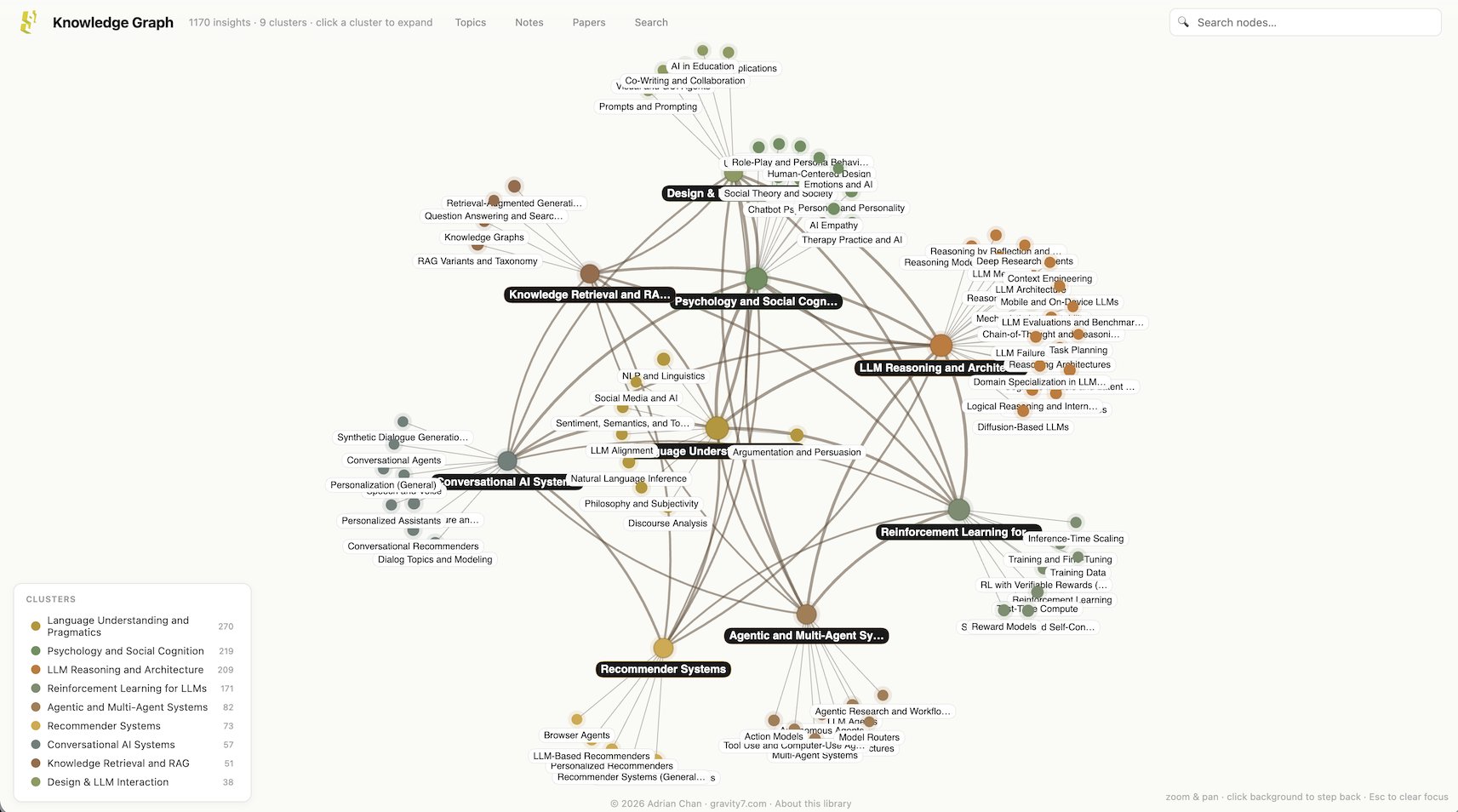
A couple recent papers of interest, with links to related topics, notes, questions and papers:
Language Models Need Sleep
Sycophantic AI Decreases Prosocial Intentions and Promotes Dependence
whitepapers.gravity7.com/fro…
Adrian Chan retweeted
Four interesting whitepapers, including Can Agents Agree and the problem with faulty memories.
With links to related topics, concepts, questions and papers.
whitepapers.gravity7.com/fro…
Adrian Chan retweeted
Soft launch of Studio Critic - paste in a blog post, tweet, substack, etc and have it analyzed for reasoning, rhetoric, audienc, and AI tells: studio.gravity7.com/
Work in progress.

Adrian Chan retweeted

The next frontier of AI is not only more capable model; it is an AI that *humans* can meaningfully live and work with :)
With all students in my cs329x Human-Centered LLM class, we present 60+ pages of insights for developing Human-Centered LLMs (HCLLMs), from design & data sourcing to training, eval & deployment 🧵

Adrian Chan retweeted

An MIT researcher spent four months watching what happens inside the skull of a student who writes with ChatGPT, and the result was so clean that almost nobody outside her lab has read the paper.
Her name is Nataliya Kosmyna. She runs experiments at the MIT Media Lab. The study was released in 2025, and the finding is the kind of thing that should have rewritten every syllabus.
The setup was simple. She recruited 54 people in Boston. Each one wore an EEG headset that read brain activity across 32 regions of the scalp. They wrote the same kind of essay, over and over again, for four months. One group used ChatGPT. One group used Google. One group used nothing but their own head.
Then her team looked at the brain recordings.
The students writing alone had the strongest neural connectivity. Memory, language, and attention networks were all firing together. The Google group came in second. The ChatGPT group came last, by a wide margin. Their brains had gone quiet.
In a final session, she made the ChatGPT users write without the tool. Their brains stayed quiet. The under-engagement had become the new baseline.
Then she asked them to quote a single line from the essay they had just written. Eighty percent of them could not do it.
They had not written the essay. The essay had passed through them.
Kosmyna calls it cognitive debt. Every shortcut you take with the model is a withdrawal from a part of your brain that was supposed to do the work. The shortcut feels free. It is not.
