

Find all bugs. Make no mistakes. AI security for the future of finance on Solana.
Joined February 2026
- Tweets96
- Following83
- Followers455
- Likes295






hackhack retweeted

our smart contracts passed the audit.
@hackhackai @SuperteamGEO
hackhack retweeted

if you're a @solana project stressing about audits, consider using @hackhackai
built by @r0bre and @HenronEldini, they bring autonomous pre audits & full audits together -- with the cost of your pre audit credited toward the full @accretion_xyz audit
what this means is that it gets you most of the way there before the full audit starts -- so less time wasted, and a full audit that can go deeper -- saving you time, money & energy
huack huack


hackhack retweeted

Last year, we found a critical bug during @lightprotocol's Anchor-to-Pinocchio upgrade. While backtesting AI auditors, they kept missing this specific issue. But why?



hackhack retweeted

AI audits will be more common as the machine doesn't have the limited time and focus humans have. Its like an intern that can spot, chain and reproduce known patterns ran in a infinite simulation
@hackhackai is doing awesome stuff. make no mistakes

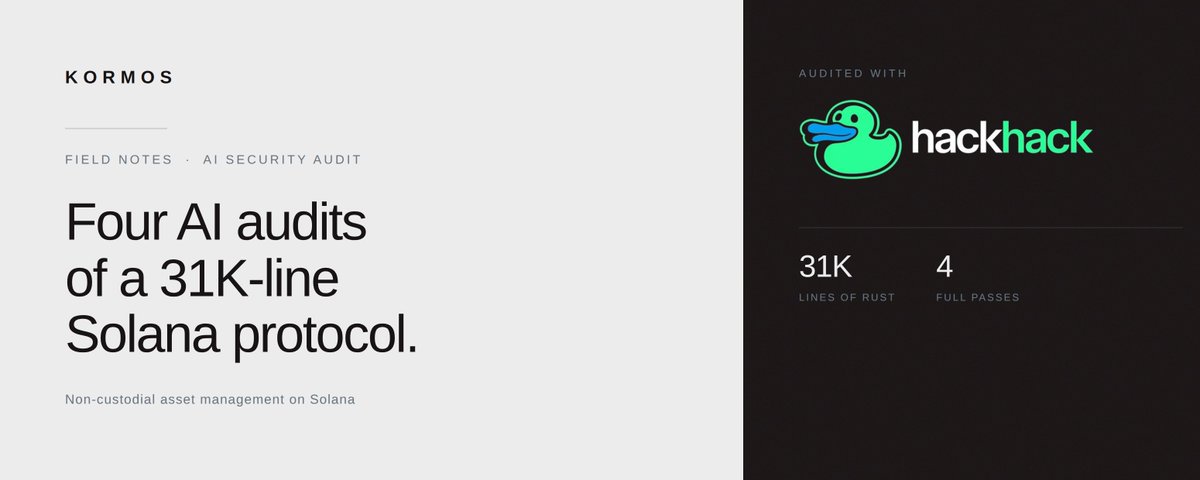
We ran four full AI audits of our tranching vaults protocol with @hackhackai — ~31K lines of Rust code.
It changed our view of what a serious smart-contract review can look like. Full write-up:
hackhack retweeted

AI audits is an incredible tool all protocols should embrace.
Thank you for the amazing work @hackhackai!
We ran four full AI audits of our tranching vaults protocol with @hackhackai — ~31K lines of Rust code.
It changed our view of what a serious smart-contract review can look like. Full write-up:
hackhack retweeted

hackhack.ai @hackhackai has outbid @Tokenshit_ replacing them on the blanket to save my boy.
Hackhack autonomously reviews Solana programs, reproduces exploitable vulnerabilities, and returns verified findings in hours. Built for Anchor, native Rust, and Pinocchio.


hackhack retweeted

I found 28 bugs and reached level 5 in @hackhackai's bug hunt. Find all bugs. Make no mistakes. Can you beat my score? hackhack.ai/bug-hunt/?score=…

hackhack retweeted
I found 8 bugs in @hackhackai's bug hunt. Find all bugs. Make no mistakes. Can you beat my score? hackhack.ai/bug-hunt/?score=…

hackhack retweeted
Implemented a new element for our website!
try it out on hackhack.ai
I heard the best engineers can get >100 score, not sure if this is true


I found 8 bugs in @hackhackai's bug hunt. Find all bugs. Make no mistakes. Can you beat my score? hackhack.ai/bug-hunt/?score=…
hackhack retweeted

Ireland is one of the dopest countries I’ve been to.
With trillions of dollars of ETFs and other funds domiciled there and an ambitious government, I suspect it will play a large role in the future of crypto.
Superteam Ireland is one of our largest communities, and @A_gutierro put together something really special at Slane Castle this year and I hope they run it back again soon.
Was a pleasure to meet some of the teams on Solana:
@Styx_PQ
@realPumpApi
@MentionedMarket
@infesteddotfun
@craftsdev
@finagotchi
@slasheddotwin
@hackhackai
@aikidoapp
@STEALFxyz
@AniketKumar_13
🇮🇪


hackhack retweeted
@avici getting hacked today
this is one of the first transactions by the attacker.
solscan.io/tx/5Rxc6gQcAPpe5W…
they then do the same pattern across multiple instructions of the target program (which actually is rain.xyz, not avici)
what we see is two Ed25519 invocations followed by a program invocation.
the double ed25519 is the smoking gun: clearly this is the attack pattern.
the program that is being exploited likely has a bug in its ed25519 signature parsing. It clearly is a case of a Ed25519 cross-instruction aliasing bug.
Ed25519 instruction 0 contains a valid signature under attacker-controlled key CLUci....
Instruction 1 sets all three source indices to 0, so Solana verifies instruction 0.
But instruction 1’s inline public key is the privileged key 9qZpp..., and its inline signature is just repeated 0x09 bytes.
Rain’s WithdrawCollateralAsset path apparently trusts that inline public key, even though it was never the key Solana verified.
actually just today, before this hack we found two vulnerable programs with THE SAME BUG using @hackhackai . Maybe would have found this one too if rain was open source

hackhack retweeted
How do Durable Nonces work?
A solana transaction basically consists of a transaction message and the signatures. The transaction message is a list of instructions you want to call. For example, transfer 1 sol from A to B. When you sign a transaction, you attach a wallet's approval to that message. In this case, you'd let A sign, approving their transfer. Without their signature, the transaction would arrive at the validator node, and then be rejected because it needs a signature from A but doesn't have it.
Now, what you usually don't want is that someone signs a transaction like a transfer, sends it through the internet towards the blockchain, but the packets never reach the blockchain nodes. So you send it again, and the second try works.
But a few minutes later the original transaction ends up making it to the blockchain and now you've sent the transaction twice.
For this and many other reasons, we must include a recent blockhash in our transactions. When a node receives your transaction it makes sure that it includes the hash of a block that was created within the last 150 blocks, which is 60 seconds on a 0.4s slot window.
now, this 60s window can theoretically be a problem when the time between getting the latest blockhash, reviewing and signing a transaction and then sending it to the current leader takes more than that. It could take more time than that if you're slow with your hardware wallet signing process, and when you take your time validating every byte before signing it manually.
That's why a workaround was introduced: Durable Nonces. Basically they allow you to submit transactions that were signed a long time ago.
These transactions have to include a nonce in place of the blockhash, and they need to call the advance nonce system instruction so that the validator knows that theyre using a durable nonce (and the durable nonce gets updated).
Now which one is gonna be a valid nonce?
Well, we can set it up by creating a nonce account, and the nonce will be derived from the latest (real) blockhash and saved in this nonce account. What's interesting is that I can create nonce accounts for others, without their approval (which makes sense as if we'd needed their approval, this means they'd have to sign a transaction within the 60s window, defeating the nonce purpose).
Another interesting thing is that the attacker fucked up a little. They created the nonce accounts for the victims from the start. This could have tipped of the victims -- why is there a nonce account for me suddenly?
The attacked could have instead created nonce accounts for their own wallets (which generates the durable nonce), then make the victim sign for that durable nonce, and then change the nonce account authority from themselves to the victim before executing the pre-signed transaction!
That's why I think that monitoring for nonce accounts in your name is not a silver bullet. It could have been in a different name and changed to your name a second before you're drained.
What also becomes evident here is that the drift team likely used hardware wallets, and the capability the attacked had was only to get them to sign a malicious transaction. They didn't compromise keys directly.
Using nonces was useful for the attacked because they removed time from the equation. If no nonces existed, the attacked would have to create a malicious proposal, get victim 1 to sign it, and then get victim 2 to sign it. Time would pass between those two signatures. Minutes, hours, maybe days. Even if the victims machines are compromised and on their computers the proposal would render as harmless, this time would introduce risk to the attacker where someone else could see the proposal, figure that its malicious, and flag it.
A time lock on the multisig would have helped here, as it could have introduced that same time - detection risk to the attack.
But a timelock itself would not have been enough -- it would have to be made sure that someone with an uncompromised computer actually checks out the transactions during that timelock period.

Earlier today, a malicious actor gained unauthorized access to Drift Protocol through a novel attack involving durable nonces, resulting in a rapid takeover of Drift’s Security Council administrative powers.
This was a highly sophisticated operation that appears to have involved multi-week preparation and staged execution, including the use of durable nonce accounts to pre-sign transactions that delayed execution.
hackhack retweeted
Re Drift Hack, part 2
So now that we've established that we have an
Admin/Multisig compromise on our hands, lets investigate further and try to figure out what keys of what multisigs were compromised when.
First thread can be found here:

Drift has been hacked. Lots of confusing information going around. I've taken a look at what's actually happening.
The core attack sequence is just 3 transactions:
1. Create a new Drift User Account:
solscan.io/tx/4xzb1AXSw45Q8S…
2. Deposit 500 Million "CVT" into Drift as collateral:
solscan.io/tx/5V72ZK1WejP5Mh…
3. Withdraw Millions of real assets against the provided collateral:
solscan.io/tx/2jCAE2SakEHtaZ… (and later transactions)
Now, as it turns out, this CVT token was just created a few weeks ago. The core question: How did it become accepted collateral within Drift?
