







Pinned Tweet
Our first @NatureHumBehav article! It took 8 months for the acceptance (Submitted: August 2024 / Accepted: April 2025), and the responses to reviewers was book-thick text. :) But finally it's out and we are so happy! 🥂 Read it here: rdcu.be/epoQJ

🎉 Huge news! Our paper 'A semantic embedding space based on large language models for modelling human beliefs' is finally out in @NatureHumBehav! This research uses LLMs to build a 'map' of human beliefs and reveals why people adopt certain beliefs through relative dissonance.

Haewoon Kwak retweeted

We're releasing one of the largest & most detailed look at how Americans use ChatGPT complementing reports from OpenAI, giving a much more deeper view into ChatGPT use
Explore our interactive tools & analysis: stateoftheprompt.net
Let us know if you want to see any analysis!


STATE OF THE PROMPT: Our Rutgers CSS Lab team analyzed a year of real ChatGPT conversations from 70K+ US panelists. See the new interactive tools, plus research reports on health, politics & more.
stateoftheprompt.net/
With @gvrkiran @shagunjhaver @RutgersCommInfo @RutgersU
AI may democratize mathematical discovery, allowing people outside elite institutions to explore ideas and prove new theorems.
But there's an interesting distinction: democratizing discovery doesn't always mean democratizing recognition. Who decides which discoveries matter?
One underappreciated impact of AI on Go is the democratization of knowledge. Players no longer need access to elite study groups to explore new strategies or challenge established wisdom. Anyone with an AI can do that.
I wonder if mathematics is heading in the same direction.
It also admits I’m in a similar transition. As an Informatics professor, I meet LLMs with the same unease and curiosity Go players felt a decade ago: how should I advise my PhD students now? So it closes with respect for the Go pros who walked this road first.
Personally, I had the most fun writing the Position Statement: how a long amateur life with Go (a kids’ Go academy, Hikaru no Go, then AlphaGo) led me to this study.
“When AI Becomes Routine: A Decade of Public AI Mediation in Korean Go Commentary” (AIES 2026)
Paper: arxiv.org/abs/2607.28332
Code: github.com/haewoon/routine-s…

Math is in a confusing moment. Errors keep turning up in AI proofs, yet some mathematicians watch a model suddenly prove what they spent years on. Still, I think math’s AlphaGo moment is near, if not already here. I want to see how mathematicians and AI take on math, together.
In Go, that recession is fairly safe. Stakes are low and AI evaluation is close to an oracle. Math today looks more like Go in 2016, when AI was still the topic itself.
We read this as the signature of domestication. Naming the AI gives viewers a hook to question it. Reading off the winrate, or “it says...”, lets the source recede. Compared with 2016, the receding forms now take a much larger share.
In late-period BadukTV broadcasts, an AI winrate graph is on screen about 98% of the time. Yet AI-salient talk is only 2.63% of sentences. Winrate and point-gap talk stays. The word “AI” goes unsaid.
In 2016, AI was what commentators talked about: “AI clearly has weaknesses, but so far we have not been able to find them.” By the 2020s, AI is what they talk from: “It says to block on this side now.” The source goes unnamed.
Mathematicians are now arguing over a flood of AI-generated proofs. Go players went through their version of this a decade ago, after AlphaGo. My #AIES2026 paper looks at what came next: 10 years of Korean Go commentary on YouTube, ~1,900 hours. 🧵
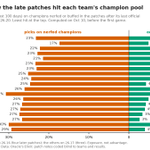
After the final we'll check the rest of the paper's analyses on 2026, including whether opponents ban the buffed champions of the most-buffed teams, as they did in past Worlds.
Exposure is not advantage. Across 1,097 Worlds games (2016–2025) we could not establish, in either direction, whether late patches change who wins.
Because Riot both writes the rules and runs the event, we argue it should publish team-level impact and explain its trade-offs.