
Art Arts & Culture Design & Architecture Literature Music Science Technology & Science
California, USA
Joined January 2017
- Tweets1.9K
- Following154
- Followers90
- Likes642


Teresa Coelho retweeted

Rev. Fr. Christopher Alar explains in simple words the reason why women can NEVER be ordained as priests in the Catholic Church.
The Church is wise.

Teresa Coelho retweeted

Have you ever thought about praying the Rosary specifically for the purification of your memory?
In Catholic thought, the memory is one of the faculties of the soul, alongside the intellect and the will. To purify the memory is to surrender painful recollections, regrets, intrusive thoughts, and unhealthy attachments to Christ, asking Him to free us from their power.
At the beginning of your Rosary, you can simply pray:
“Lord, I offer this Rosary for the purification of my memory.
Take every painful recollection, every regret, and every unholy image, and wash them in Your grace.”
You can also bring this intention into each mystery:
• Agony in the Garden: memories of anxiety and fear
• Scourging at the Pillar: memories of suffering and shame
• Crowning with Thorns: impure or troubling thoughts
• Resurrection: renewal, hope, and new life
Or add a simple clause to the Hail Mary:“…and blessed is the fruit of thy womb, Jesus, who purifies my memory.”
Mary, Our Lady of Sorrows, pray for us.

Teresa Coelho retweeted
There is one sin you keep going back to. You confess it, you mean it, and two weeks later you are on your knees for the same thing again. Fr. Dan Reehil, an exorcist, gave a one-line prayer for exactly that moment, and it is not the one you would expect.
He was asked on Dr. Taylor Marshall's podcast how people can protect themselves. Part of his answer is a step many of us skip. Do not only confess your sins:
"RENOUNCE THEM AND THEN ASK HIM TO PARDON YOU."
The host asked whether the grace of Jesus can really help someone conquer a sin like that, even to total victory. Fr. Reehil did not hesitate:
"YEAH, 100%."
Then he pointed to help most people forget they have:
"YOU HAVE A GUARDIAN ANGEL. CALL ON YOUR ANGEL."
And for the one sin you keep falling back into, he gave the words. Not a long prayer. A request:
"YOU HAVE A PARTICULAR SIN YOU GO BACK TO"
Tell your angel:
"SMACK ME IN THE HEAD BEFORE I DO THIS AGAIN."
It sounds like a joke. It is not. Your angel has been beside you through every one of those falls, and asking him to step in before the next one is exactly the kind of help he is there to give. You are not asking for a feeling. You are asking for a warning, at the moment you need it most.
Then, Fr. Reehil said, go one step further:
"THEN GO TO THE SAINTS THAT HAD PARTICULAR CHALLENGES."
Somebody in heaven fought the same battle you are fighting, and won. In his words: "THERE'S A SAINT FOR EVERYTHING."
So tonight, name the sin to yourself, the real one, and say this out loud. Ten seconds:
"My guardian angel, you know the sin I keep going back to. I renounce it. Next time it comes, smack me in the head before I do it again. Jesus, I trust You for the victory. Amen."
Then find the saint who struggled with the same thing, and ask for their help tomorrow morning.
👇 One word if you just asked your angel for help: SMACK.
Credit: Father Dan Reehil Community

Teresa Coelho retweeted

“I am your sister and your friend. Never will I cease watching over you.”
St. Thérèse of Lisieux
Basilica of the National Shrine of the Little Flower, Texas 🇺🇸🌹

Teresa Coelho retweeted

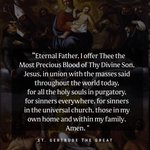
Oração de Santa Gertrudes
Prometeu o Senhor a Santa Gertrudes, que seriam libertas 1000 Almas do Purgatório, cada vez que esta Oração fosse rezada, sendo ainda extensível aos pecadores.
Eterno Pai,
ofereço o Preciosíssimo Sangue
de Vosso Divino Filho Jesus,
em união com todas as missas
que hoje são celebradas
em todo o Mundo,
por todas as santas Almas
do Purgatório,
pelos pecadores, em todos os lugares,
pelos pecadores,
na Igreja Universal,
pelos da minha casa e meus vizinhos.
Amém.

Teresa Coelho retweeted

The saints knew how to die well because they learned how to live for God.
We prepare for eternity through the choices we make today: returning to confession, persevering in prayer, offering our sufferings, and caring for those who need us.
This moving homily explores preparing for a holy death, the Anointing of the Sick, and the importance of calling a priest early during serious illness. The priest also shares his mother’s final moments, surrounded by her family’s prayers.
▶️ Watch the homily and share it with someone caring for a loved one.
Please leave the first names of those who are sick, dying, or recently deceased below. Let us remember them—and their caregivers—in prayer.
“Jesus, Mary, and Joseph, may I breathe forth my soul in peace with you.”
#CatholicFaith #HolyDeath #PrayForTheDead
youtu.be/cTBHeSo5IH8

Teresa Coelho retweeted

Purgatory
1. Purgatory is the masterpiece of God's justice and mercy. St. John tells us in the Apocalypse that nothing defiled can enter into the Heavenly Jerusalem. (Apoc. 21:27)
There are very few, however, who are privileged to arrive at the supreme moment of death still wearing their baptismal robe of innocence. Even the just man falls very often, as the Holy Spirit warns us. (Prov. 24:16) We all possess many failings and have been guilty of many sins, either mortal or venial. It is true that we can obtain forgiveness by penance and by receiving the Sacraments, but there still remains the temporal punishment due to our sins. Neither the small penance imposed by the confessor nor our own tiny acts of voluntary mortification are sufficient to satisfy our debt. We cannot be certain, moreover, that we shall be able at the hour of death to cleanse ourselves of all our sins by means of one good confession. Even if we appear before the judgment scat of God without any grave faults, there will still, unfortunately, be many debts to be paid and many imperfections to be purified.
What, then, will happen to us? The justice of God cannot admit us, imperfect and defiled as we are, into the everlasting happiness of the Beatific Vision. Will He reject us, therefore, even as He rejects those who die in mortal sin and are condemned to eternal punishment? This is unthinkable, for the mercy of God is as infinite as His justice. And so there is Purgatory, where the souls of those who have died in the state of grace, but still scarred with imperfections and burdened with debts to be paid, can find a way of purifying themselves and of making themselves worthy of an everlasting reward. Let us thank God for this gift, the last link in the chain of His mercies, which enables us to prepare ourselves for our entry into the Beatific Vision.
2. Devotion to the dead and the belief in a place of expiation and purification after death can be traced back not only to the early days of the Church but even to the dawn of the human race. Although Luther denied the existence of Purgatory, he was compelled to acknowledge the existence of this ancient and universal belief, sanctioned by tradition, by faith, and by human reason. This belief was already present among pagan people, as is attested by the better-known writers of antiquity such as Homer, Sophocles, Plato, and Virgil, and by ancient funeral inscriptions. Evidence of the belief among the Jews is found in Sacred Scripture, where it is related that, after he had conquered the worshippers of Jamnia, Judas Machabaeus collected twelve thousand drachmas of silver in order to have sacrifices offered for the dead. It is a holy and wholesome thought, adds the text, to pray for the dead, that they may be loosed from sins. (2 Mach. 12:46)
3. The clear testimony of the New Testament may also be invoked in support of this teaching. Jesus refers to sins which cannot be forgiven either in this life or in the next, (Cf. Mt. 12:31-32) from which the Fathers deduce that there are sins, namely those of a venial nature, which can be forgiven after death. St. Paul, moreover, speaks of imperfections which will be expiated and purged by fire after death. (Cf. 1 Cor. 3:10-15) Obviously, this cannot take place in Hell, but only in Purgatory. It would be impossible to cite here all the testimonies of the Fathers and of theological writers. Nobody can deny that they exist, however, for they combine to build up a tradition which the Council of Trent (Sess. XXV) gathered together when proclaiming the existence of Purgatory and the obligation of the faithful to pray for the dead who are expiating their sins there.
This is a very consoling doctrine. It is comforting to know that one day we shall find a way of purifying ourselves of all trace of sin and imperfection and that meanwhile we can be spiritually united with our departed loved ones and can help them by our prayers. (Antonio Cardinal Bacci)

Teresa Coelho retweeted
The moment a human being draws a last breath, Catholic doctrine teaches that the soul steps immediately—without delay or reprieve—into the presence of Christ the Judge. This encounter, called the particular judgment, is the private, irrevocable verdict rendered on one individual life. As one of my seminary professors was in the habit of saying, “the person who we are at the moment of death, is the person we shall be for eternity.”
Unlike the general judgment at the end of time, when every soul will be publicly vindicated or condemned before the assembled universe, the particular judgment is intimate: only the soul, its conscience, and God.
At that instant the entire moral history of the person is laid bare. Every grace offered, every commandment kept or broken, every secret motive and public act passes before the divine light. The standard is not abstract perfection but fidelity to the light each person actually received: the natural law written on the heart, the revealed law of Scripture and Tradition, and the unique vocation inscribed by Providence.
Three outcomes alone are possible.
Souls who die in perfect love, detached from all sin, enter at once into the bliss of heaven—often, the Church adds, after a final cleansing in purgatory. Souls who die in friendship with God yet still bearing the temporal effects of forgiven sin are admitted to purgatory, a state of purifying joy that ends infallibly in heaven. Souls who die in unrepented mortal sin, having freely chosen final separation from God, enter hell: the eternal ratification of their own refusal of love.
Scripture states the principle plainly: “It is appointed for men to die once, and after that comes judgment” (Heb 9:27). The Catechism distills two millennia of teaching: “Death puts an end to human life as the time open to either accepting or rejecting the divine grace manifested in Christ… Each man receives his eternal retribution in his immortal soul at the very moment of his death” (CCC 1021–1022).
Thus the particular judgment is not a preliminary hearing but the definitive sentence. No reincarnation, no second probation, no mitigation after the soul leaves the body. The doctrine therefore invests every earthly choice with everlasting weight and every confession with urgent hope. In the unforgettable words of Saint John of the Cross, “At the evening of life, we shall be judged on love.” Catholic faith replies: the examination begins the very second the evening falls.

Teresa Coelho retweeted

“The saints suffered. Therese had tuberculosis. Teresa of Avila had cancer of the stomach. Padre Pio had perpetual diarrhea and asthma. Bernadette had asthma too. Mother Cabrini had high fever to malaria she contracted during her travels. Holiness is not for wimps and the cross is not negotiable, sweetheart, it’s a requirement”.
-Mother Mary Angelica (to me)
Happy All Saints Day

Teresa Coelho retweeted
The Incorrupt body of Saint Cecilia (also known as St. Cecilia of Rome), the patron saint of musicians.
Saint Cecilia was martyred around AD 230 under Roman persecution.
Her body was discovered in 1599, when her tomb in the Catacombs of Rome was opened during renovations or investigations in the Basilica of Santa Cecilia in Trastevere.
According to historical accounts from witnesses, including Cardinal Paolo Emilio Sfondrati and others present, when the marble sarcophagus lid was lifted, her body was found lying in a position as if she had just died or was peacefully sleeping: on her right side, with her head turned downward, a wound visible on her neck from the attempted beheading (she reportedly survived three strikes before dying).
The body showed no significant decay, remaining remarkably intact and flexible, with no foul odor.... considered a miraculous sign of incorruptibility in the Catholic Church . This event inspired the famous marble sculpture by Stefano Maderno (1600), titled The Martyrdom of Saint Cecilia, which depicts her in exactly that position as she was reportedly found.
The sculpture is now in the Basilica of Santa Cecilia in Trastevere, Rome, placed over or near her tomb area.
Her remains are still venerated today in the basilica, though the visible body in some depictions or relics may involve protective coverings or artistic representations over time. This discovery in 1599 is widely regarded as the first well-documented case of an incorrupt saint in Church history.

Teresa Coelho retweeted
DEAR JESUS,
For the things we cannot
explain, please give us peace.
For the decisions we are
unsure about, please give
us wisdom.
For the people we love,
please keep them safe. And for the days when our
faith feels small, please
remind us that You are
still near.
I love You JESUS

Teresa Coelho retweeted

St. Raphael, healer of the sick, pray for us. 🕊️
St. Raphael the Archangel is invoked for all who are sick in soul or body, that they may be healed, as Tobias’s father was healed.
“O Raphael, Celestial Medicine, companion of travelers and healer of the sick! Guide us safely through the perils of this life, and cure the wounds of our souls, that we may enter into the eternal joy of the Lord.”
Hear more of the Sisters’ chant on our first album, Lumen, out January 15.
💿 Pre-order now and download two chants instantly. sistersofaquinas.bandcamp.co…
Teresa Coelho retweeted

FR. RIPPERGER ON GRATITUDE
Fr. Ripperger recently blessed the newly completed chapel of the Society of the Most Sorrowful Mother (Doloran Fathers) here in Colorado. His sermon for the occasion was quite providential, in light of his current situation.
“It doesn’t matter that you’re suffering. There’s some good there somewhere that God is giving you…. If we’re focusing on the good all the time, even in cases of adversity, then even when we are suffering … there were still be gratitude for what God has given to us here and now, regardless of what we’re suffering.”
Watch the full video here: dolorans.org/chapel
“In all things give thanks: for this is the will of God in Christ Jesus concerning you all.” (1 Thess. 5:18)

As most of you know by now, Archbishop James Golka of Denver has asked Fr. Chad Ripperger to take one year off “from public speaking and interviews.” archden.org/archdiocese-of-d…
As a personal friend and big fan of Fr. Ripperger, I was obviously sad when he shared this news with me privately several weeks ago (it was never his intention to make a public spectacle of it). Now that it’s a matter of public record, I want to publicly commend Fr. Ripperger for accepting Archbishop Golka’s request with humility and obedience, according to the example of the Saints.
And let’s all remember this: “Archbishop Golka is grateful for Fr. Ripperger’s priestly service, exorcism ministry, and for the generous spirit in which he received this request. We ask the faithful to join us in praying for Fr. Ripperger and for the Society [of the Most Sorrowful Mother].”
In addition to praying, please consider donating to support the Society’s vital work: dolorans.org/donate
And with Christmas coming soon, now is a great time to order some of Father’s books: sentradpress.com
Let’s also pray for Archbishop Golka, that he will see all the good fruit that Fr. Ripperger’s public speaking has produced and allow him to resume such endeavors in one year’s time.
Our Lady of Sorrows, pray for us!

Teresa Coelho retweeted
WHAT YOUR GUARDIAN ANGEL BRINGS TO THE ALTAR DURING MASS
During the Offertory of the Mass, the bread and wine are not the only gifts being brought forward. According to the private revelation of the Bolivian mystic Catalina Rivas (whose writings on the Mass received an imprimatur from her bishop), a hidden procession unfolds at that moment.
As the gifts are prepared, guardian angels rise from beside each person present. They move down the aisle toward the altar, some carrying golden vessels filled with radiant light. Our Lady explained that these are the angels of those who consciously offer their joys, sorrows, hopes, sufferings, and intentions.
Others arrive empty-handed:
the angels of those present in body but offering nothing. Still others come last, sad and downcast: the angels of those who attend out of mere obligation, with no desire to participate.
Mary told Catalina that this is the moment when our guardian angel carries our offerings and petitions before the altar of the Lord, and that we should be generous because the Mass has infinite value.
This vision echoes older mystical insights. St. Gertrude the Great saw the Heart of Jesus as a golden altar upon which guardian angels placed the prayers and good works of those in their care, while saints offered their merits.
Padre Pio, who often lingered long at the Offertory with eyes fixed on the Crucifix, taught that this is the moment when the soul is separated from all that is worldly, and he urged his spiritual children to send their guardian angel to the altar with their intentions.
The Offertory is not a pause between the Liturgy of the Word and the Consecration. It is the Church’s preparation of the sacrifice.. bread, wine, and ourselves.. united to Christ’s own offering.
What we place in our angel’s hands in those few minutes is carried into the one Sacrifice of Calvary made present on the altar
🤖 Made with AI

Teresa Coelho retweeted

Happy Feast of St. Thérèse of Lisieux!
May we learn from St. Thérèse to trust God’s merciful love, seek His grace to embrace His holy will in all things, and do everything out of love for Jesus.
St. Thérèse of Lisieux, pray for us!
Teresa Coelho retweeted
Saint Thérèse of the Child Jesus, remember your promise to do good on earth; send your shower of roses in abundance on those who call upon you, and obtain for us from God the graces we are waiting to receive from His infinite goodness.

Teresa Coelho retweeted
Today is the Feast of the Exaltation of the Holy Cross. This day is also called the Triumph of the Cross, Elevation of the Cross, Holy Cross Day, Holy Rood Day, or Roodmas. This Feast was observed in Rome before the end of the seventh century. It commemorates the recovery of the Holy Cross, which had been placed on Mount Calvary by St. Helena and preserved in Jerusalem, but then had fallen into the hands of Chosroas, King of the Persians. The precious relic was recovered and returned to Jerusalem by Emperor Heralius in 629.
The liturgy of the Cross is a triumphant liturgy. When Moses lifted up the bronze serpent over the people, it was a foreshadowing of the salvation through Jesus when He was lifted up on the Cross.
Our Mother Church sings of the triumph of the Cross, the instrument of our redemption. To follow Christ we must take up His cross, follow Him and become obedient until death, even if it means death on the cross. We identify with Christ on the Cross and become co-redeemers, sharing in His cross.
We make the Sign of the Cross before prayer which helps to fix our minds and hearts to God. After prayer we make the Sign of the Cross to keep close to God. During trials and temptations our strength and protection is the Sign of the Cross. At Baptism we are sealed with the Sign of the Cross, signifying the fullness of redemption and that we belong to Christ.
Let us look to the cross frequently, and realize that when we make the Sign of the Cross we give our entire self to God — mind, soul, heart, body, will, thoughts.
O cross, you are the glorious sign of victory. Through your power may we share in the triumph of Christ Jesus.
Image: Central panel of the ceiling fresco “Triumph of Christianity over Paganism” (also called Triumph of the Christian Religion or Il Trionfo della Fede sugli idoli pagani) by the Sicilian painter Tommaso Laureti (c. 1530–1602).
The scene shows a vast classical interior. A golden crucifix (with the INRI titulus) stands on a marble pedestal in the center of the hall. At its base lie the shattered fragments of a pagan statue—usually identified as a classical deity such as Mercury—symbolizing the replacement of idols by the Cross after Constantine’s promotion of Christianity throughout the empire.

Teresa Coelho retweeted

“After my death, I will let fall a shower of roses. I will spend my heaven doing good upon the earth. I will raise up a mighty host of little saints. My mission is to make God loved.”
St. Therese of Lisieux 🕊️

Teresa Coelho retweeted

"My weakness is my strength."
Fr. Robert Spitzer, who is blind, says he senses God more now than he ever did with his sight. He explains why he's blessed, even without a miraculous healing.
🎧 Listen to the full episode on The Chris Stefanick Show. Available on your favorite podcast platform.
Teresa Coelho retweeted
On the solemnity of the Assumption, an impressive image of the Virgin Mary, Our Lady of Mercy, was blessed in Konotopie (Poland), making it the tallest in Europe.
More than a record, it's a sign pointing to Heaven: Mary continues to lift her eyes up on her children and remind us of the way to Jesus.
What prayer would you entrust to Our Mother today?. 🙏
Video - medjugorje_reina_delapaz