
interested in #bees, especially #bumblebees
Joined March 2017
- Tweets624
- Following84
- Followers328
- Likes4.4K





Pinned Tweet
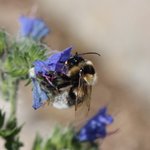
My first tweet & thought it must be a shot of Bombus muscorum as one of my favorite species. This time visiting Echium vulgare. #bumblebee

Hanno's bees retweeted

A queen of Bombus argillaceus was randomly spotted this spring south-west of Munich. So the species must have finally found its way through the Alps, maybe originating from the Innsbruck population seen here: inaturalist.org/observations…
Hanno's bees retweeted
Bombus argillaceus new in Germany. @PaulWilliamsNHM
sz.de/lux.SiBR6x6pH6q31pk3m1…

Hanno's bees retweeted
Hee. Honey bees literally stealing pollen off (the scopa of) solitary bees. Link to PDF with photos. zobodat.at/pdf/Biodiversitae…
Hanno's bees retweeted

@PaulWilliamsNHM @wurflenii @BumblebeeTrust @olds_liam @StevenFalk1 Bombus monticola queen with white tip to the abdomen. Is this unusual as I have never seen it before.East Lancs. April 20th 2023.


Hanno's bees retweeted
Morphological specialisation for primary nectar robbing in a pollen specialist mining bee (Hymenoptera, Andrenidae) jhr.pensoft.net/article/9826…
Hanno's bees retweeted

Here are some pics of the other species Lawrence @BuzzingWales and I recorded today. Shrill carder (B. sylvarum), Brown banded (B. humilis tristis colour form), Great yellow (B. distinguendus) & Confusing bumblebee (B. confusus). All pics taken by Lawrence. @BumblebeeTrust


Hanno's bees retweeted

We spent today in vast flower rich hay meadows in the Czech republic!
We found B. distinguendus (Great yellow) and more B. sylvarum (Shrill carder) than we could count. And B. humilis (Brown banded) in two colour forms not found in the UK!
@nikkigammans @BumblebeeTrust


Hanno's bees retweeted

Bumblebee heaven: Swedish clover ley fields with 'forgotten' grassy and shrubby corners, edges, ditches and rocky patches for nesting.
Common species in such fields include Bombus subterraneus, B soroeensis, B hortorum and B sylvarum.
#biodiversity


Hanno's bees retweeted
August is male bumblebee time! Lots of males hanging around, patrolling and scent-marking.
This is a male Bombus subterraneus. He has spent the day actively searching for nest holes, expecting freshly emerged queens, and is now refuelling on his favourite flower.
#biodiversity


Hanno's bees retweeted

1/5 new paper: BUMBLEBEE BIOGEOGRAPHY (map of species richness) conserves deep historical patterns precisely because bbs are poor at dispersing & establishing over seas/deserts, so species don’t occur everywhere they could - but seas/deserts come & go
https://xitter.gq/t.co/nKAE87HNVw

Hanno's bees retweeted
Spot the differences! On the left a queen Bombus lucorum, and on the right its Müllerian mimic Bombus soroeensis.
Both enjoying the local goat willow.
#biodiversity


Hanno's bees retweeted
The dark forms of Bombus ruderarius and Bombus sylvarum are very similar, and often fly together. Luckily, sylvarum buzzes notably higher (about a third) which helps with ID!
On the left B ruderarius, on the right B sylvarum. Note subtle difference in coat fluffiness.
#bees


Hanno's bees retweeted
A Skåne specialty: Anthophora plagiata (🇬🇧Chimney Flower Bee, 🇸🇪Humlepälsbi, 🇳🇱Schoorsteensachem).
Quite common in Skillinge, where they nest in old brick walls. But they like nest boxes more.
The, let's say, chimney-shaped nest entrances are something to behold!
#biodiversity


Hanno's bees retweeted
A bee with a real 'last chance to see' vibe: Osmia maritima (🇸🇪Havsmurarbi, 🇳🇱Waddenmetselbij). It used to occur in coastal sand dunes along the North and Baltic seas, but populations are disappearing, and there might be only a few hundred females left in Europe...
#biodiversity


Hanno's bees retweeted

♀️ Golden-fringed Mason Bee (Osmia aurulenta) using leaf mastic (chewed-up plant material) to seal her nest within an old shell of the Garden Snail (Cornu aspersum). Seen on the Llyn Peninsular this week - fascinating to watch! #insectweek #bees


Hanno's bees retweeted
I almost couldn't believe it, my first ever queen Bombus soroeensis! Over a decade after seeing males and workers. Very elusive. But so relieved I instantly recognized her as different.

Hanno's bees retweeted
There must be at least four wurflenii workers on the meadow right now. Haven't had this many in seven years or so. 😀 One has found the Vicia patch and is about to do some damage.

Hanno's bees retweeted

2. Queen bumblebees were the most conspicuous insects, and the majority were Moss Carders Bombus muscorum, a stunning northern form called 'agricolae' that is cream and red with a black belly (1-3). Looks very different to the mainland form (4).


Hanno's bees retweeted
BUMBLEBEE BIOGEOGRAPHY - CHANGING CORRIDORS THROUGH DEEP TIME
- how and when did bumblebees reach South America? paper now in press with Systematics & Biodiversity, with talk online at youtube.com/watch?v=67_D_Y0b…

Hanno's bees retweeted
Spent a wonderful afternoon bee recording at @RSPBNewport yesterday. As per usual, Shrill Carder Bee (Bombus sylvarum) and Brown-banded Carder Bee (Bombus humilis) were everywhere, seeing both species within the first minute of arrival. But there were other nice bees too 🔽

