

Testing Twitter
Joined June 2010
- Tweets4.6K
- Following160
- Followers134
- Likes8.1K





540flair.loopring.eth retweeted

BlueBird 11. Fully deployed.
All 13 satellites - 20,000 sq ft of phased arrays in orbit - performing as planned.
American innovation built for space based cellular broadband, resilience, and security. 🇺🇸🌎📶📱

540flair.loopring.eth retweeted
Another convoy is on the move.
BlueBirds 14, 15, and 16 have left our Texas facility and are on the road to Cape Canaveral.
Next stop: orbit. 🚀🚀🚀🚀🚀🚀🚀🚀🚀🚀🚀🚀🚀🚀🚀🚀
The largest commercial communications arrays ever deployed in low Earth orbit. A scalable platform to deliver space-based cellular broadband connectivity directly to standard phones, support secure government applications, and deliver a new third layer of connectivity.
In Midland, Texas, production continues to advance through BlueBird 50, with more than 20 spacecraft structures now being integrated as part of our assembly process.
One constellation. Connectivity. Resilience. Security. Built in Texas. 🇺🇸🌎📶📱
#ASTSpaceMobile #Broadband #ConnectingtheUnconnected #BlueBirds
540flair.loopring.eth retweeted
AST SpaceMobile Accelerates Presence Across Europe with Leading Mobile Network Operators
businesswire.com/news/home/2…

540flair.loopring.eth retweeted
AST SpaceMobile Announces Successful Orbital Launch of BlueBirds 11, 12, and 13
businesswire.com/news/home/2…

540flair.loopring.eth retweeted
Successful launch… again!🚀🚀🚀🚀🚀🚀🚀🚀🚀🚀 🚀🚀 🚀
Our DC team in full comms with BlueBirds 11, 12, and 13 within minutes, and just confirmed full Nominal Operations.
BlueBirds 14, 15, and 16 to follow soon after, with production underway in Texas through spacecraft 42.
We now have ~20,000 sq ft of combined aperture hardware in Space! Bigger is better and we have the biggest!!!
Beta service around the corner! 🤠 🇺🇸🌎📶📱

540flair.loopring.eth retweeted
Built Differently.
Engineering at scale unfolded in orbit.
This is cellular broadband from space.
BlueBird 10 has successfully deployed in low Earth orbit. Adding another of the world's largest communications array - the size of a tennis court - to our growing constellation.
BlueBirds 8 and 9 are next.
Engineered for broadband connectivity to everyday smartphones. No special hardware. No modifications. Cellular broadband from space. 🌎📶📱🇺🇸
#ASTSpaceMobile #Broadband #ConnectingtheUnconnected #BlueBirds


540flair.loopring.eth retweeted
BlueBird 11 at the Cape. BlueBirds 12 and 13 on the road from Midland to Florida.
Next: orbital launch imminent . 🚀🚀🚀🚀🚀🚀🚀🚀🚀🚀🚀🚀🚀
#ASTSpaceMobile #Broadband #ConnectingTheUnconnected #BlueBirds


540flair.loopring.eth retweeted
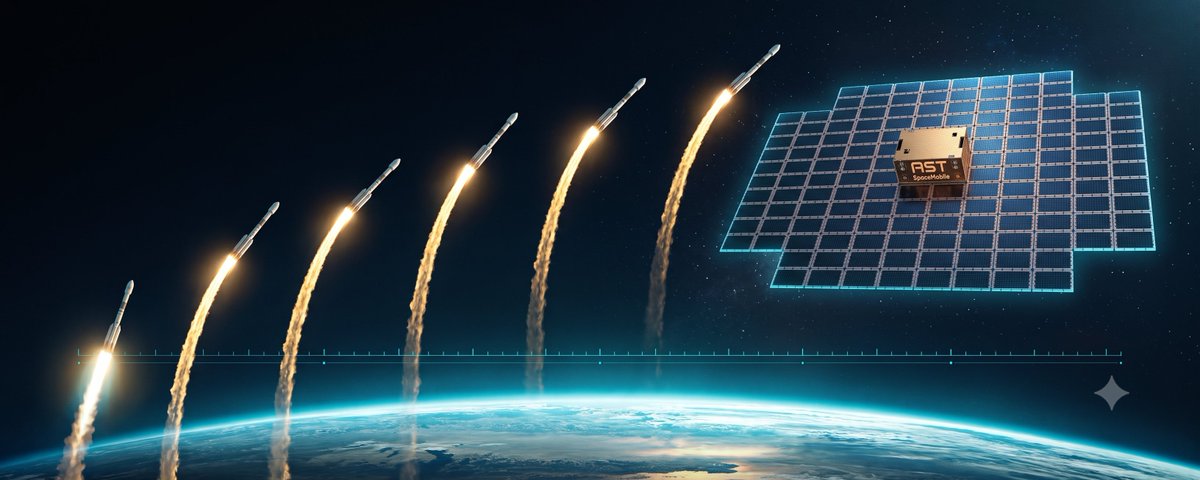
Execution in Motion
BlueBird 11 is on its way from Midland to Cape Canaveral ahead of next month's orbital launch.
BlueBirds 12 and 13 will follow soon. 🚀🚀🚀🚀🚀🚀🚀🚀🚀🚀🚀🚀🚀
Production continues through BlueBird 38 in Texas.
Build. Ship. Launch. Repeat.
Execution at scale. 🌎📶📱🇺🇲
#ASTSpaceMobile #Broadband #ConnectingtheUnconnected #BlueBirds

540flair.loopring.eth retweeted
250 Years. One Relentless Spirit of Innovation
Now extending it beyond Earth
For two and a half centuries, America has been a place where bold ideas take flight.
We are proud to continue the tradition - building what has never been built before: the world’s first space-based cellular broadband network to connect directly to everyday smartphones.
Together, we are working to build a more connected America, and a more connected world. 🌎📶📱🇺🇲
Built in Texas. Broadband from space. A market we invented.
#FourthOfJuly #America250 #MadeInUSA #ASTSpaceMobile #ConnectingTheUnconnected

540flair.loopring.eth retweeted
Vodafone Ireland and the Irish Government test satellite technology to keep emergency services connected
vodafone.com/news/newsroom/t…

540flair.loopring.eth retweeted

$ASTS
The $2.9B Spectrum Shift: T-Mobile, Grain, and AST SpaceMobile.
Backstory: T-Mobile is selling its 800 MHz low-band spectrum to private equity firm Grain Management for $2.9 billion. Announced in early 2025, the close has dragged on for over a year due to FCC reviews & Senate pushback over Grain requesting a 12-year deployment extension. It is now expected to close in mid-2026.
Problem: The FCC enforces strict "use-it-or-lose-it" rules. Building cell towers to protect the licenses is slow & expensive for Grain, triggering the regulatory delay.
Solution: Grain petitioned the FCC to deploy this spectrum via satellite Direct-to-Device (D2D) networks. AST SpaceMobile backed the request to help bypass ground build-out hurdles.
Once the deal closes, Grain is expected to lease the spectrum to ASTS:
Grain satisfies FCC population coverage rules instantly from space.
ASTS combines with AT&T & Verizon assets to create a 7MHz x 7MHz low-band superhighway, boosting network capacity.
540flair.loopring.eth retweeted

¿Cómo funciona Vodafone SAT?
La tecnología direct-to-device permite que un smartphone convencional se conecte directamente a satélites cuando no existe cobertura terrestre. El objetivo es extender la conectividad a lugares y situaciones en los que la red no está disponible, desde zonas rurales y entornos marítimos hasta emergencias, transporte, industria, agricultura o defensa.
🔺 Sin antenas externas.
🔺 Sin dispositivos especiales.
🔺 Sin una tarjeta SIM adicional.
Vodafone SAT. Del satélite a tu móvil 🛰️
540flair.loopring.eth retweeted
A milestone worth lighting up New York City.🚀🚀🚀🚀🚀🚀🚀🚀🚀🚀
BlueBirds 8, 9, and 10, the largest commercial communications arrays ever in LEO, are now successfully orbiting Earth.
#ASTSpaceMobile #ConnectingTheUnconnected #Nasdaq

540flair.loopring.eth retweeted
AST SpaceMobile Announces Successful Orbital Launch of BlueBirds 8, 9, and 10
businesswire.com/news/home/2…

540flair.loopring.eth retweeted

Watch Falcon 9 launch the @AST_SpaceMobile BlueBird 8-10 mission to orbit xitter.gq/i/broadcasts/1XxyggrrX…

540flair.loopring.eth retweeted
T-Minus: BlueBirds 8, 9, and 10 are Go for Launch aboard Falcon 9.
Launch window opens June 17 at 2:39 a.m. EDT. 🚀🚀🚀🚀🚀🚀🚀🚀🚀🚀
Getting closer to connecting the unconnected and under-connected worldwide. 🌎📶📱
#ASTSpaceMobile #Broadband #ConnectingtheUnconnected #BlueBirds
Watch live: youtube.com/live/zjQieDzQTGo

540flair.loopring.eth retweeted
Encapsulation complete.
BlueBirds 8, 9, and 10 are now secured inside Falcon 9's fairing ahead of launch.
A stacked configuration powered by advanced carbon fiber structures, engineered to withstand ascent forces comparable to carrying a fully loaded space shuttle orbiter during launch. 💪
Next stop: launch. 🚀🚀🚀🚀🚀🚀🚀🚀🚀🚀
Built in Texas. Broadband from space. Designed to connect directly to everyday smartphones. 🌎📶📱
#ASTSpaceMobile #Broadband #ConnectingtheUnconnected #BlueBirds


540flair.loopring.eth retweeted

$ASTS After reading this commentary from T-Mobile CFO, I asked Grok how @AST_SpaceMobile sat solution addresses the issues raised regarding Starlink tech and this was the response:
How AST SpaceMobile's satellites address the issuesAST SpaceMobile builds a space-based cellular broadband network that connects directly to standard, unmodified smartphones (no special hardware, apps, or satellite phones needed). It partners with mobile network operators (MNOs) like AT&T, Verizon, Vodafone, and others to use their licensed spectrum and integrate seamlessly with terrestrial networks.
ast-science.com +1
Here’s how their BlueBird satellites (and the upcoming larger Block 2 versions) directly counter the CFO’s physics-based objections:Overcoming signal power and penetration (the "path loss" and indoor/car problem):
BlueBird satellites deploy the largest commercial phased-array antennas ever flown in LEO—~693 sq ft for the first five Block 1 satellites already in orbit, scaling to ~2,400 sq ft (3x larger) for Block 2 with 10x the data capacity. These massive, electronically steerable arrays provide enormous antenna gain and highly focused beams, dramatically improving the link budget (effective signal strength delivered to the phone) despite orbital distance.
ast-science.com +1
Critically, they use premium low-band and mid-band spectrum (e.g., AT&T/Verizon’s 850 MHz low-band in the U.S., plus their own global holdings). Low-band frequencies propagate farther and penetrate buildings, glass, vehicles, and obstacles far better than higher-frequency bands. This is the exact counter to the "not enough signal to overcome roofs/glass/modern vehicles" limitation.
theregister.com +1
Early tests with their BlueWalker 3 prototype and Block 1 BlueBirds already demonstrated 4G/5G voice calls, texts, video calls, and data speeds (10–21+ Mbps) to unmodified phones—real-world proof of viable indoor/outdoor performance in targeted areas.
payloadspace.com
Solving capacity and beam-size constraints:
The huge phased arrays enable narrow, high-intensity beams (not Manhattan-sized footprints serving only ~10 users). Larger antennas create tighter beams with higher power density per user area, supporting far more concurrent connections and true broadband (voice + data + video streaming) at peak speeds up to 120 Mbps per coverage cell. Each BlueBird has ~100x the bandwidth/capacity of a typical Starlink D2C satellite.
satnews.com +1
Block 2 satellites add even more processing power and beamforming flexibility, allowing millions of daily connections while avoiding interference with ground networks. The design treats satellites like "cell towers in space" rather than retrofitting broadband satellites for limited D2C use.
youtube.com
Overall system design advantages vs. the critiqued approach:
AST’s satellites orbit in LEO (similar altitudes to Starlink) but are purpose-built and far more capable per satellite. The constellation plan calls for ~168 satellites for global coverage (far fewer than Starlink’s thousands for D2C), because each one carries vastly more power, spectrum access, and antenna area. This avoids the "catch-22" of needing endless small satellites while still delivering reliable broadband where terrestrial coverage is uneconomical.
crossroadscap.io
It’s explicitly a complementary extension of MNO networks (handing off seamlessly when you leave tower range), aligning with the CFO’s view of the role satellites should play—but with technology that pushes the performance envelope well beyond basic outdoor/texting service.
In summary, the CFO’s critique applies to certain D2C implementations (like the one T-Mobile has partnered on), but AST SpaceMobile’s BlueBird architecture—massive phased arrays + low-band spectrum + advanced beamforming—is specifically designed to deliver the strong, penetrating, high-capacity signals needed for real mobile broadband. They’ve already proven key milestones (voice/video/data to unmodified phones) and are scaling the constellation now (5 Block 1 satellites in orbit, more launches planned throughout 2025–2026)


$ASTS: The CFO of T-Mobile was at Evercore today and was asked about satellite service as a potential terrestrial competitor. His response was very defensive and clearly directed towards Starlink (350km orbit, thousands of satellites, V2, etc).
I've never seen T-Mobile respond like this about Starlink. In prior periods, they would have said they're happy with their partnership and that Starlink Mobile is a complementary service. Instead Peter goes into a detailed dressing down of Starlink.
As we've known, not all is well in the Magenta paradise.
Kutgun Maral: Analyst Evercore ISI
Understood. And maybe switching gears a little bit, but still talking about competition. You can fill-in the gaps over here, but I want to talk about satellite. And, there are certain satellite operators that sound pretty confident in their ability to compete with broadband against -- not with broadband, but against terrestrial providers in direct-to-sell. Can you help us understand whether there's a real business case for these satellite operators and especially as they kind of move towards their next-gen satellite launches and/or close on some of their spectrum deals?
Peter Osvaldik: T-Mobile CFO
Yeah. Well, the short answer is No. There's no effective way for them to compete with a terrestrial network and they're not limited by money or number of satellites. They're limited by the laws of physics. And here, let me get into that a little bit more. Two fundamental things that are the problem.
One of those being just signal power. So when you're thinking about a terrestrial network, you've got a site that's probably I'm going to go kilometers now for the second, like a kilometer away from you, obviously has a lot of spectrum and is putting out a lot of power.
Compare that to, for example, a satellite, remember, these are different constellations in the broadband satellites, a satellite that's 350 kilometers up, which is probably as low as you can go. You go any lower, you're going to have a lot of propellant needed to keep the things stabilized, which means you get in a catch-22 cycle of then larger power arrays, which mean more atmospheric drag, which just so 350 kilometers is probably the lowest that you can go.
So now you're trying to send a spectrum signal think about this is like a garden hose, water through a pipe. And you're trying to shoot at 350 kilometers away to a mobile device. It's a lot different than the broadband product, which is shooting to an outdoor large antenna. You're trying to not only shoot a small mobile device, but it's mobile.
And the problem is the basic physics of that water through the -- through the pipe and through the outlet is what we call OpenSignal loss. And this is just the amount of signal loss that you get with no obstruction is not just linear in terms of the distance, it's actually an inverse square.
And you cannot put enough power. You can put 100,000 satellites up with all the spectrum of all three MNO operators and you will never be able to project enough power to overcome that OpenSignal loss of 350 kilometers. What that practically means is by the time you get down to earth where the mobile phones are, you don't have enough signal to overcome things like roofs, glass, modern vehicles. And so you cannot provide a reliable experience to customers in 70% of the time where they spend is in buildings or in cars, modern vehicles.
So you can't service a customer in 70% of the time that they're spending on a mobile device. And again, you can put up all the satellites you want to, the fundamental laws of physics will not allow you to generate a beam signal strong enough to actually overcome obstacles. So that's the first and most basic reason why it cannot be a competitor to terrestrial networks.
The second is capacity. And there's a theoretical limit also to the beam size. When we do estimates around one of the operators out there who is going to have a of V2, a D2C or D2D, however you want to think about it satellite, that beam size is significant. For example, if you think about Manhattan, New York, where you're in New York a lot, that beam size is roughly multiple six to 15 times depending on how you define Manhattan, but multiples the size of Manhattan.
And that V2 service is going to be able to provide a decent service, outdoor service, see the previous conversation I had to about 10 concurrent users. So think about that. A beam size larger than the size of Manhattan that can reliably provide service to 10 concurrent outdoor users. It's just not an experience that customers demand.
And so for those two fundamental reasons, it's just not an over-comeable situation. Now that doesn't mean it doesn't have a place. Like we've long said, it has a great complementary place in outdoor areas, particularly areas like national parks where the economics just don't make sense to build a terrestrial network, but it can be a great added complementary benefit for customers and that's where we see it play-out. That's where we see the hotspots are. If I look at the last week of data, D2D traffic on our network was count the zeros, 0.002% of traffic. And that's because it -- for the first two reasons, I said, it's just not where 70% of people are, but it does make sense in that place where terrestrial networks just don't make feasible economic sense.
And that was the whole purpose of the JV is how do we make this a win-win for satellite operators, for consumers and make it economically viable for the carriers as well. So how do we stimulate competition in this space, give consumers the coverage in those few limited outdoor areas like national parks where, by the way, by pulling our spectrum together, we can take care of the hotspot needs of a Yosemite or a Yellowstone National Park and have it be a great complementary service. That was the whole thought process behind this.
But in terms of a competitor to a mobile network operator, it's just not physically possible. And this is also the reason why we said, well, well, you've given them an MVNO, said, well, it doesn't differentiate you, like there's no differentiation. So no, we're not going to give them an MVNO. It doesn't make sense for us to give them an MVNO The answer is no.
