

content creator
Joined August 2022
- Tweets3.4K
- Following1.1K
- Followers1.2K
- Likes16.3K







a robot doesn't care if the lights go off. it cares if the camera moved 1 centimeter.
that's the most counterintuitive thing i've read this month. it comes from @prismaxai's prep for iros.
before the conference they ran over 10,000 simulated experiments. a simulated experiment is the robot practicing in a video game version of the room - thousands of times, changing one thing at a time, to see what actually breaks it.
what they changed:
● lighting
● backgrounds
● where the camera sits
● how the arm is mounted
● how the model was trained
the result surprised me. lighting and background - the stuff you'd expect to confuse a robot - mattered much less than people assume once the whole model was trained properly. mounting height did not. a 1 cm error in how high the setup sits cut the success rate by roughly 70%.
here's an analogy. you practice darts for a month, always from the same line. then someone moves the line one step back without telling you. your arm still works. your eyes still work. but every throw you practiced is calibrated for the wrong distance.
that's what the robot experiences. it learned the world from one exact viewpoint. move the viewpoint and everything it learned shifts with it.
then they tested it for real. a model trained on data from a clean white-background work cell was deployed zero-shot - with no extra training - on a different rig, in a convention center it had never seen, with people walking behind it all day. it picked fruit into containers.
what i find interesting is that the fix isn't more intelligence. their list of lessons is almost boring:
● train the whole model, not just the part that outputs movements
● use relative actions - "move 2 cm left" instead of "go to this exact point" - so small rig differences don't break things
● get the mounting right
● cut latency
this is what real robotics looks like up close. not a breakthrough. a ruler.
🤝 Paid partnership

1
20
211
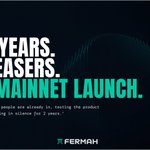
vanishree rao posted something in september that i keep thinking about.
"90 people are already in and crazily testing every day the product we have been building in silence for 2 years."
two years. no teasers, no roadmap threads, no "big things coming" posts.
the product is ultramint. it's now in mainnet beta on base, backed by a16z csx.
here's what makes the silence interesting.
fermah already had two live products. froben settles zk proofs for zksync era and abstract chain - 2.8m+ of them at 99.7% reliability. flashcast resolved over a million prediction markets in six weeks.
both of those shipped publicly. both got attention. and the whole time, a third thing was being built that nobody was talking about.
that's an unusual choice in crypto, where most teams announce a product the moment the idea exists. building quietly for two years means you're either very confident or very patient. usually both.
what they built: a prediction market where anyone mints a market and earns a cut of every trade on it. creators bring the volume, creators keep the fees. no house taking the rake.
access is through joinwaitlist. xyz.
referrals move you up the queue, promo codes move you up. they didn't open the doors - they built a door.
i'll be honest: i haven't used it yet, i'm in the queue like everyone else. so this is from the outside.
but two years of silence followed by a mainnet launch is a different signal than a whitepaper and a countdown timer.
@fermah_xyz @7wealthh @vanishree_rao
🤝 Paid partnership

2
24
260
Hawk retweeted

just minted my first market on @ultramint_xyz
will $HYPE outperform $BTC over the next 7 days?
took me like a minute to set up. you mint the market and earn a cut of it.
yes or no?


prediction markets usually make you trade someone else's question.
@ultramint_xyz lets creators mint the market themselves and keep the cut, which is why i'm looking at it.
– built by @fermah_xyz, backed by @a16zfrontier CSX and @lemniscap
– creators mint the markets and keep the cut
– new Mint Points system for anyone who creates and trades
still waitlist/invite for now.
join here to start creating a market and trade w it: ultramint.xyz/?invite=kaff#k…

a simulation can look photorealistic and still be useless for training a robot.
this confused me for a long time, so here is the clean version.
when you look at a game, you judge the graphics. light, shadows, reflections, texture detail. that is rendering - the job of producing a convincing image for a human eye.
a robot does not care about the image being beautiful. it cares about whether the physics lies.
three things decide that, and none of them are visual.
● friction - does the object slide out of the gripper at the same angle it would in reality, or does the sim hold it like glue?
● inertia - when the arm swings a weight, does the weight pull back with the right force, or does it behave like it is made of foam?
● deformation - does a towel crumple, a cable bend and a sponge squash the way real ones do, or do they move like rigid plastic?
a model trained in a sim where friction is wrong learns a grip that drops things in the real world. the picture was perfect. the lesson was false.
this is the sim-to-real gap, and it is not a graphics problem. you can close it with a flat grey render that gets the forces right, and you can completely fail with a cinematic render that gets them wrong.
the practical consequence is uncomfortable. you cannot verify a simulation by looking at it. a human looking at a render has no way to tell whether the friction coefficient is correct. the only check is to run the same task on real hardware and compare what happened.
which is exactly why real-world recorded episodes stay valuable even in a world full of simulators. the sim is where you get volume. the real data is the only thing that tells you the sim is lying.
beauty is not fidelity. i think that one sentence saves people a lot of wasted compute.
@prismaxai
🤝 Paid partnership

1
16
187
top 5 on @kash_bot. finally.
eighteen days ago i was ninth. today the all time board has me fifth, on $9.5K of volume and +$830.83 in winnings.
the part i keep looking at is who is above me. three of the four traded two to five times my volume to get there. i am in the top five on a fraction of what they put through.
and the other number: $9.5K is $500 short of the $10K flag i set for myself back in september, when the volume was $1,749. that one lands this week.
this is not the finish line. four names left, and none of them are standing still either.
see you higher up the board.
🤝 Paid partnership

6
15
90
most crypto projects give you one role: buy the token and wait.
prismax has two, and neither of them is waiting.
role one - you need the data. you are training a model that has to move physical objects, and you have no way to get thousands of hours of real manipulation footage. you buy access to the data bank. plans differ by how much of the library you get and how many robot arm types are covered - 4 arms on the entry tier, 8 in the middle, 12+ on enterprise, with up to 5,000 hours of custom capture per month at the top.
role two - you make the data. you log into the operator portal, you remotely drive a robot arm through real tasks, and you get paid per episode you deliver. $1M+ has gone out to contributors so far. no hardware of your own needed, because the robot is somewhere else and you are driving it over the internet.
that is the whole structure. one side needs hours of recorded physical work. the other side has hands and time.
● demand side: labs and companies training vision-language-action models
● supply side: people anywhere with a connection and a few hours
● the protocol sits in the middle and settles between them
what i like about this is that neither role is speculative. the buyer gets a dataset they could not assemble themselves. the operator gets paid for work performed. the token is the settlement layer between two things that already have value without it.
i will say the honest part too. operator earnings depend on how much demand exists at any given moment, and demand for robotics data is early. this is not passive income. it is piece work, priced by a market that is still forming.
but the shape is right. in text ai, the people who produced the training data got nothing - their blogs were scraped. here the capture is deliberate and the payment happens at capture time. that is a meaningfully different deal.
@prismaxai
🤝 Paid partnership

3
29
276
Hawk retweeted

Every community grows stronger when people bring their own energy and stay involved 💙
Today, my appreciation goes to @hawk_tyt for being one of the members making our @PrismaXai Ukrainian community more active and connected.
And congratulations on the Navigational role!

biggest win i have had on @kash_bot , and it did not come from picking a side.
@MarioNawfal put up a market on whether Abdul El-Sayed would beat Mike Rogers in Michigan's 2026 U.S. Senate election. $13.3K of volume, 564 predictions.
a market that size does not sit still. the price kept moving the whole way through. up, back down, up again.
so i traded it instead of sitting on it. in and out of the moves, not one position held to the end.
finished as the top trader on the market with +$103.71. my old personal best was $39.33, so that is 2.6x.
this is the part people miss about @kash_bot. the AMM always has a price on both sides, so you can leave whenever you want. the market stops being a bet slip and becomes something you can actually trade.
thanks for the market Mario. plenty of movement in that one.
🤝 Paid partnership

i went looking at what tasks are actually in a robotics dataset. not the marketing version. the file names.
pipe-tighten. medicine-sort. clothes-fold. towel-hang. cable-route. drawer-open.
read that list again and notice what is not in it. no "navigate complex environment." no "demonstrate general intelligence." no demos. just chores.
this is the thing that reframed physical ai for me.
every one of those names is a job somebody is currently paid to do. tightening a fitting on a pipe. sorting pills into the right compartments. folding laundry in a hotel. routing a cable through a panel without pinching it. these are not toy problems picked to look impressive in a video. they are the actual contents of low-margin labour.
and each one is harder than it sounds the moment you try to describe it precisely.
● pipe-tighten: how much torque is enough? you cannot see torque. you feel it stop
● medicine-sort: pills look nearly identical and the cost of one mistake is enormous
● clothes-fold: cloth has no fixed shape, so the same shirt is a different problem every time
● cable-route: the thing you are holding bends while you hold it
a human learns all of these in minutes by touching them. a model learns them from thousands of recorded attempts, because nobody has figured out how to write them down.
my honest read: the unglamorous names are the strongest signal in the whole dataset. a lab chasing headlines records backflips. a company building a product records pipe-tighten six thousand times. one of those gets you a viral clip. the other gets you a robot that pays for itself in a warehouse.
i would rather look at the boring file names than the demo reel. the file names tell you what somebody is actually planning to sell.
@prismaxai
🤝 Paid partnership

1
20
349


halloween rule and ethereum rule turn out to be the same rule.
whoever gets to the door first takes the candy. everyone else gets the empty bowl and a sad look.
too slow is too slow.
@get_optimum #BoostedMeme
@get_optimum
@blockchainjeff
@cryptooflashh
@kentlinyy
@ChandlerOtterbe
@MurielMedard
@samurai_itan
🤝 Paid partnership
two kinds of robot data. people keep arguing about which one is better. that is the wrong question.
they do different jobs, and you need both. here is the simple version.
egocentric data - a person records themselves doing a task in first person. camera on the head, hands in frame. cheap, fast, anyone can do it.
teleoperation data - a person remotely drives an actual robot arm through the task. expensive, slow, needs hardware and training.
now the part that makes it click. think about how a language model gets built.
● first, pretraining: you feed it enormous amounts of rough text so it learns how language works in general
● then, post-training: you feed it a small amount of carefully made examples so it learns to behave precisely
robot data maps onto this almost exactly.
egocentric is the pretraining fuel. you need millions of hours of "this is how physical tasks generally go" and you need it cheap. volume matters more than precision here, because the model is learning the shape of the world, not exact motor commands.
teleoperation is the post-training fuel. when the robot drives, every joint angle is recorded in the robot's own body. there is no guessing how a human wrist translates to a two-finger gripper, because a gripper actually did it. the data is exact. it is also expensive, so you use it where precision is the whole point.
so the stack is: learn the world from humans, learn the body from robots.
what i find genuinely interesting is that this is a cost argument, not a philosophy argument. if teleoperation were free, nobody would bother with egocentric capture. it is not free - every hour needs hardware, a trained operator, and a physical setup. so you spend cheap hours on scale and expensive hours on precision.
anyone who tells you one of these replaces the other is selling you something. the models being trained right now eat both.
@prismaxai
🤝 Paid partnership

8
40
384
1.4M Users, Same $5B. Read That Again.
in march, at the Series A, @KASTxyz reported more than one million users and about $5 billion in annualised transaction volume.
in october the user count is 1.4 million. the volume figure is still around $5 billion.
users up roughly 40%. volume flat. normally that reads as a problem - growth without revenue behind it.
i think it is the opposite, and it is the most interesting number the company has published this year.
➤ flat volume with more users means average spend per user went down
➤ spend per user goes down when the new arrivals are smaller than the old ones
➤ smaller users are normal users
the first cohort of any crypto card is traders and whales moving large amounts. big volume, few people. the second cohort is someone paying for groceries and a phone plan. small amounts, lots of people.
a product that only ever grows volume is still serving the first group. a product where the user count outruns volume is reaching the second.
that is the harder number to get, and the one that decides whether @KASTxyz ends up a niche tool for crypto people or a bank replacement for everyone else.
@KASTxyz @Coleta_Cripto
🤝 Paid partnership

8
40
347
kash cabal unlocked. that is all three rungs.
voice, then guide, then cabal. i got the first one in a weekly update back in september, next to four other names.
the thing that makes it mean something: the roles are reviewed regularly. you do not earn them once, you hold them. stop showing up and somebody who did show up takes your place.
what it took was boring and daily. discord, content, feedback on the app, bugs reported honestly, markets created, calls posted with the price attached and the losing ones left up.
i did not grind for a role on @kash_bot. i just live in this project.
🤝 Paid partnership

3
27
198
999 cards. each one is a real ethereum slot.
@get_optimum made turbocards to mark their mainnet launch, and they made them the smart way. instead of artwork about speed, they took actual blocks they accelerated in the first days of running, and turned each one into a card.
what is on it:
● the slot number - a specific moment in ethereum history
● latency - how many milliseconds the block took to arrive
● speed boost - 1.7x, 3.3x, 4.8x. depends on the slot
● bid uplift - what that speed was worth in money
the frame is not just decoration either. copper, silver, black iron, gold. inside sits a cube glowing its own color.
the thing i like is that these numbers cannot be faked or redrawn. the block either arrived in 99ms or it did not. the card just records what happened.
soulbound, one per wallet, free to mint apart from gas. codes drop in twitter and discord.
i have not caught mine yet. but i will keep hunting, because i want a card with a decent speed boost, not just any card.
@get_optimum @blockchainjeff
@cryptooflashh @kentlinyy @ChandlerOtterbe @MurielMedard @samurai_itan
🤝 Paid partnership
a robot can work perfectly and still fail as a product.
here is the math that decides whether anyone buys it, and it has nothing to do with the ai.
imagine you run a warehouse. one task, done by a person, costs you roughly $40,000 a year once you count wages and everything around them. a robot arm plus installation, integration, safety work and the software to run it comes to about $180,000 up front. it also needs maintenance, say $8,000 a year.
so the robot saves you $40,000 a year and costs $8,000 a year to keep. net saving: $32,000.
$180,000 divided by $32,000 is about 5.6 years.
now suppose the robot only handles 60% of the task and a person still has to cover the rest. your saving drops to $24,000, your net to $16,000, and your payback stretches past 11 years.
● payback under 2 years: easy yes, the buyer signs
● 2 to 4 years: a real decision, depends on the industry
● over 5 years: almost nobody signs, because the hardware will be outdated first
that last line is the whole problem. a 9-year payback is not a slow win, it is a no. the robot works, the demo is impressive, and the purchase order never arrives.
this is why reliability matters more than capability in this market. going from 60% to 95% task coverage does not make the robot more impressive in a video - the video looked fine already. it moves the payback from 11 years to under 4, which is the difference between a research project and a business.
and that last 35% is exactly what you cannot get from more compute. it comes from edge cases - the cup that was already wet, the box that was stacked crooked, the label facing the wrong way. those have to be recorded, by someone, in reality.
the bottleneck on robot adoption is not intelligence. it is payback period. and the lever on payback period is data.
@prismaxai
🤝 Paid partnership

15
50
384
there's a new button on fermah's site. "build on kernel."
it links to an open form. not a sales contact. not "get in touch." an invitation to build things on their infrastructure.
that's a meaningful change in posture.
up to now, fermah's relationship with the outside world was: we generate proofs, you're a customer. the value flowed one direction. you send a proof request, you get a proof back.
"build on kernel" is different. it's saying the engine is available for things fermah didn't build.
the site lists what that could look like:
● defi automation - strategies that run autonomously on any condition, including off-chain ones
● programmable liquidity - lp positions that adapt to macro events and volatility in real time
● price feed construction - kernel builds a tradeable feed from any verifiable source
● cross-protocol sequencing - one verified condition triggers borrow, swap, stake, settle
none of these are fermah products. they're categories of things someone else could build.
there's also an entry on the list that just says "your app here - any autonomous workflow. if it can be measured, triggered, or sequenced, kernel can run it."
here's why the timing makes sense.
you don't open your infrastructure to outsiders until it's stable enough to survive uses you didn't anticipate. fermah has 2.8m proofs and 1m markets running through the same engine. that's the evidence that it holds.
i'm curious what people build with this. the interesting applications for a general engine are usually the ones the original team never thought of.
@fermah_xyz @7wealthh @vanishree_rao
🤝 Paid partnership

6
30
257
ninth place, and $8.32 from eighth.
that is where the all time board has me on @kash_bot. $577.97 in total winnings. the two people directly above are on $586.29 and $586.46.
eight dollars and change. less than one position on a normal matchday.
the rest of the update: lifetime volume just crossed $5,403, which clears the third of five milestones. it was $1,749 when i started tracking this seven weeks ago.
82 winning positions to get here, and plenty of losing ones still sitting on the profile where anyone can scroll them.
i do not think ninth is the ceiling. i think it is just where the number stopped this week.
🤝 Paid partnership

14
55
345
you do not need a robot to teach a robot.
this is the part of robotics data that sounds wrong when you first hear it, so let me break it down slowly.
egocentric data means first-person recording. a camera on your head or chest, looking at what your hands are doing. you fold a shirt. you sort pills into a box. you wipe a counter. the camera sees exactly what your eyes see, and your hands move in frame.
no robot arm. no lab. no $30,000 hardware. just a person doing an ordinary task with a camera pointed the right way.
why would a model care about human hands when it is going to control a metal gripper?
because the hard part of a task is not the hardware. it is the plan. what order do you do things in. where do you grab the shirt so it does not slip. how do you know the counter is clean. when do you slow down. that knowledge lives in the sequence of what you did, not in the specific fingers you used.
so the model learns the plan from humans, then learns the hardware separately.
● teleoperation data: you drive the actual robot, so the data is in the robot's own body
● egocentric data: you just do the task yourself, and the data is in a human body
the second one is dramatically cheaper and faster to collect. anyone with a camera can contribute. that is the whole point - the bottleneck in physical ai is hours of recorded human work, and egocentric capture removes the hardware from that equation.
i will be honest about where my head is at. for a long time i assumed robot training data had to come from robots. it took me a while to accept that most of what a robot needs to know is just a human skill, and humans are already everywhere.
prismax is opening egocentric collection in waves right now, through a waitlist. the hardware requirement being near zero is exactly why that can scale.
@prismaxai
🤝 Paid partnership

5
38
325
fermah's proof market has a name now. froben.
it used to just be described as "the universal proof market" - a function, not a brand. now it sits alongside flashcast social as a named product with its own page.
small change, but it reveals the shape of the company.
here's what i mean.
when a company has one product, the company name and the product name are the same thing. fermah does proofs. simple.
when a company has an engine that powers multiple products, the naming has to change. otherwise every product gets described as "the fermah thing that does x," and the relationship between them gets muddy.
so now the structure is explicit:
● fermah kernel - the engine underneath everything
● fermah froben - the zk proof market, b2b, live on mainnet
● flashcast social - prediction markets, consumer, live
two products with different names, different audiences, different business models. one engine underneath both.
froben is b2b infrastructure sold to protocols - zksync era and abstract chain are paying customers, 2.8m+ proofs settled at 99.7% reliability.
flashcast is consumer - anyone creates a market in one second, 1m+ resolved in six weeks.
these are genuinely different products. a proof marketplace for rollup teams and a prediction market for people betting on the world cup share almost nothing at the surface. they share the workflow engine underneath.
what this naming signals is a company that expects more products. you don't build a naming structure for two things. you build it for what comes next.
@fermah_xyz @7wealthh @vanishree_rao
🤝 Paid partnership

7
39
373