

Transforming Field Force with AI. Empowering teams with Chatbots, WhatsApp Integration, Route Planning and a lot more #FieldForce #Workforce #Automation
India
Joined March 2015
- Tweets198
- Following4
- Followers97
- Likes37







“Ask Meera. She knows who actually picks up.”
The SOP says to submit a ticket. The work moves because someone remembers the relationship, timing and tone.
Operational knowledge includes human context that no flowchart fully captures.
Who is your team’s “ask them” person?


7
“Where is the original copy?”
It was uploaded yesterday. Still, someone needs the paper.
Process automation should define the source of truth, evidence requirement and retention rule before adding tools.
Which approval still needs both a scan and a physical file?


1
4
“We had six calls with them.”
Good. Are they more likely to buy?
Sales forecasting should distinguish customer engagement from deal progression. Activity shows effort; movement shows whether probability changed.
Which signal makes you revise a forecast?


4
“Please share updates here.”
Six months later, the same update lives in three channels.
Team communication works when each work chat has a clear purpose, an owner and a reason to stay open.
Which group would you archive today?


6
“This used to take one conversation.”
Now it needs a login, a code and fourteen answers. The task is simple. The form has other plans.
Process digitisation should remove work, not just give the old paperwork a password.
Which routine task became longer after it moved online?


2
“Nothing to report.”
That might be the report.
The weekly call stopped. The monthly order never arrived. No complaint, just a broken routine.
Silence matters when it breaks a customer's usual pattern.
Which missing activity would make you pick up the phone?


4
“Hi, gentle reminder.”
Three replies later: “Adding my manager for visibility.”
The task hasn't changed. The audience has.
Email escalation often adds people before clarifying ownership or next steps.
Which sentence tells you a thread has officially escalated?


6
“Lovely to meet you. Could you start from the beginning?”
Eight years as a customer. Back to page one.
Customer history matters only when teams can use it. Purchase records rarely explain unresolved conversations.
What do customers have to explain twice to your team?


3
“The report can wait. This customer can't.”
Sometimes the most useful management insight is knowing what to interrupt.
Operational priorities need an owner and a next action; another chart alone doesn't provide either.
Which customer issue should interrupt your morning?


8
“Noted,” replies the chat. The task still doesn’t move.
Message ambiguity becomes a management problem when acknowledgement is mistaken for commitment. Clear communication distinguishes “seen,” “understood” and “I’ll do it.”
Which reply would save your team the most follow-up?


6
“The dashboard was updated at 10:47 PM.”
Management reporting is only as current as its slowest manual hand-off. Real-time visibility cannot emerge from yesterday’s numbers being consolidated tonight.
Which reporting step creates the biggest delay in your team?


1
9
“Why has this customer suddenly escalated?”
Usually, they haven’t suddenly done anything. The warning signs were already there: slipping promises, longer response times and conversations becoming harder to sustain.
Which signal should reach management before the complaint does?


4
“Has she seen the numbers yet?”
That question reveals more than another review of the deck. Informal communication helps leaders understand what the formal agenda cannot show: readiness, resistance and risk.
What do you need to know about the room before you enter it?


4
“Which app do I open for this?”
“Depends—which department asked?”
Enterprise application sprawl grows one tool at a time. But for frontline employees, eleven sensible systems can mean one fragmented workday.
How many apps does one person on your team use before lunch?


10
“Who knows why this customer has gone quiet?”
“Arjun did.”
Employee turnover becomes a management risk when customer context leaves with the employee. A clean handover needs more than an account list.
What information is most often missing when someone leaves your team?


3
“Just ask Neha. She’ll know.”
Her title doesn’t say “keeper of how things get done,” but everyone knows she is.
The org chart shows reporting lines. The informal network shows where knowledge and influence really sit.
Who is the “Neha” in your organisation?


7
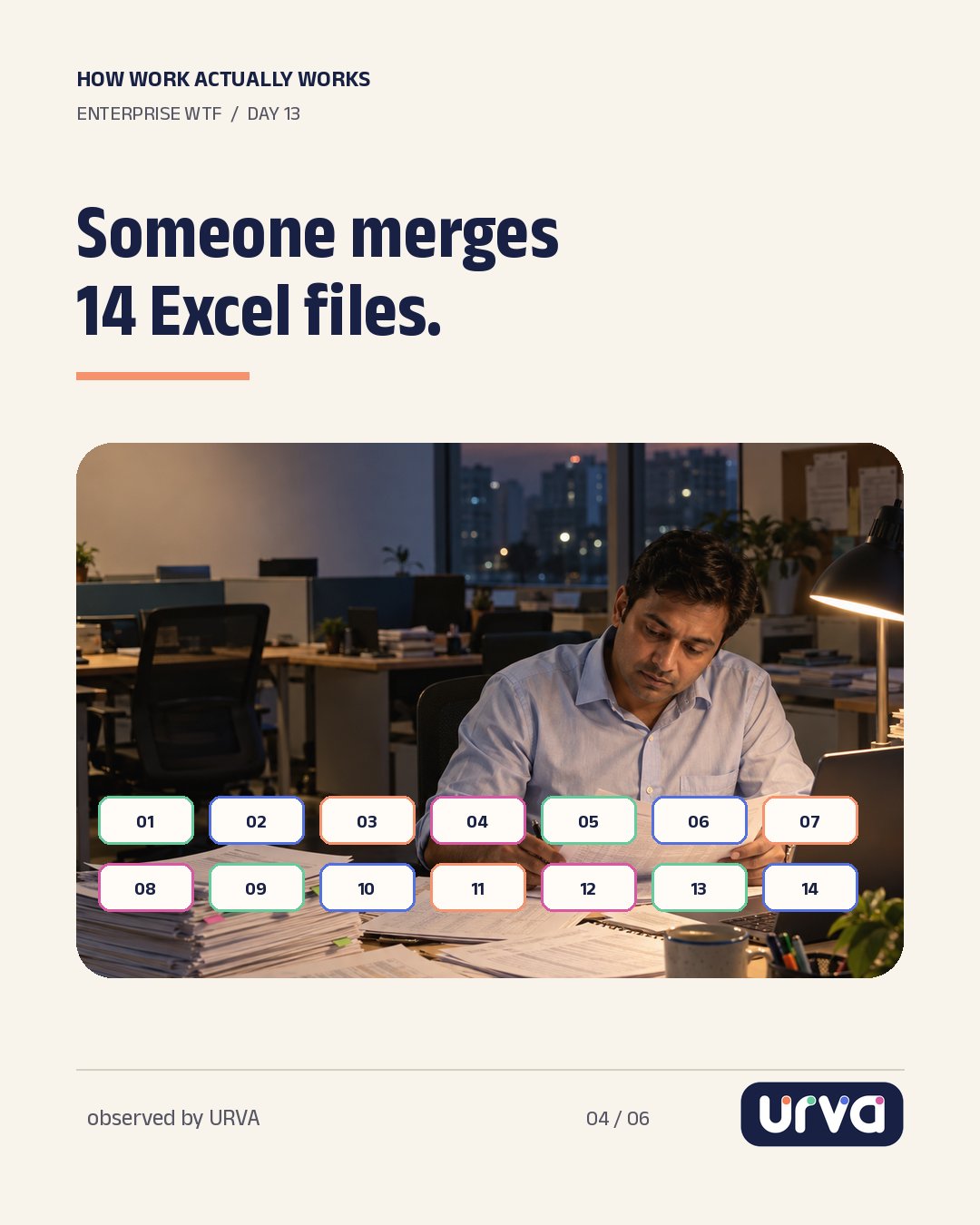
“Which file should I use?”
“FINAL_LATEST_USE_THIS.xlsx.”
Every company buys software to replace Excel. Six months later, someone exports the data, adds four columns, and rebuilds the workflow in a spreadsheet.
Which Excel sheet in your organisation simply refuses to die?


16
“The team is flat out.”
That may be true. It still doesn’t tell a manager whether customer problems are being resolved. Activity metrics show motion; outcome metrics show progress.
Which result tells you more than a long activity report?


6
“Done for the day?”
“Almost. I still have to explain everything I did today.”
The EOD update was meant to create team visibility. Somewhere along the way, status reporting became a second shift.
Which part of your day do you end up reporting twice?


12


