

Deep Intelligence Money https://xitter.cf/t.co/3AdYL9xOpq
Palo Alto
Joined February 2024
- Tweets1.3K
- Following151
- Followers27.3K
- Likes499





Pinned Tweet
🚨 Live: Hetu 3.0 Deep Intelligence Money— a full upgrade for an AI-native abundance economy.
Years of deep tech & research, now an agentic-ready production stack: 3-Money ( $HETU / $USDAI / $FLUX), EVM causal DAG, and verifiable #PoCW/ #PoSA.
Auditable, financeable intelligence — unlocked.
🧵1/6
#DeepIntelligenceMoney #AI #AIagent
Why does a network of GPUs need its own asset at all?
Because the people running inference and the people asking for it don't know each other. Every request has to be priced, paid for and trusted between strangers, in real time.
So the network settles per inference, lets prices move with supply and demand, and asks nodes to stake and build a reputation, so a node that cheats has something to lose.

Most mining proves that energy was spent. We think mining should prove that something useful was served.
On Hetu, the work a GPU gets paid for is inference: a model answering a real request. The compute that serves the request is the compute that earns, whether it sits in a compute center or on a single idle card.
That's why we still call $HETU an AI Bitcoin. Same discipline, different work.
#DeepIntelligenceMoney

HETU is the native asset of the sovereign AI economy.
Sovereign means the intelligence isn't rented from one provider. It runs on a peer-to-peer network of GPUs with no central API to switch off, and requests and model weights stay encrypted end to end.
A native asset is how that network pays for itself. GPUs earn by serving real inference, not by solving puzzles nobody needs.
$HETU

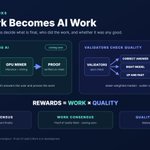
The design: GPU miners prove their work cryptographically. Validators spot-check the output: correct answer, right model, node up and fast.
Scores are combined by stake-weighted median, outliers clipped.
rewards = work × quality


For Hetu, this suggests a useful separation:
PoUW can certify that a defined AI computation was performed.
PoCW could connect that verified computation to causally downstream agent events and attribution.
This is a research direction, not an integration claim.
The question is not only whether compute is useful. Can the system preserve two distinct records:
1. what computation was verified
2. how it contributed to a downstream outcome
PIP-0002: github.com/pearl-research-la…


The proposed division of labor is clear:
PoUW accounts for useful matrix compute.
PoCW preserves causal relationships between events.
Hetu connects execution, attribution and settlement.
One proves work. The other helps explain contribution.
The goal is not to add an “AI” label to a chain.
It is to make compute and contribution legible to the same economic system.
This remains an architecture thesis—not an integration announcement.
Pearl: github.com/pearl-research-la…
Hetu: github.com/hetu-project


The integration thesis is simple:
Hetu workloads create compute demand → verified matrix work contributes to consensus → incentives improve compute economics → more capacity returns to the applications.
This is a research thesis, not an integration announcement.
We still need to test workload provenance, verification overhead, hardware economics and security assumptions. “Useful” must be demonstrated at the system level—not declared in a slogan.
github.com/pearl-research-la…