

Helping agency + coaching owners close 50-100% more on the same ad spend | Let me review your last sales call 👉 https://xitter.gq/t.co/OosFxJOesk
Salt Lake City, Utah
Joined January 2022
- Tweets1.2K
- Following1.1K
- Followers521
- Likes3K







Pinned Tweet
10 movies that will teach you more about sales than any course you can buy (1 hour training):
1. True Grit
2. The Gentlemen
3. 12 Angry Men
4. The Godfather
5. Lincoln
6. Dog Day Afternoon
7. Heat
8. Inside Man
9. Glengarry Glen Ross
10. Djano Unchained
1
2
1,162
Mr. Long Money retweeted
THINGS THAT DESTROY SALES TEAMS:
1. Showing every rep the whole funnel's numbers → they find the one metric that looks good and focus on that.
2. Optimizing the wrong metric, like conversion rate → reps over-vet and disqualify leads to pump it up.
3. A KPI system over-engineered for your team size → the company ends up drowning in information and dies from lack of wisdom.
4. Changing the comp plan constantly → everyone quits.
5. A skinny comp plan → it attracts people who are already starving, and they starve your business.
6. Hiring ahead of growth with no new leads or ad spend behind it → the broken promises burn your reputation.
7. No end-of-day reports → while you coach one rep, another one's calls go south.
8. 100% self-paced training → most reps struggle and fail without talking to other humans every day.
More leads or better closers won't fix a single one of these.
A $10 million construction company told a rep on the call:
"Just send it through, I'll pay now."
Every ROI question the rep asked got waved off with "no, no, it's good, let's go."
So the rep took them at their word and never collected the deposit on the call.
That was a big mistake.
They still haven't paid. Not after the calls, the texts or the emails.
Another prospect told the same rep the exact same thing, and hasn't paid either.
Both of those yeses came too fast.
When a buyer says yes that fast, hit the brakes and make them argue the other side:
"Can you think of any reason that this wouldn't work?"
Then:
"What would your team's concerns be?"
When it sounds too good to be true, it usually is.
THINGS THAT DESTROY SALES TEAMS:
1. Showing every rep the whole funnel's numbers → they find the one metric that looks good and focus on that.
2. Optimizing the wrong metric, like conversion rate → reps over-vet and disqualify leads to pump it up.
3. A KPI system over-engineered for your team size → the company ends up drowning in information and dies from lack of wisdom.
4. Changing the comp plan constantly → everyone quits.
5. A skinny comp plan → it attracts people who are already starving, and they starve your business.
6. Hiring ahead of growth with no new leads or ad spend behind it → the broken promises burn your reputation.
7. No end-of-day reports → while you coach one rep, another one's calls go south.
8. 100% self-paced training → most reps struggle and fail without talking to other humans every day.
More leads or better closers won't fix a single one of these.
Mr. Long Money retweeted
After 12 years of selling high ticket products/services, I found out how to cut sales calls from 70 minutes → 30 minutes (free course):
If your closers' calls keep running 60 to 90 minutes, they've lost control of the call.
And why is this so important?
→ A closer who wraps in 30 minutes can take TWICE the calls of one who needs 70, which on the same offer means twice the business. It’s just math.
The long calls don't close better either. By minute 70 the prospect's brain is out of gas, and a tired brain can't comfortably say yes to a price.
So I'm giving away the video training where I walk through all 7 fixes. It's called How To Cut Your Sales Calls From 70 Minutes To 30.
In the video I cover:
1. Two opening questions to replace dead ends like "what made you book the call?"
2. A 4-question discovery sequence to run before you pitch, so you never go back for answers you skipped
3. A one-line redirect for the prospect who won't stop talking
4. How to surface what they've tried BEFORE the pitch, so "we hired a vendor 2 weeks ago" never shows up after pricing
5. Why most prospects don't need your 60-minute pitch deck, and how to spot the 2 or 3 beliefs that need selling
6. My "if you can, then we will" format that turns your pitch into a plan you build together
7. A solution design close: run the ROI math out loud and close on a plan, not a price
Your closers can run all 7 on their next call. It only takes the discipline to run them in order.
Want in?
Comment "THIRTY" + follow me and I'll DM it to you

Mr. Long Money retweeted
I've reviewed 15,000+ sales calls.
11 reasons prospects say "I need to think it over":
The problem they'd rather not tell you:
1. "It's too expensive."
2. "I don't have the budget."
3. "I need to talk to my partner."
4. "Let me shop around first."
5. The timing isn't right because of something inside their company.
6. Something outside the company has them waiting.
7. They don't trust you to deliver yet.
What you did to make them say it:
8. The call moved too fast.
9. You talked too much and didn't listen enough, so they felt rushed.
10. Your script is so dialed in it feels like a roller coaster to the credit card they can't get off.
11. There was no script at all, so every part of the call was improv, and your disorganization leaves them farther from a buying decision than they were at the start of the call.
When you hear it, say "Tell me more about that."
They'll usually pivot to one of the first 7.
Bookmark this for your next sales call.
After 12 years of selling high ticket products/services, I found out how to cut sales calls from 70 minutes → 30 minutes (free course):
If your closers' calls keep running 60 to 90 minutes, they've lost control of the call.
And why is this so important?
→ A closer who wraps in 30 minutes can take TWICE the calls of one who needs 70, which on the same offer means twice the business. It’s just math.
The long calls don't close better either. By minute 70 the prospect's brain is out of gas, and a tired brain can't comfortably say yes to a price.
So I'm giving away the video training where I walk through all 7 fixes. It's called How To Cut Your Sales Calls From 70 Minutes To 30.
In the video I cover:
1. Two opening questions to replace dead ends like "what made you book the call?"
2. A 4-question discovery sequence to run before you pitch, so you never go back for answers you skipped
3. A one-line redirect for the prospect who won't stop talking
4. How to surface what they've tried BEFORE the pitch, so "we hired a vendor 2 weeks ago" never shows up after pricing
5. Why most prospects don't need your 60-minute pitch deck, and how to spot the 2 or 3 beliefs that need selling
6. My "if you can, then we will" format that turns your pitch into a plan you build together
7. A solution design close: run the ROI math out loud and close on a plan, not a price
Your closers can run all 7 on their next call. It only takes the discipline to run them in order.
Want in?
Comment "THIRTY" + follow me and I'll DM it to you
I've reviewed 15,000+ sales calls.
11 reasons prospects say "I need to think it over":
The problem they'd rather not tell you:
1. "It's too expensive."
2. "I don't have the budget."
3. "I need to talk to my partner."
4. "Let me shop around first."
5. The timing isn't right because of something inside their company.
6. Something outside the company has them waiting.
7. They don't trust you to deliver yet.
What you did to make them say it:
8. The call moved too fast.
9. You talked too much and didn't listen enough, so they felt rushed.
10. Your script is so dialed in it feels like a roller coaster to the credit card they can't get off.
11. There was no script at all, so every part of the call was improv, and your disorganization leaves them farther from a buying decision than they were at the start of the call.
When you hear it, say "Tell me more about that."
They'll usually pivot to one of the first 7.
Bookmark this for your next sales call.
Mr. Long Money retweeted
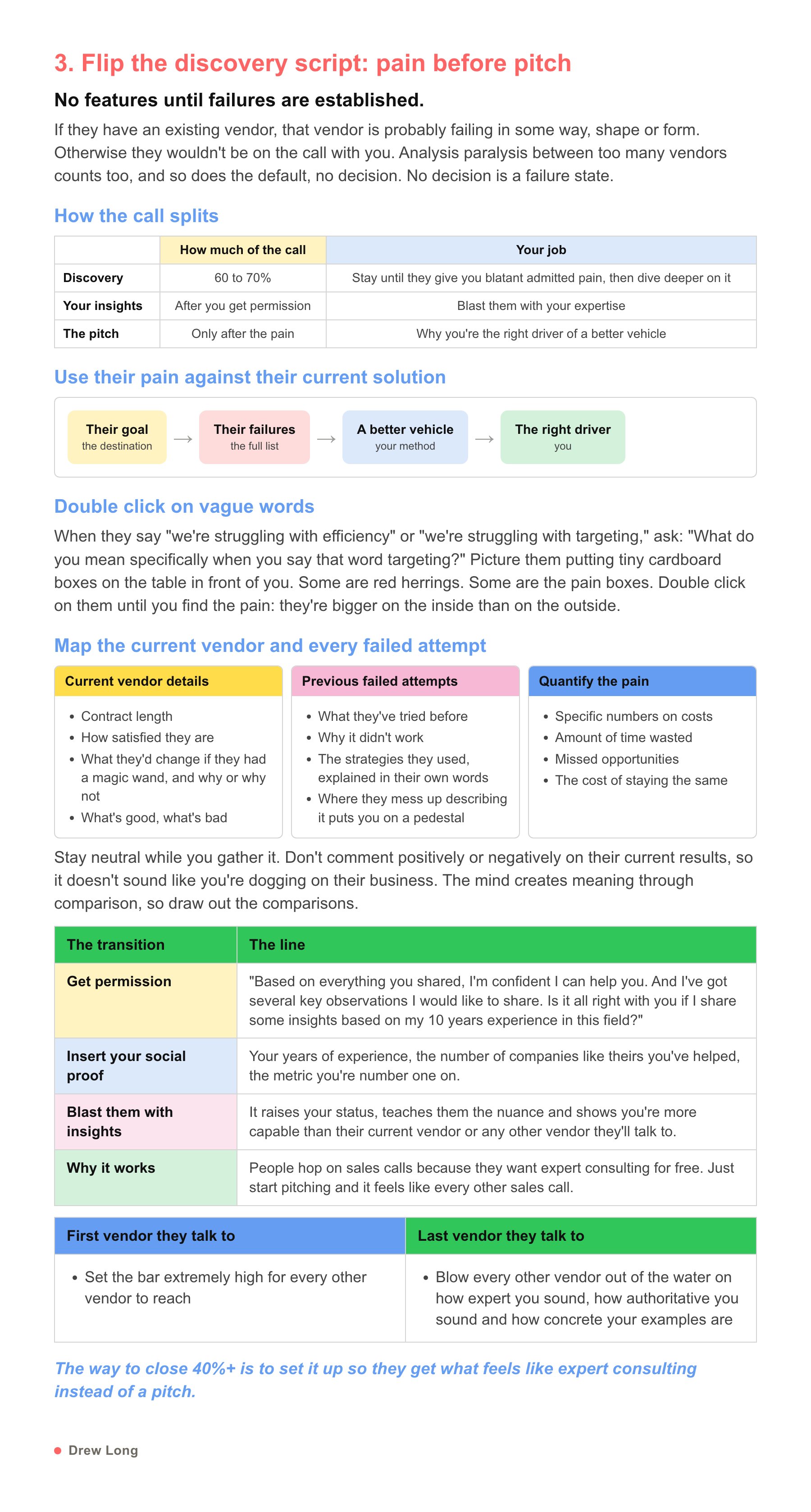
After hitting $1.6B in sales, I’m LEAKING the playbook I'd hand any sales rep to close 40%+ on cold traffic:
(win any vendor battle)



By the time you fire a bad sales hire, the damage is already done. I hired one on the spot early in my career, and he cost us about $150,000. The story:
The company was growing fast, and I was desperate to scale the team.
Then the perfect, polished candidate walked in, with a great resume, great references and all the fintech buzzwords.
Within 30 days, he'd burned through 200 of our best leads and closed ZERO of them.
When I listened to his calls, he was pitching and pushing with a system he'd learned somewhere else. Our product, our category and our prospects were all different, so none of it translated.
The worst part was that he was poisoning our culture. Other reps started to question our process, and our conversion rates were tanking.
Of course, I had to let him go.
Letting him go didn't bring back those 200 leads. It took us 2 months to recover our team morale.
That's when I realized most professional salespeople are BS artists by nature. If you don't know what to look for, they'll sell you in the interview better than they'll ever sell your prospects.
2,000+ interviews later, these are the 4 tells I look for when hiring reps:
1. Within the first 10 minutes, ask "What questions do you have for me about this role so far?" B players ask about the commission structure and the quota. A-players ask what your number one salesperson is doing that's different from everybody else.
2. About 15 minutes in, raise a real concern about their candidacy, like "I'm worried you might be overqualified for this role." B players get defensive or argumentative. A players thank you for being frank and ask what you think they're lacking. This is a test of their objection handling skills.
3. Pick a section of their resume full of numbers and keep asking "How exactly did you accomplish that?" BS artists go vague ("we just worked really hard"). A players can drill down to the smallest detail, because they're the ones who actually solved the problem.
4. At the end of the interview, notice whether actually try to close the deal. “Do you have any objections to hiring me?” That's objection handling in real time, and less than 10% of people do it for a sales role.
5. Do they send a follow up thank you email? Do they persist in reaching out if you ghost them for a week or two? Not that I’d ever advocate deliberate ghosting, but their follow-up on a job they want tells you a lot about how they’ll follow up with your prospects.

After hitting $1.6B in sales, I’m LEAKING the playbook I'd hand any sales rep to close 40%+ on cold traffic:
(win any vendor battle)
How many vendors was your last lost deal comparing you to?
We can run a review of your most recent won or lost sales call.
thisiscadence.com/interview
170
Hiring "safe" people who will never leave often means paying for people who never grow
There is a break-even point; they stay long enough to hard ROI, PLUS they refer you other A-players
Then if they leave, it doesn't even matter

founders should hire people who could leave and start a serious competitor.
if that scares you, hiring people who couldn’t is going to be a lot more expensive.
85
Business growth is all about calculated risks. Founders who are too risk-averse never grow.
The difference between those playing to win, and those trying to avoid losses, gets wider every year.

After growing sales teams from closing $50k per month to over $6,000,000 per month, this is the framework I'd hand any B2B founder to DOUBLE their close rate without competing on price:


Do your closers know which sale they're making before they pitch?
What we do is give you raw human feedback on your last 5 sales calls, based on what we've seen working growing sales teams from 2 people to 150 people
Apply to get feedback here:
thisiscadence.com/interview
38
Mr. Long Money retweeted
Top closers:
• NEVER say the polite thing after showing the pricing packages: "Take your time, look them over." The prospect does exactly that, then ghosts.
• Know the prospect compares the price to $0, the cost of doing nothing, until someone hands them a better comparison
• Put a $149 monthly fee next to the $3,000 a month the prospect's problem is costing them
• Answer a price objection with a new comparison, because defending the price is the lethal mistake
• Ask a prospect making $50,000 in profit if $149 really feels like a big investment
• Catch it when a prospect says "once I come up with that startup fee" and then objects to a small monthly fee. The fee is a smoke screen for not having the cash yet.
• Notice when a prospect never mentions money, because people avoid it when they don't have the funds
• Ask "Is this more about the ongoing cost, or that you don't have the capital available?" when a small detail is killing a big deal
• Get the prospect to pick one package before anyone talks about next steps
• Lead the prospect into the close instead of letting them set the timeline with "I'll call you next week once I've made a decision"
• Never stretch 1 call into 2, because follow-up calls close at lower rates than first calls
• Choose every word on the call on purpose, because prospects follow whatever they're told to do
How many of these did your closers do on their last lost deal?
We can run a review of your most recent won or lost sales call.
Apply here:
thisiscadence.com/interview
140
Mr. Long Money retweeted
After growing sales teams from closing $50k per month to over $6,000,000 per month, this is the framework I'd hand any B2B founder to DOUBLE their close rate without competing on price:
Mr. Long Money retweeted
I heard a rep on an inbound customer service call and peeked at her name tag. Within 2 weeks she was selling for me, and she went on to have a $380,000 day.
It was a beautiful spring day, and I was walking through our customer service department. Her voice made my ears perk up, because I heard something different.
Later, quite by chance, we ran into each other in the kitchen. Thanks to the name tag, I knew who she was. So I introduced myself and asked,
"Ever considered sales?"
She hadn't. Her plan was to become a law enforcement officer. But she was money motivated, so I gave her the steps to apply to our department.
Nobody would have called her a “natural salesperson”, but she was great at no-nonsense communication and wasn't afraid of anyone.
Our sales process went right on top of her very good customer service and people skills, so teaching her was a cinch, and she delivered the talk tracks in her own powerful and unique way.
Sales isn't complicated. It takes 3 things, and she had all 3 in spades.
1. She was smart enough to stick to a proven process
2. Fearless enough to question BS.
3. On top of that, she was a hard enough worker to do it over and over, on repeat.
She won a huge number of deals, including that $380,000 day. I believe it still stands as a record to this day.
Her resume had no sales background on it at all. If I'd waited for her to apply, I'd never have hired her.
Your future top salespeople currently live in the unlikeliest of places.