

Microbial bioinformatics, statistics, machine learning. Research Engineer @AITtomorrow2day
Tulln, Austria
Joined February 2011
- Tweets231
- Following371
- Followers231
- Likes1.9K






BacFlux v2.1.0 is live! A unified workflow for Illumina, ONT, hybrid data or existing bacterial assemblies, integrating decontamination, quality control, taxonomy, annotation, AMR gene detection and mobilome analysis github.com/iLivius/BacFlux

ALT BacFlux v2.1.0 DAG metro map.
65
Four workflows became one: BacFlux v2.0.0 is out.
Illumina, Nanopore, hybrid data or existing assemblies now enter the same Snakemake workflow for reproducible bacterial-genome analysis — including an optional AMR mobilome module.
github.com/iLivius/BacFlux/r…
#Bioinformatics

39
A small preprocessing assumption can quietly discard close to half of an amplicon dataset.
In mixed-orientation libraries, R1 may start with either primer. MetaFlux processes both arrangements instead of losing the swapped pairs.
ilivius.github.io/MetaFlux/a…
#Bioinformatics

ALT Diagram comparing fixed- and mixed-orientation amplicon libraries, with all FASTQ reads shown 5′→3′. Fixed libraries contain R1 starting with the forward primer and R2 with the reverse primer; mixed libraries also contain swapped pairs. MetaFlux processes both arrangements separately, normalises the swapped output and combines them into consistently oriented, primer-free reads without double counting.
34
Connections often count more than perfection, science and bioinformatics included.
Jung offered a counterpoint:
“No matter how isolated you are and how lonely you feel, if you do your work truly and conscientiously, unknown friends will come and seek you.”
32
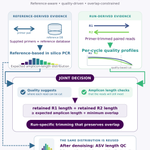
Where should paired-end amplicon reads be trimmed? Quality alone can't decide: trim too far and R1/R2 may lose overlap. MetaFlux combines per-cycle quality with expected amplicon lengths to choose trimming points that preserve overlap.
ilivius.github.io/MetaFlux/a…
#bioinformatics

Very pleased to have been accepted into the Claude for Open Source Program by @AnthropicAI to support my #Bioinformatics work. I put it to use immediately: one of the first results was the release of MetaFlux.
github.com/iLivius/MetaFlux

72
ChatGPT for Academic Researchers is a great @OpenAI initiative but restricting eligibility to selected universities excludes researchers at major non-university research organisations. Why not base eligibility on demonstrable research activity rather than institutional category?
149
Livio Antonielli retweeted

GPT-5.5 & Opus 4.7 on ARC-AGI-3
- GPT-5.5: 0.43%
- Opus 4.7: 0.18%
We found 3 failure modes:
- True local effect, false world model
- Wrong level of abstraction from training data
- Solved the level, didn’t reinforce the reward
See our full analysis 🧵

Livio Antonielli retweeted

There will be no AI jobpocalypse.
The story that AI will lead to massive unemployment is stoking unnecessary fear. AI — like any other technology — does affect jobs, but telling overblown stories of large-scale unemployment is irresponsible and damaging. Let’s put a stop to it.
I’ve expressed skepticism about the jobpocalypse in previous posts. I’m glad to see that the popular press is now pushing back on this narrative. The image below features some recent headlines.
Software engineering is the sector most affected by AI tools, as coding agents race ahead. Yet hiring of software engineers remains strong! So while there are examples of AI taking away jobs, the trends strongly suggest the net job creation is vastly greater than the job destruction — just like earlier waves of technology. Further, despite all the exciting progress in AI, the U.S. unemployment rate remains a healthy 4.3%.
Why is the AI jobpocalypse narrative so popular? For one thing, frontier AI labs have a strong incentive to tell stories that make AI technology sound more powerful. At their most extreme, they promote science-fiction scenarios of AI “taking over” and causing human extinction. If a technology can replace many employees, surely that technology must be very valuable!
Also, a lot of SaaS software companies charge around $100-$1000 per user/year. But if an AI company can replace an employee who makes $100,000 — or make them 50% more productive — then charging even $10,000 starts to look reasonable. By anchoring not to typical SaaS prices but to salaries of employees, AI companies can charge a lot more.
Additionally, businesses have a strong incentive to talk about layoffs as if they were caused by AI. After all, talking about how they’re using AI to be far more productive with fewer staff makes them look smart. This is a better message than admitting they overhired during the pandemic when capital was abundant due to low interest rates and a massive government financial stimulus.
To be clear, I recognize that AI is causing a lot of people’s work to change. This is hard. This is stressful. (And to some, it can be fun.) I empathize with everyone affected. At the same time, this is very different from predicting a collapse of the job market.
Societies are capable of telling themselves stories for years that have little basis in reality and lead to poor society-wide decision making. For example, fears over nuclear plant safety led to under-investment in nuclear power. Fears of the “population bomb” in the 1960s led countries to implement harsh policies to reduce their populations. And worries about dietary fat led governments to promote unhealthy high-sugar diets for decades.
Now that mainstream media is openly skeptical about the jobpocalypse, I hope these stories will start to lose their teeth (much like fears of AI-driven human extinction have).
Contrary to the predictions of an AI jobpocalypse, I predict the opposite: There will be an AI jobapalooza! AI will lead to a lot more good AI engineering jobs, and I’m also optimistic about the future of the overall job market. What AI engineers do will be different from traditional software engineering, and many of these jobs will be in businesses other than traditional large employers of developers. In non-AI roles, too, the skills needed will change because of AI. That makes this a good time to encourage more people to become proficient in AI, and make sure they’re ready for the different but plentiful jobs of the future!
[Original text in The Batch newsletter.]

Finally found some time to refresh BacFlux and release updated workflows for short and long reads. Just my own “recipe” for bacterial genome analysis. Maybe useful to someone else. github.com/stars/iLivius/lis…

72
Just released cFMDbench: a repository where I pulled together methods I’ve been using for #ML classification on #metagenomic data with #mlr3, benchmarked on the #cFMD dataset. More a structured workflow than a “product”, but maybe useful to others. github.com/iLivius/cFMDbench

"Feel crowded in the left queue? You're welcome on the right one—plenty of space!"🤓 – at Tulln an der Donau, Österreich


112
🔥 New #workflow alert! 🔥
Introducing FunFlux—a dedicated pipeline for fungal genome assembly, decontamination, completeness validation, and gene annotation. Now added to my list of #WGS analysis tools. Explore it here: github.com/stars/iLivius/lis…
Interested in #MachineLearning for #Metagenomics? Check out my GitHub repo from @miCROPe_org 2024! 🦠💻🔬 If you enjoyed my talk or want to explore prediction tools in microbial data analysis, visit github.com/iLivius/miCROPe20….

🚀 #BacFlux v1.1.8 is out! 🎉
🧬 Updated tools: Bakta v1.9.4, CheckM v1.2.3, GTDB-Tk v2.4.0 with r220 db, SPAdes v4.0.0, CheckV v1.0.3 🔬 New BLAST support for core_nt & nt_prok db
Check it out on GitHub: github.com/iLivius/BacFlux
#Bioinformatics #BacterialGenomes

3
271
Years of bacterial WGS in soil, plants, food, and human gut research led to BacFlux. Researchers' invaluable feedback helped create a tool that lets them focus on biological insights over tech. Explore it here: github.com/stars/iLivius/lis…
This time, I swapped my beloved microbes for a terrestrial crustacean! Happy to share our latest work about the transcriptomic analysis of 𝘏𝘦𝘮𝘪𝘭𝘦𝘱𝘪𝘴𝘵𝘶𝘴 𝘳𝘦𝘢𝘶𝘮𝘶𝘳𝘪𝘪, providing insights into arthropod sensory systems. sciencedirect.com/science/ar…
1
189
Stop by @PhytobiomesJ and check out our new #microbesandplants article. Our research dives into the unknowns of #seed #germination, a critical factor for plant establishment and agricultural productivity. Find out more: doi.org/10.1094/PBIOMES-03-2…