

thanye west retweeted

Difference in yardstick:
The normalization of sleep requirements to 7-8h was made before the AppleWatch. It included episodes now labeled "awake" where the subject isn't aware of the interruptions.
I suspect that if we adjust by these interruptions sleep requirements wd be lower.


thanye west retweeted

Eminent scientists from around the world have shown their support for the Gravity Aging Hypothesis. Some of them even said that it could be groundbreaking for human longevity.
But that’s not enough. It’s time for empirical proof.
I believe this theory deserves rigorous scientific scrutiny. Continue Research is already working with scientists and researchers to test, refine, and even challenge the Gravity Aging Hypothesis.
Our commitment: We’ll ‘continue’ to fund and support work that proves or disproves it.
Last but not the least, we are NOT saying that gravity is the only cause of aging. We are only saying it might be a key, fundamental, and overlooked driver that might be the rate-limiter to human longevity.
Even if we learn to live better with gravity, we won’t defy death. But we might just unlock two, three, or maybe even five more decades of healthspan. Will this make us live up to 150?
Only time will tell.


thanye west retweeted
Now let’s talk about inversions.
Inversions are already popular for lymphatic fluid drainage. We found that inversions are also the most effective way to counteract the negative effects of gravity on our brains.
Our biggest finding is that six weeks of using inversion tables for >10 minutes every day, led to a baseline increase of 7% in our daily average Brain Flow. This possibly nullifies 10 years of loss of Brain Flow with age.
Passive inversions vs Active inversions (e.g. Headstands in Yoga): Passive inversions (head below the heart tilt using inversion tables) increase Brain Flow by almost 50% more than the increase from Active inversions.
Also, most commonly known healthy habits help improve Brain Flow as well.
Here’s a cheat sheet to increase your daily average Brain Flow.
[Disclaimer: None of this is medical advice. Always consult a qualified physician before changing your lifestyle or attempting any inversion practice.]


thanye west retweeted
So what can we do about this?
We don’t have to escape gravity to counteract the negative effects it has on us. It’s necessary for us to live. Like astronauts, our health would deteriorate in <1G.
We just have to learn how to live longer and better at 1G.
Science already knows that Brain Flow is highly correlated to age, and an important biomarker for aging. However, we don’t pay much attention to Brain Flow.
So first and foremost, all of us need to start recognising how important blood flow to the brain is to our health, and longevity.


thanye west retweeted
I am not saying “gravity exists” or “blood flow matters.” Everyone knows that. The new part is connecting these 3 known facts:
1. Upright posture reduces blood flow to the brain by small amounts, compounding every day for decades.
2. Neurons in the hypothalamus and brainstem are highly metabolic and depend on tiny perforating blood vessels, which makes them very sensitive to even small drops in blood flow.
3. These regions control aging itself: Hormones, inflammation, metabolism, autonomic balance, repair.
Nobody has put these 3 pieces together into a single, testable mechanism for aging. A big part of human aging might be brain-first and gravity driven, and not body-first (like we’ve always believed). That’s the breakthrough.
The more time we spent asking scientists to poke holes in this, the more I began to feel like we were tracing the outline of something hidden in plain sight.
Clues kept appearing. Scattered across biology, physics, medicine, and even evolution. The list runs long.


thanye west retweeted
I’m not sharing this as the CEO of Eternal, but as a fellow human, curious enough to follow a strange thread. A thread I can’t keep with myself any longer.
It’s open-source, backed by science, and shared with you as part of our common quest for scientific progress on human longevity.
Newton gave us a word for it. Einstein said it bends spacetime. I am saying gravity shortens lifespan.
Read on, and tell me what you think.


The A.I. Bubble Doesn’t Exist, The Bears Are Wrong!
Time and time again I have turned on a major financial news network, listened to a financial podcast, or seen a post on X indicating that we’re in an A.I. bubble. The rapid surge in A.I. related investments and some stock valuations have created a narrative that the current environment is similar to the dot-com crash of the early 2000s. The main arguments I have seen are that the current euphoria outpaces real world results, valuations are detached from fundamentals, there is a lack of demonstrable ROI, companies ae hitting infrastructure and resource constraints, and the escalating costs are creating unsustainable business models.
The bear narrative almost always leads back to the idea that A.I. stocks and startups are trading at premiums that resemble past bubbles and are being driven by FOMO rather than profitability. It doesn’t help that users on X are posting triple and quadruple digit gains that are often hundreds of thousands or millions in profits from their actual accounts. Some accounts on X are twisting the dagger deeper as their posting gains from naked options or call spreads which have finance professionals screaming into thin air as some of the underlying equities are unprofitable and pre-revenue businesses.
I have a newsflash for every bear, A.I. is not a bubble. In every market environment there are always companies that become overly expensive with valuations that look unsustainable for no reason other than they have built a cult like following and there are more buyers than sellers. This is not a period of extreme speculation unlike the dot com bubble where investors poured capital into any company with .com in its name.
The rapid growth of the internet changed how information was disseminated and how people communicated which led to the overvaluation of startups as venture capital flooded the market fueling unsustainable growth. The dot com bubble burst because many of the companies from height of the era were nothing more than hype prioritizing user growth over sustainable business models that focused on revenue and profitability. The Fed hiked interest rates several times during 1999 and 2000 which caused investment capital to tighten, making it harder for cash-burning companies to sustain operations or roll over debt, leading to bankruptcies.
The four companies leading the transformational shift with A.I. are Microsoft (MSFT), Amazon (AMZN), Alphabet (GOOGL), and Meta Platforms (META). These are not startups or companies tapping the debt markets to build out new business ventures with the promise of becoming profitable. These are the largest companies in the world with the strongest balance sheets and largest profitability. Everyone has the right to their opinion but when the CEO’s and board of directors are taking a blank check approach to building out data center infrastructure to harness the power of A.I. their probably the ones who are probably correct.
Here are some statistics about MSFT and keep in mind that their 2025 fiscal year just ended as they are not on a calendar year regarding reporting. Since the 2022 fiscal year ended, over the next 3-years, MSFT’s long-term debt has declined by -14.63% (-$6.88 billion) while they have increased their allocation toward CapEx by 170.25% ($40.67 billion). Over this period MSFT has increased the cash from operations it generates by 52.93% ($47.13 billion) from $89.04 billion to $136.16 billion which has allowed them to increase the amount of capital their allocating toward CapEx while paying down their debt obligations. MSFT is now generating $71.61 billion of free cash flow ((FCF)) while allocating $64.55 billion toward CapEx and they did this while repurchasing $18.42 billion worth of shares and paying $24.08 billion in dividends during the 2025 fiscal year. This is a much different period than the dot com era and when companies like MSFT are leading the way, funding the data center buildouts organically from their cash from operations there is no bubble in sight.
If we look at GOOGL, it has $23.61 billion in long-term debt with $95.15 billion in cash on hand between its cash and short term investments with another $52.57 billion in long-term investments on the balance sheet. GOOGL has allocated $66.98 billion toward CapEx in the TTM which was also funded organically as they have generated $133.71 billion in cash from operations over this period. Not only did they allocate $66.98 billion toward CapEx but they generated $66.73 billion in FCF which allowed them to repurchase $59.55 billion worth of shares and pay $9.87 billion in dividends over this period.
The combination of AMZN, MSFT, GOOGL, and META allocated $88.25 billion toward CapEx in Q2 2025. This was an increase of 66.97% ($35.39 billion) YoY. The growth rate that these companies are spending to build out data centers is expanding, considering that in Q2 2024 the combination of these 4 companies increased their CapEx spend QoQ by 19.33% ($8.56 billion) to $52.85 billion. We just saw that the latest Q2 2025 QoQ increase from them was 22.73% ($16.34 billion) to $88.25 billion. Oracle Corporation (ORCL) and CoreWeave (CRWV) also released critical information that supports an extended CapEx buildout. On ORCL’s recent earnings call, Safra Catz (ORCL CEO) indicated that their remaining performance obligations reached $455 billion, which was an increase of 359% YoY, and they are expecting to allocate $35 billion toward CapEx this fiscal year. CoreWeave reported that its revenue backlog increased by 85% to $30.1 billion in Q2 2025.
While bears often cite a lack of demonstrable ROI and stalled productivity gains as evidence of an A.I. bubble McKinsey's latest research estimates that A.I. could unlock $4.4 trillion in annual productivity growth from corporate use cases, with early adopters reporting tangible efficiency boosts in workflows like automation and decision-making. The bears also point to infrastructure constraints, such as soaring energy demands and potential grid overloads. The U.S. Department of Energy's Speed to Power initiative which was launched this month aims to accelerate grid expansions and clean energy integrations specifically for A.I. data centers to ensure that the U.S. maintains its edge in global A.I. development.
The hyperscalers are in a prisoners dilemma as MSFT just announced that it had signed a deal to spend $4B on a second data center in Wisconsin. MSFT went on the record saying that this data center will be the most advanced in the world as it will run hundreds of thousands of Nvidia (NVDA) GB200 GPUs that will be connected by enough fiber to wrap the planet four times over. MSFT believes that this is where the next generation of AI will be trained which will set the stage for new discoveries in medicine, science, and other critical fields that will shape the future. AMZN, GOOGL, and META can’t take their feet off the gas now and they are likely to come over the top on the next earnings calls.
Forget about smaller companies that are getting large valuations as that’s not where the A.I. story resides. The largest companies in the world are spending like drunken sailors on CapEx and it’s only going to get larger. MSFT just said they will allocate more than $100 billion this year on CapEx, and AMZN is already allocating over $100 billion per year. These companies can continue to increase their CapEx allocations because their generating more cash from operations and funding all this organically without tapping the debt markets.
At the end of the day, MSFT, AMZN, GOOGL, and META generated $493.31 billion in cash from operations, allocated $291.35 billion in CapEx and generated $201.96 billion in FCF in the TTM. These numbers indicate that the dot com era and the A.I. era are very different and there is no A.I. bubble to be found.
@amitisinvesting @KrisPatel99 @RealMattMoney @_financeken @Futurenvesting @FunOfInvesting @Kross_Roads @DataDInvesting @StockMKTNewz @StockMarketNerd @sam_badawi

80

thanye west retweeted

This is the core premise of the Thousands Brain Theory from Numenta:
The neocortex is a sheet made of repeating cortical columns (tiny brains) all voting to integrate information from multiple sources & establish a robust consensus of what is being perceived.

Ilya Sutskever on Comparing AI Systems to Biological & Human Intelligence.
Its always so interesting to listen to him.
He explains the brain’s adaptability, where children with half their brain removed still function well.
And another experiment shows sensory inputs can remap to different brain regions.
i.e. that cortical structures are highly uniform, reused across functions, similar to DNA and protein encoding.
This suggests that intelligence relies on a general, repeatable architecture, and the idea that AI can mirror biological systems.
---
From 'No Priors: AI, Machine Learning, Tech, & Startups' YT channel


thanye west retweeted

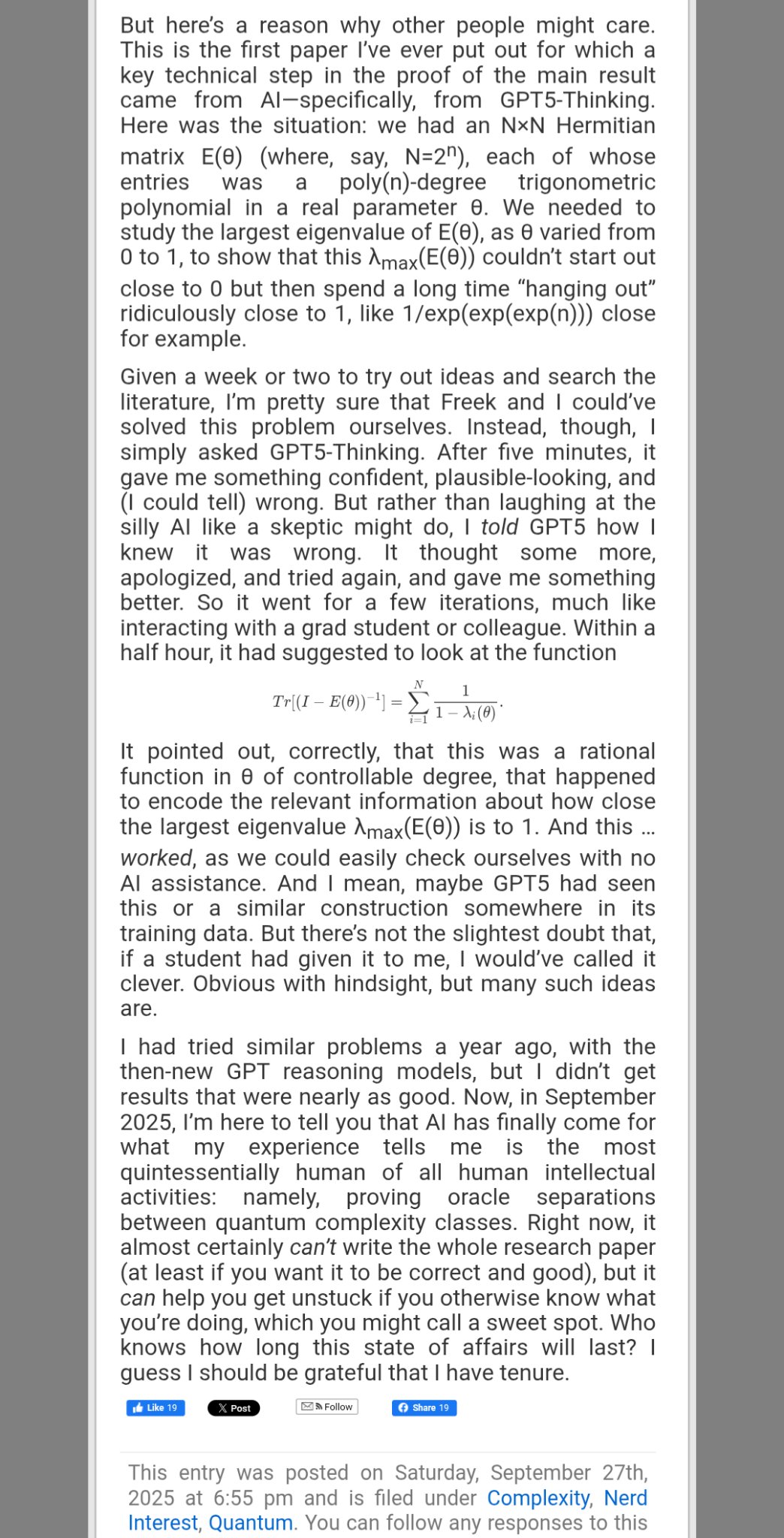
For those who don’t know who Scott Aaronson is, he is widely regarded as one of the smartest people alive today! He ranked seventh on a list of the ten smartest living people, behind only Tao, Witten, and a few others in mathematics and physics. When he talks we listen!

Yet more evidence that a pretty major shift is happening, this time by Scott Aaronson
scottaaronson.blog/?p=9183&f…