

https://xitter.gq/t.co/Wjv4N5kTEX - https://xitter.gq/t.co/5rltf1Xgoa - I code for fun and sometimes money. Feel free to reach out.
United States
Joined April 2009
- Tweets1.6K
- Following296
- Followers179
- Likes18.3K





What happened to my three-month internet shutoff global net-pocalypse scheduled for this weekend? Are we doing it after markets close?
1
1
52
that feeling when you have prepmaxxed so hard the last five years, you have no more prep to maxx now.
1
5
117


Duke Ian retweeted

so:
- no succession plan.
- 60 reports which means no obvious person with complete understanding of the co operates. or at least it’ll be insanely messy. potential for a lot of infighting.
- a weak board suddenly tasked to manage a crazy crises w/ arguably the most important co of this era.
- possible talent exodus since founder is leaving.
- a ceo search that could take a while with no obvious outsider candidate at the top.
- potentially more revelations.
- jensen will have zero involvement going forward. no chairman role.
- downstream impact on ai ecosystem from funding, support etc.
this is not good. what am i missing?


I'm so bored. Claude is maxing out my local compute cluster. Other Claude is running RunPod CUDA experiments. Kimi is doing performance stress tests.
I'm just gonna sit over here scrolling X and feeling less than useful.
1
3
528

I'm publishing a new collection of skills called Shipyard.. This is a distillation of a number of internal engineering pipeline management skills that I've been using for the last six months. I know skill publishing is "so six months ago", but I figured I'd throw it out there anyways.
github.com/ianzepp/shipyard
I've probably put well over 100 billion tokens through this pipeline with over 10,000+ agent and subagent sessions, and it's proven to be quite reliable in taking a rough sketch and turning it into full-blown implementations without needing significant human oversight.
At this point, frontier LLMs themselves are very good at managing the engineering process, so this skill isn't quite as useful as it was earlier this year, but it's still a solid and reliable factory pipeline.

7
86

This is my baby! so proud..

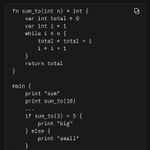
Faber 1.17 is out.
This one is mostly about kernels and about making the toolchain tell you what to do next.
Kernels pick their own math. A kernel now has a tier:
@ kernel is IEEE-correct by default;
@ kernel relaxed lets the GPU use fast division, fast square root and fast transcendentals;
@ kernel unsafe also drops the index checks the compiler can’t prove.
Write relaxed on the kernels where speed matters more than the last bit. Then run with --safe to see whether the answers change. That flag only ever lowers a tier, never raises one. Integer and decimal results stay exact at every tier, and checks you wrote yourself always run.
On Metal the tier is chosen per call site. Our flood-simulation benchmark solves in about 55 s with its launch kernels marked relaxed, against about 118 s at the strict default.
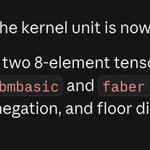
Wider values in kernels. i64, u64, wrapping<u64> and d64 are legal kernel values now. On Metal, d64 runs exact decimal math, with faster multiply and divide than before.
Lists know their size range. list<int, size 0…3> says how long a list may be. A short literal takes the capacity of the place it’s stored in. size is now the one way to write a capacity, so list<int, 4> becomes list<int, size 4>.
New in the language:
- return thread ends one lane from anywhere inside it. The checker handles it today; code generation comes next.
- reduce via first finds the first match in a tensor.
xs.find(…) and xs.extend(ys) on lists.
scan via for prefix scans.
- Ranged integer cells like saturating<u32, 0‥8>.
Errors explain themselves now. faber check shows the source line, the message, and help that says what to write instead, in all eight languages Faber reads. faber explain answers in your own language’s spelling. Want the old one-line format? Use --no-diagnostics.
Run what you build. faber run --target go, ts and llvm-host build your package and run it. --target clif-jit compiles in memory with Cranelift, with no linker and no Rust toolchain. --device cpu --threads N spreads kernels across CPU cores.
Fixed: a long list of correctness bugs across Rust, Go, TypeScript, Swift, Python, LLVM, Cranelift, WebAssembly, Metal and CUDA. Many of them came from writing real programs: a NumPy-style benchmark set, molecular-dynamics and sequence-alignment workloads, a drone simulation and a video decoder. Each of those turned up bugs, and we fixed them.
Heads up: Faber is experimental through version 1, and this release has breaking changes: the size marker, retired byte-type words, English as the default code locale, and new exit codes. The release notes list each one as what to rewrite.
Full release notes (long):
faberlang.dev/en-US/releases…
Already on 1.15 or later? `faber update` does it.
Notes: github.com/faberlang/release…
Docs: faberlang.dev
2
38
Duke Ian retweeted
Faber 1.17 is out.
This one is mostly about kernels and about making the toolchain tell you what to do next.
Kernels pick their own math. A kernel now has a tier:
@ kernel is IEEE-correct by default;
@ kernel relaxed lets the GPU use fast division, fast square root and fast transcendentals;
@ kernel unsafe also drops the index checks the compiler can’t prove.
Write relaxed on the kernels where speed matters more than the last bit. Then run with --safe to see whether the answers change. That flag only ever lowers a tier, never raises one. Integer and decimal results stay exact at every tier, and checks you wrote yourself always run.
On Metal the tier is chosen per call site. Our flood-simulation benchmark solves in about 55 s with its launch kernels marked relaxed, against about 118 s at the strict default.
Wider values in kernels. i64, u64, wrapping<u64> and d64 are legal kernel values now. On Metal, d64 runs exact decimal math, with faster multiply and divide than before.
Lists know their size range. list<int, size 0…3> says how long a list may be. A short literal takes the capacity of the place it’s stored in. size is now the one way to write a capacity, so list<int, 4> becomes list<int, size 4>.
New in the language:
- return thread ends one lane from anywhere inside it. The checker handles it today; code generation comes next.
- reduce via first finds the first match in a tensor.
xs.find(…) and xs.extend(ys) on lists.
scan via for prefix scans.
- Ranged integer cells like saturating<u32, 0‥8>.
Errors explain themselves now. faber check shows the source line, the message, and help that says what to write instead, in all eight languages Faber reads. faber explain answers in your own language’s spelling. Want the old one-line format? Use --no-diagnostics.
Run what you build. faber run --target go, ts and llvm-host build your package and run it. --target clif-jit compiles in memory with Cranelift, with no linker and no Rust toolchain. --device cpu --threads N spreads kernels across CPU cores.
Fixed: a long list of correctness bugs across Rust, Go, TypeScript, Swift, Python, LLVM, Cranelift, WebAssembly, Metal and CUDA. Many of them came from writing real programs: a NumPy-style benchmark set, molecular-dynamics and sequence-alignment workloads, a drone simulation and a video decoder. Each of those turned up bugs, and we fixed them.
Heads up: Faber is experimental through version 1, and this release has breaking changes: the size marker, retired byte-type words, English as the default code locale, and new exit codes. The release notes list each one as what to rewrite.
Full release notes (long):
faberlang.dev/en-US/releases…
Already on 1.15 or later? `faber update` does it.
Notes: github.com/faberlang/release…
Docs: faberlang.dev
I had to go to the Ford dealership today to get a new key programmed for my bronco because I lost the other one a long time ago. It cost just shy of $600 and all I could think about was "I could have three months of super intelligence with Claude Max for the same price as a small little piece of plastic".. just an unbelievable rip off.
2
3
162


Make sure to check your random numbers against ChatGPT next time you need to generate a root certificate.

4
57
I just received an inbound phone call with no caller ID that I decided to pick up out of curiosity and a desk, sergeant or someone who claimed to be a sergeant said that I've missed a federal grand jury summons. When I asked for verification because of the amount of spam calls, they promptly hung up on me.
1
6
229

