


Ryven retweeted
I still don’t understand why everyone isn’t using this yet. Three folders cut my costs by $1,000.
Karpathy described the system in April 2026, and his post passed 21 million views.
It’s a second brain that knows everything about you.
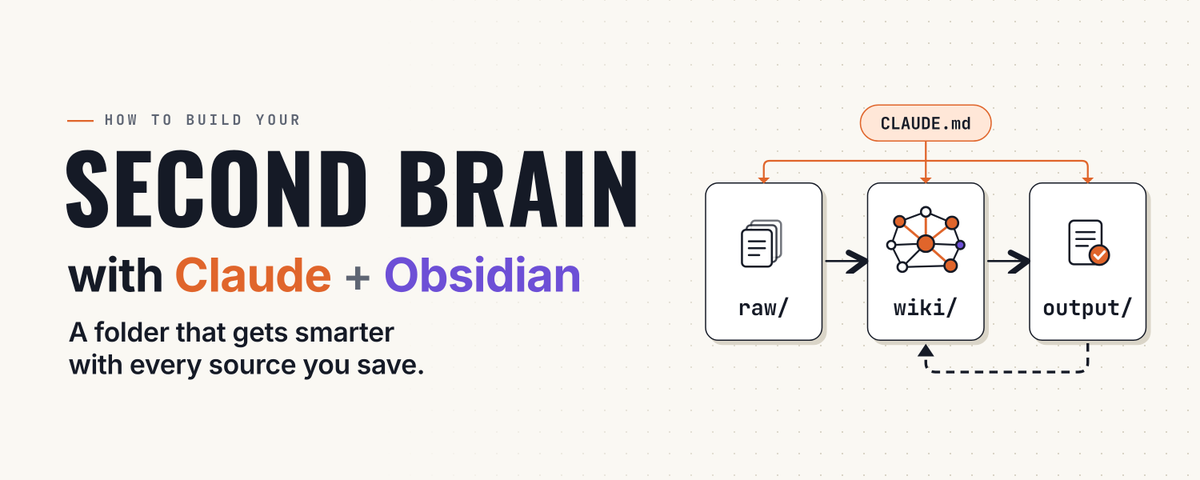
It’s not a plugin or an app. It’s three folders of plain text files that Claude reads and writes itself.
raw/ holds your sources, read-only for Claude. wiki/ holds the pages it writes and keeps current. CLAUDE.md holds the rules. Add a source, ask against the wiki, run a check, and every new session starts where the last one stopped.
Setup is ten minutes:
mkdir -p brain/{raw,wiki,output,.brain}
cd brain && git init
claude
Tell Claude to interview you and write its own rules file. It asks about your work, your goals, your strengths and weaknesses, and writes it all down.
Then I tested it. I planted one false sentence in the wiki, and a 95-line script with no AI inside caught it in milliseconds, for zero tokens.
The full guide has the folders, the prompts, the script, the hooks, the nightly run, and where the whole idea breaks.
Ryven retweeted
I still don’t understand why people keep building a Claude second brain from scratch when these 10 repos already built the whole system
They take in your sources, link them into a wiki, check every claim, and one of them runs fully on your own machine
01 obsidian-skills → Obsidian’s own CEO teaches Claude how Obsidian really works
github.com/kepano/obsidian-s…
02 claude-obsidian → drop in any source and Claude reads it, links it and files it into one connected graph of plain Markdown you own
github.com/AgriciDaniel/clau…
03 obsidian-second-brain → Claude Code remembers you between sessions, with 48 commands, all inside your Obsidian vault
github.com/eugeniughelbur/ob…
04 karpathy-llm-wiki → one install line, then ingest, query with citations and lint, in Claude Code, Cursor, Codex or OpenCode
github.com/Astro-Han/karpath…
05 second-brain → raw sources in, linked wiki pages out, browsed in Obsidian
github.com/NicholasSpisak/se…
06 second-brain-os → the full kit: a 77-page guide, a starter vault, 18 skills, 72 commands and 6 subagents, four of them read-only
github.com/undefined-ui/seco…
07 llm-wiki → two-layer memory: 10 to 20 rules Claude loads every session, 50 to 200 wiki pages pulled only when needed
github.com/MehmetGoekce/llm-…
08 vouch → agents propose changes, you approve them, and a claim without a source is an error
github.com/vouchdev/vouch
09 ai-second-brain → your ChatGPT and Claude history becomes a linked Obsidian vault, then a wiki
github.com/charlie947/ai-sec…
10 LLM_Wiki_SecondBrain → the whole pipeline on a local model, no cloud API. 32 GB of RAM recommended
github.com/DimitrisLianos/LL…
I still don't understand why everyone isn't using this yet. Five minutes of setup saved me thousands of dollars
Andrej Karpathy, a co-founder of OpenAI, shared a simple idea that reached 21 million views: stop pointing AI only at code, point it at everything you know.
Drop any article, transcript or PDF into a folder. Claude files it into a living wiki, a second brain linked to everything you already saved.
Every new source makes the next answer sharper, and you stop pasting the same context into every chat.
The whole setup:
> Create an Obsidian vault and open it with Claude Code
> Hand Claude Karpathy's wiki idea file and let it build the structure
> raw holds your sources, wiki holds its pages, CLAUDE.md holds the rules
> Drop a source into raw and type "ingest this"
> Then ask anything, and it answers from all of it
Set it up once, and Claude stops forgetting you between chats.
The full step-by-step guide for Claude and Obsidian is in the article below.
Bookmark this and set it up tonight
Ryven retweeted
This is getting f*cking scary.
A 23-year-old developer from China launched 300 Claude Code agents at once, then made every single one of them prove its work.
His numbers:
→ 300 agents researching and writing at the same moment
→ every claim checked against its source in about 100 ms
→ anything that fails goes back for a rewrite, and only verified pages get saved
→ 100+ company profiles, three passes, zero errors left
→ all of it filed into an Obsidian vault
The trick is the split. one model does the work. a cheaper one has a single job: decide whether the claim is true.
That is the line between a swarm and a mess. 300 agents with no checker give you 300 confident guesses.
If you build this, give the checker the claim and the source, never the researcher’s reasoning. it judges the evidence, not the argument.
Weeks of analyst work, collapsed into one run.
It’s the Second Brain idea scaled up: a swarm to produce, a checker to trust, a vault to keep.
Save this if you’re building one.
Ryven retweeted
I genuinely don’t understand why everyone is still skipping this
Andrej Karpathy, a co-founder of OpenAI, shared a simple idea that reached 21 million views: stop pointing AI only at code, point it at everything you know.
Throw any article, transcript or PDF into a folder, and Claude turns it into wiki pages, a second brain stitched to everything you’ve already saved. Nothing sits in a pile, and every source you add makes your next answer sharper.
The whole setup:
> Create an Obsidian vault and open it with Claude Code
> Hand Claude Karpathy’s wiki idea file and let it build the structure
> raw holds your sources, wiki holds its pages, CLAUDE.md holds the rules
> Drop a source into raw and type “ingest this”
> Then ask anything, and it answers from all of it
Five minutes to set up, and Claude stops forgetting you between chats.
The full step-by-step guide for Claude and Obsidian is in the article below.
Bookmark it before you start
Ryven retweeted
I can’t believe people still build a Claude second brain from scratch when Obsidian’s own CEO already shipped the shortcut.
4 GitHub repos that already set up Claude to read, write and organize your notes:
→ obsidian-skills, 49.8K stars: written by Obsidian’s own CEO, so Claude actually knows how Obsidian works
→ claude-obsidian, 15K stars: the whole wiki loop (ingest, query, lint) as ready-made commands
→ obsidian-second-brain, 4.8K stars: 48 commands that run in Claude Code, Codex and Gemini
→ second-brain-starter: interviews you first, then writes a 9-phase build plan for your own setup
older guides still show old star counts, these numbers are current
two rules no repo can enforce for you: keep your sources read-only, and ask with “using only wiki/”, otherwise Claude quietly fills the gaps with its own guesses
the full step-by-step guide is in the article below
Ryven retweeted
OpenAI co-founder Andrej Karpathy called it a compiler, not a storage system. this diagram shows the architecture he described.
Your second brain is a filing cabinet. It holds a thousand saved articles you will never open again, and it is exactly as smart today as the day you started.
A compiled wiki is built differently:
raw holds the sources, untouched, as your ground truth
wiki is where the model turns raw into linked, structured pages, so you read it and the model writes it
output is where finished work lands, built from the wiki and never from memory
At the center sits CLAUDE.md: who you are, what you want, what you're building. The model reads it before every session, so you never explain yourself twice.
The whole loop starts with one prompt:
"Ingest the new file in raw/. Write a summary in wiki/, link every concept it touches and add it to wiki/index.md. Never edit raw/."
Five automations keep it running: ingest, write, manage, review, maintain.
Every new source gets compiled into what's already there, so the system gets smarter with each one.
Ryven retweeted

Andrej Karpathy's LLM wiki gist has 5,000+ stars, and this is the clearest step-by-step build of it.
Try to name one thing you read this year that you could use today. You will fail, and that is what your reading is worth right now.
The fix takes about 20 minutes: a folder where everything you save gets read, summarized and linked to the rest.
→ raw/ holds your sources, and Claude never edits them
→ wiki/ holds the linked pages Claude writes from them
→ CLAUDE.md tells Claude who you are before every session
One phrase keeps it honest, and that phrase is "using only wiki/". Without it, Claude fills the gaps with general knowledge and hands it back as if it were yours.
Next week you will read more, and all of it will end up exactly where this year's reading went, unless you build this tonight.

Ryven retweeted
This setup straight from Anthropic’s docs saved me about $1,000.
The idea is simple, each model only does the job it is worth paying for.
→ Opus 5.5 plans and signs off on the final diff
→ Sonnet 5.5 does the legwork
→ Fable 5.1 steps in only when called
Opus runs at high effort and owns the final diff.
Sonnet runs at medium effort across three subagents: an explorer that reads the code, a worker that edits files and runs tests, and a researcher that pulls the docs.
Fable sits behind /advisor fable, reads the whole session, and speaks only when it is called, which happens at three moments:
→ before a plan ships, to ask whether this is the right approach
→ when the same error comes back twice, to ask whether the search is stuck in the wrong place
→ before a long task counts as done, to ask what got missed
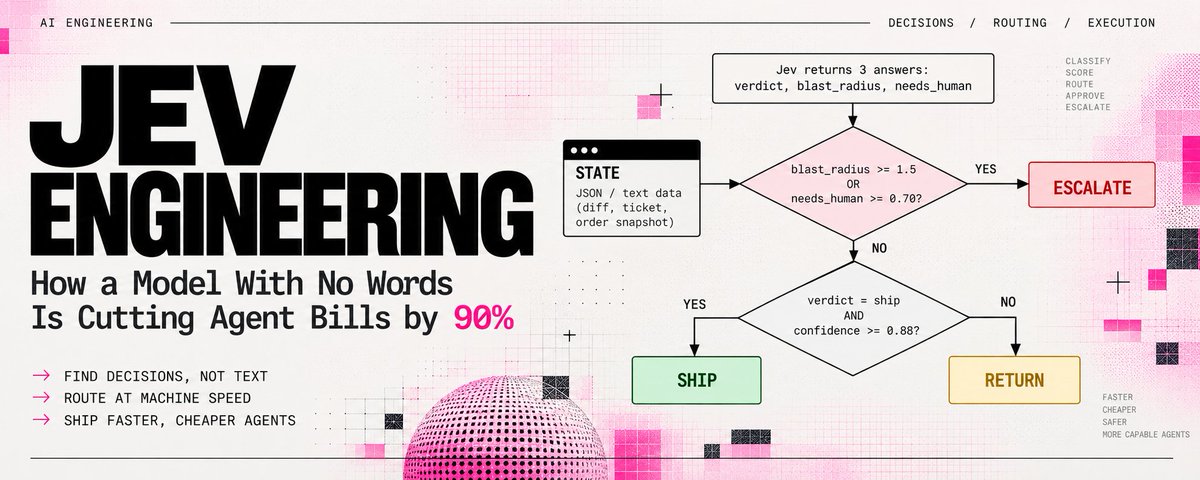
The same split works for the smallest decisions. Which file to open, which tool to run, and whether to retry or stop need no deep reasoning, so a decision model like Jev answers them in a fraction of a second and the big models only see the real forks.
Run Opus on everything and you pay it to check whether a file exists.
Paste this into Claude Code:
“Rebuild my Claude Code setup around three tiers.
First, look in ~/.claude/agents and .claude/agents for subagents that already act as explorer, worker or researcher. Create only the missing ones, each with model: sonnet and effort: medium. If an existing one is pinned to another model, list it and leave it alone.
Second, in ~/.claude/settings.json set advisorModel to fable, and set high effort for Opus under modelSettings for claude-opus-5-5, because a top-level effortLevel does not apply to Opus 5.5.
Third, report without changing anything: whether CLAUDE_CODE_DISABLE_ADVISOR_TOOL, DISABLE_TELEMETRY or anything that blocks feature-flag fetches is set, whether CLAUDE_CODE_EFFORT_LEVEL is set, since it can override subagent effort, and whether using Fable as advisor needs a one-time billing consent. If you can’t tell, say so.
Fourth, add one line to ~/.claude/CLAUDE.md: consult the advisor before a big plan, when the same error shows up twice, and before marking a long task done.
Show every change as a diff first, and touch nothing until I say go.”
Docs: code.claude.com/docs/en/advi…
This setup straight from Anthropic’s docs saved me about $1,000.
The idea is simple, each model only does the job it is worth paying for.
→ Opus 5.5 plans and signs off on the final diff
→ Sonnet 5.5 does the legwork
→ Fable 5.1 steps in only when called
Opus runs at high effort and owns the final diff.
Sonnet runs at medium effort across three subagents: an explorer that reads the code, a worker that edits files and runs tests, and a researcher that pulls the docs.
Fable sits behind /advisor fable, reads the whole session, and speaks only when it is called, which happens at three moments:
→ before a plan ships, to ask whether this is the right approach
→ when the same error comes back twice, to ask whether the search is stuck in the wrong place
→ before a long task counts as done, to ask what got missed
The same split works for the smallest decisions. Which file to open, which tool to run, and whether to retry or stop need no deep reasoning, so a decision model like Jev answers them in a fraction of a second and the big models only see the real forks.
Run Opus on everything and you pay it to check whether a file exists.
Paste this into Claude Code:
“Rebuild my Claude Code setup around three tiers.
First, look in ~/.claude/agents and .claude/agents for subagents that already act as explorer, worker or researcher. Create only the missing ones, each with model: sonnet and effort: medium. If an existing one is pinned to another model, list it and leave it alone.
Second, in ~/.claude/settings.json set advisorModel to fable, and set high effort for Opus under modelSettings for claude-opus-5-5, because a top-level effortLevel does not apply to Opus 5.5.
Third, report without changing anything: whether CLAUDE_CODE_DISABLE_ADVISOR_TOOL, DISABLE_TELEMETRY or anything that blocks feature-flag fetches is set, whether CLAUDE_CODE_EFFORT_LEVEL is set, since it can override subagent effort, and whether using Fable as advisor needs a one-time billing consent. If you can’t tell, say so.
Fourth, add one line to ~/.claude/CLAUDE.md: consult the advisor before a big plan, when the same error shows up twice, and before marking a long task done.
Show every change as a diff first, and touch nothing until I say go.”
Docs: code.claude.com/docs/en/advi…
Ryven retweeted
Your “deleted” photos may not be deleted. Claude Code found years of them sitting in old backups on my Mac.
I plugged in my new phone for a backup while Claude Code ran a read-only check on my disk. it flagged something I never asked about. a folder called MobileSync/Backup. 318 GB.
inside were 6 backups from 3 different iPhones, and two of those phones belonged to someone else now.
a backup is a snapshot of the whole phone on the day it was made. everything I deleted afterward is still inside the backup from before it. the screenshots I cleared. the photos I removed twice because I didn’t trust the first time.
the person who bought my phone got a clean device. I kept everything it used to hold.
what was sitting there:
2020 backup: 74 GB
2021 backup: 69 GB
2022 backup: 61 GB
2023 backup: 58 GB
2024 backup: 33 GB
2025 backup: 23 GB
none encrypted. last opened: never
nothing was hacked. nobody broke in. it was just a folder I never opened.
check this today. it takes two minutes:
1/ open Finder, click your iPhone, then Manage Backups
2/ look at the dates and sizes
3/ delete every old backup you don’t need
4/ turn on “Encrypt local backup” for the ones you keep
5/ check Recently Deleted in Photos too, because iCloud keeps its own copy
I went from 6 backups to 1, and from 318 GB to 23 GB.
bookmark this, and send it to anyone who has ever sold an iPhone.
How many old backups are on your Mac right now?