

Family doctor focused on functional and integrative care. Passionate about translational medicine. Newly a grazier: soil health = human health.
Kansas
Joined July 2010
- Tweets11.7K
- Following2.2K
- Followers6.3K
- Likes19.7K




Jeff Davis, MD retweeted

California politicians wanted to make sure fast food workers got their “fair share,” and that’s when 557,000 workers across 30,000 restaurants got a very real economic reality check.
📽️: @BessByers @reason
summary of this post:
why we lost
1) Started a war
2) Didn't address the cost of living/inflation
3) Didn't put America First
4) Instead put Israel first

One of the things the data analysts on our side obsessed over was "composition"—whether the electorate looked close enough to 2024 for Republicans to win. And despite polls that showed a Democrat blowout, the data kept on telling us the same story: in some states turnout was merely OK, in other states it was downright amazing, and in no state was it catastrophic. There was a genuine sense of optimism on our team: our people were showing up.
So, I asked the smartest data guy I know, does that mean we're going to shock the world? "No," he told me. "We might do better than the polls suggest. But the data is telling us that a lot of Trump/Vance 2024 voters are pissed and planning to vote for the other guys. Our voters are turning out, but they may not vote for us."
Well, that looks prophetic now. Our voters did show up. In Florida, for example, the electorate was 9 points more Republican than Democrat, just a couple points worse than 2024. Undoubtedly there were places we could have done better on turnout. But the main problem is not turnout. The main problem is that many people who voted for Trump/Vance in 2024 voted for Democrats in 2026.
There will be a lot of infighting and arguing over what happened and why that is. One of the pollsters I really respect told me that our economic messaging wasn’t sharp enough down the stretch. I’m sure that’s true.
But the real reason we lost is obvious to almost everyone.
Another pollster—one of the smartest people I know in politics, told me yesterday we’d lose the generic ballot by 13 points. I felt negative going into Tuesday, but even I was shocked by this. In his polling, he saw that a lot of Trump 2024 voters were angry and planning to vote for Democrats. He asked those voters who had abandoned us what would cause them to come back on our team. The top four answers, accounting for nearly all of the responses were:
1) End the war
2) Focus on cost of living/inflation
3) Put America First
4) Change our relationship to Israel
Our voters showed up. And the above four reasons are why many of them voted for Democrats. This is according to a pollster who nailed the results. While many spent Monday attacking Rachel Campos Duffy for calling for a diplomatic resolution to the conflict, it turns out her political advice was sound. (She’s also a great person.)
In the next few months, there's going to be a lot of gaslighting. Expect to hear any number of establishment politicians say the solution to our woes is amnesty. I'm open to the idea that we should change enforcement—by focusing more on businesses that hire illegal labor, for instance. But anyone pushing amnesty is lying to you.
The reason we lost is the war. The president himself said so last night.
If you'd like to argue it was worth it, that losing the Senate for the next 6 years was worth it, then do so. Argue it was a worthwhile cost to pay. Agree or disagree, that's at least honest.
But everyone knows why we lost. And any honest conversation about where we go from here must start there.
I remain hopeful about our country. To the people who are pissed off and want to say, “I told you so”: you’re right, you did tell us so. Take that energy into electing Republicans who share your worldview. To the people who are just pissed at the results, you should be. Let’s take that anger and get back to the work of saving our country.
2
244
Even worse, Republicans are just the the pawl in the ratchet.

The Republican congress did nothing. Achieved nothing. Took the mandate they were given and did precisely zero with it. Feckless losers who are relieved to no longer be in the majority. The only thing Republicans do with power is bide their time until they can relinquish it.
169

Jeff Davis, MD retweeted

The year is 1873. Your wife tires easily and reads too much. The doctor prescribes the rest cure: six weeks flat in bed, no books, no visitors, fed on milk, forbidden to sit up without his permission. The man who devised it is the most famous nerve specialist in America, and the women come out of it quieter, which is taken as the cure.
The year is 1915. The hospital has a new way of delivering your child. Morphine, then scopolamine, and the mother wakes two days later with a baby she cannot remember having. They call it twilight sleep. The women are strapped into padded cots so they do not hurt themselves while they scream, and the straps are the modern part. The babies arrive blue and slow to breathe.
The year is 1945. The truck comes down your street fogging DDT, and the children run behind it in the white cloud because the man on the back says it is harmless. At the beach it is sprayed over the bathers on their towels. It goes on the cattle, over the barn, and across the kitchen table.
The year is 1948. Your son has trouble with his ears. The doctor slides a rod tipped with radium up each nostril and holds it there for the best part of ten minutes, and you bring him back three more times. Hundreds of thousands of American children get the same treatment. The cancers arrive in their fifties.
The year is 1962. The health visitor tells you breastfeeding is old-fashioned and the formula is scientific. By 1972 fewer than one American baby in four is breastfed at all. The formula is skimmed milk and sugar, with the milk fat taken out and vegetable oil put in.
The year is 1971. The family planning clinic fits a small plastic crab called the Dalkon Shield. Its tail is a bundle of fibres that wicks bacteria up into the womb. 2.8 million are fitted in America before it is withdrawn, and the company goes bankrupt under the claims. It had been sold as safe and superior.
The year is 1983. The doctor says your arteries are the butter's fault. The dripping tin goes in the bin, the yolks go to the dog, the margarine goes in the fridge, and you have the heart attack anyway, on skimmed milk, having done everything right.
The year is 2001. Your 15-year-old is low, and the doctor prescribes Paxil, because the trial in the journal says it is effective and well tolerated in adolescents. The raw data, reanalysed 14 years later, shows more suicidal thinking on the drug than on the sugar pill. The company pays $3 billion to settle. Nobody rings the house.
The year is 2009. The government has spent around £500 million stockpiling Tamiflu for the pandemic, on the strength of the manufacturer's trials. When the trials are finally prised loose five years later, the drug shortens flu by about half a day and nothing shows it keeps anyone out of hospital. The stockpile goes out of date in a warehouse.
The year is 2026. The doctor has ten minutes and a screen. The number is high, so the tablet is for life. The weight is high, so the injection is for life. The meat is bad for the planet and the oil is good for the heart, and the person in the chair is as certain as everyone who ever sat in it.
Every one of those was settled, by a committee, in a journal, with a doubter somewhere being laughed at. The rest cure, the straps, the fog, the rod, the formula, the crab, the margarine, the trial, the stockpile. All of it certain, all of it printed, all of it done to somebody who had asked for help.
You were never the one who was wrong. You were the one it was done to, and the only person in the story who did as they were told every single time.
The apology comes a generation late, in a footnote, addressed to nobody.
The next one is being drafted now.


Ten years after knee scoping, sham surgery did better.
Study note: Sham-controlled RCT, n=146, degenerative meniscal tear. By 10 yr, knee replacement or osteotomy 11% after meniscectomy vs 4% after sham. OA progression 81% vs 70%. Symptoms worse. NEJM doi.org/10.1056/NEJMc2516079

120
Most people on PPIs can just stop.
Study note: RCT, n=174 on daily PPIs with no chronic indication. With only a brochure, 64% were off at 2 mo. With a tapering app, 86%. Adverse events 15% if stopped vs 14% if not. Open-label, self-reported. UEG J doi.org/10.1002/ueg2.70297

98
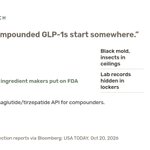
Cheap compounded GLP-1s start somewhere.
FDA found black mold, insects, and samples dumped in sinks at a Chinese semaglutide/tirzepatide ingredient plant. A second relabeled other plants' API as its own. Both on import alert. Ask where the API comes from. usatoday.com/story/money/per…

5
6
221
Banks are afraid AI agents are going to discover ways of reducing the hidden fees that banks use to fleece their customers. They haven’t worried about CC fraud for years… they pass that off to us as CoG. This agentic approach has a real effect on the bank’s bottom line.

Our AI Agents A Freaking Out Banks.
I’m sorry, the agents are relentless in junk fees.
Major U.S. banks are detecting unauthorized third-party AI agents operating inside customer accounts, sources familiar with the issue told Axios on October 22.
Some of those agents appears, according to the bankers, attempted actions that appear independent of user instructions.
The access usually begins when a customer shares login credentials with an AI assistant or agent. The agent then logs in as the user. Most bank guidelines require the human account holder to perform the login, so even access the customer has authorized still violates those rules.
These rules are designed to always make the bank in control of the user experience.
Banking executives told Axios they fear the steps an agent might take once it holds that access, particularly if the user has granted it authority to move funds or complete purchases. In other instances, banks have tracked agents contacting call centers or initiating actions without clear direction from the account holder.
One official described the situation as horrifying and said the industry holds grave concerns about agents gaining access and taking steps that could affect user finances.
Morgan Stanley has begun blocking third-party agents from its platforms, according to people familiar with the decision. JPMorgan, Bank of America, and Citi are also restricting such agents.
A Chase spokesperson said customers should not give their usernames and passwords to anyone.
A Morgan Stanley spokesperson said the bank has not observed instances of rogue AI agents accessing its platforms.
Many banks are authorizing or moving toward read-only access through open-banking connectors, the same type of limited access already granted to third-party budgeting tools.
Even with that distinction, sources said banks broadly struggle to determine whether observed activity is user-directed or whether an agent has been authorized by the customer or has gained access on its own.
The reports follow earlier statements from bank executives about external agents.
On October 13, during JPMorgan’s third-quarter earnings call, CEO Jamie Dimon said the bank would not allow just any outside agent inside because it was too risky for clients and for the company, adding that “you don’t want rogue agents, and it could be thousands of them.”
A bank spokesperson confirmed that third parties are not permitted to obtain customers’ credentials and log in on their behalf, while the bank continues to support secure, customer-authorized data sharing through open-banking providers. Read-only views of balances remain possible through those connectors; transfers and bill payments do not.
Banks are investing in defenses against the agents and preparing “day after” plans that would let them secure or restore customer access if unauthorized activity occurs.
Sources told Axios that cash on hand and experience with critical infrastructure give banks advantages in responding, yet the speed of the technology keeps revealing new weaknesses. Several executives said they recognize customers will want to use agents, but the risks of being too permissive remain too high for now.
They want to block the bots mostly for the need to stay in control. But also a small part to keep the customer safe.
Buckle up.

1
110
Gray-market peptide, gray-market data.
Study note: Reddit self-reports, 7,823 users of unapproved retatrutide. Top: more appetite 17%, fatigue 15%, nausea 12%, insomnia 6%. Phase 2 trial led with GI effects. Vial contents unverifiable. JAMA Netw Open jamanetwork.com/journals/jam…

1
233
Heavy lifting works in perimenopause. Creatine added little on top.
Study note: RCT, n=51 perimenopausal women, 6 wk heavy lifting. Leg press 1RM +175 lb creatine, +190 lb placebo, +77 lb no-lift controls. Creatine vs placebo: not significant. Preprint: preprints.org/manuscript/202…

This is what’s needed… more transparency. Data centers aren’t inherently evil… any more than a factory producing a product. But to stop the fear we need transparency.
marketing-cms-prod-partners.…
1
131
One step closer to pharmacy-grade peptides. Still no text.
FDA sent an "Interim Access Policy for Compounding Using Certain Peptides" to White House review Oct 14. Which peptides isn't public; AP's sources say BPC-157 is in. Nothing changes yet. apnews.com/article/peptides-…

1
124
Even with cannabis, its tough to medicate your way into good sleep.
Study note: Cochrane, 9 trials, n=537, insomnia. Vs placebo: sleep time +7.7 min (CI −23 to +38), no clear gain in sleep quality or daytime function, more side effects. Very low certainty. cochrane.org/evidence/CD0162…

123
Same calories on paper. Not the same meal to your pancreas.
Study note: Crossover RCT, n=32. Nutrient-matched ~300 kcal meals. Equal glucose AUC, but the ultraprocessed meal drove more insulin (60 min: 48 vs 29 µIU/mL) and less carb oxidation. Nat Metab nature.com/articles/s42255-0…

90
Apnea improving with weight loss shouldn't surprise anyone. Many effects credited to the peptides belong to weight loss itself.
Study note: Phase 3 RCT (n=2,339). Retatrutide 12 mg: −25% weight vs −3.9% placebo. OSA: AHI −34.3 vs −9.9/h (9 mg). NEJM nejm.org/doi/10.1056/NEJMoa2…

This is so true… the best diagnostic equipment you have is to close your mouth and listen.

Your doctor cuts you off about 11 seconds after you start talking. Researchers literally timed it in a 2018 study. That number is why Google's new Lancet result is bigger than it looks.
In the study, 98 real urgent care patients texted with Google's AI days before their appointment. No scans, no exam, no bloodwork, just an unhurried conversation about what was wrong. That alone put the correct final diagnosis on the AI's list 90% of the time.
Sounds like magic until you learn what medicine has known for 50 years.
Back in 1975, a British team published a study in the BMJ tracking which part of a visit actually produced the right diagnosis. The physical exam? The labs? Nope. In 82% of cases, the patient's story alone got the doctor there. Everything else mostly confirmed what listening had already found.
So the playbook for accurate diagnosis has existed since 1975. Let the patient talk. Medicine just built a system where nobody has time to run it, and an 18-minute appointment with 11 seconds of uninterrupted patient talk was the result.
Google didn't build a superhuman doctor. It built the first clinician in 50 years with enough time to use the method we already proved works.
And my favorite detail buried in the study... physicians who read the AI's pre-visit summary said it changed how they treated the patient in over half of cases. Hand a doctor the full story before you walk in the room and you get different medicine.
Turns out the most advanced medical instrument Google ever shipped is a conversation that doesn't get interrupted.
2
213
Jeff Davis, MD retweeted

Simply Shocking 🚨
The U.S. is the most medicated country in the world, and it’s not even close!
Prescriptions:
• 256M antidepressants
• 200M statins
• 71M GLPs
• 69M opioids
Yet this is not translating into longer life expectancy. America ranks last among 25 nations!
What are the best solutions to reverse these trends?
• Banning pharma ads?
• Better nutrition and exercise?
Please share your top suggestions ⬇️
@SecKennedy
🤖 Made with AI
Protein without lifting won't save the muscle.
Study note: RCT, 61 men 60-89 y, 4 wk alternate-day fasting. Lean mass lost: control 0.6 kg, protein 0.7, leucine 1.2. Neither spared muscle vs control; authors point to resistance training. Nutrients mdpi.com/2072-6643/18/19/325…
