

The room where bio partnerships get made. F500 BD, VCs, and 2,000 founders — all in San Jose, May 3–6. https://xitter.cf/t.co/wdTABwnyyH
San Francisco Bay Area
Joined April 2007
- Tweets8.1K
- Following2K
- Followers19K
- Likes8.8K




Pinned Tweet
Ticket prices go up Wednesday at midnight PST. Lock in your rate before then → syntheticbiologysummit.com/?…
#SynBioBeta2027
🤖 Made with AI

John Cumbers retweeted

Necrotic enteritis is a $6 billion problem for the chicken industry.
It starts with a microbe that belongs there. Clostridium perfringens lives in every healthy chicken's gut. But when a bird gets stressed, from a feed change or a vaccination, it turns into a gut-punching parasite. It starts making two toxins that break open the gut lining and pull nutrients out for itself.
On Sept 29, BiomEdit got @USDA approval for the first engineered microbe that engrafts in the gut and secretes an antibody to stop it. Not by killing C. perfringens, and not with an antibiotic. By neutralizing the toxins and stopping its mechanism of action in its tracks.
That mechanism is where the $6 billion comes from, and it hits farmers three ways:
- Feed conversion. Most birds don't die. They just absorb less of what they eat and need about 11% more feed per pound of meat. Feed is 65 to 75% of the cost of raising a broiler, so this hits the bottom line directly.
- Weight. Birds with the subclinical form run about 12% lighter at market.
- Mortality. In the worst cases, the birds die.
So does it work? In a challenge study with Southern Poultry Research Group, mortality fell from 13.1% to 6.6%, a 48.7% reduction. Treated birds also converted feed better and gained more weight. Same 42 days, same feed bill, more chicken.
The product is already in more than 35 million broilers across three major US producers. That data comes in around January 2027.
It's also proof of concept. You can deliver a microbe, have it engraft, and have it make a therapeutic right where the disease is.
This is just the first of many potential applications for BiomEdit's microbe engineering platform for drug delivery. Next up are rumen strains that cut methane, gut enzymes that break down inflammatory factors, and dogs with IBD, where an antibody made inside the gut can stay out of the rest of the body.
I got the chance to speak with Aaron Schacht earlier this month to learn about what BiomEdit is building and where they see this technology going. His take:
"We have an N of 1. If you think back to the first antibody that was ever made, this might be the same moment for this modality."
You can read more on the @SynBioBeta website, link in the comments.
🤖 Made with AI

John Cumbers retweeted
Weeding a garden is the most labor intensive part of any farming endeavor, whether that be growing flowers or food for a million people. What if you could spray a protein that only hits the weed, leaves the crop standing, and is gone before the next planting?
That's what Quercus Biosolutions is building. I got the chance to catch up with Jonathan Lightner earlier this month to learn more about their recent $5M raise and their aspirations for a new era of plant management.
Twenty years ago a Midwest grower planted, waited for the weeds, drove through once with glyphosate, and everything died. Today that same field takes three to five herbicides in combination to get the same control.
Every herbicide works by jamming one piece of plant machinery the plant can't live without. That target is the site of action. By the 1980s the industry had found about twenty. Then it stopped. 21 of the 31 known sites of action are now compromised.
As Jon Lightner put it to me, when you have a niche, nature finds things that fit the niche. A weed can evolve resistance in a few years. A new chemistry takes more than 11 years and about $300M to reach the market. Evolution is moving at twice the speed of the industry.
Part of the reason is how herbicides get found. You push millions of small molecules past a plant and keep whatever kills it. Small molecules need a pocket to wedge into. Many of the most interesting plant proteins don't have one. The list of sites of action is a record of what small molecules could reach, not the plant biology worth attacking.
Pharma hit the same wall and got past it with proteins. Quercus is bringing that toolkit to the field, designing mini-protein binders with an AI platform originally built for human drug discovery.
The mechanism of action is where it gets interesting. A protein doesn't have to compete for the active site the way a small molecule does. In some of their advanced programs, Jon says the active site is physically too small for their protein to reach, so it has to be inhibiting the enzyme some other way. A weed that evolved resistance in that pocket isn't necessarily protected from a protein gripping a different surface.
Proteins also solve the problem that has haunted crop protection. Jon's view is that half the unintended consequences come from molecules that persist too long. Proteins have the opposite problem. Most organisms that encounter one treat it as food. So Quercus designs for stable enough, but not too stable:
- Rainfast fast
- Gone before the fall cover crop goes in
- No target in butterflies or mammals walking through the field
- Small and expressible, because cost scales with size
Jon ran biotech at @DuPont_News Pioneer and was CSO at Genus PLC. Co-founder @EnergyCrisp founded @BensonHillInc. Their $5M seed, led by @serraventures, includes farmer-backed funds like @IowaCorn and @sdcorn.
The full story is available on the @SynBioBeta website, link in the comments.
🤖 Made with AI

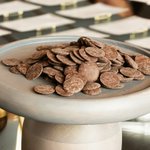
Chocolate is becoming a biomanufacturing story.
Galy just launched WunderHaus, a chocolate made with cocoa grown from cells in tanks in Massachusetts.
Galy is a Boston biotech founded in 2019 by Luciano Bueno and Paula Elbl. It grows plant cells in bioreactors instead of soil.
The investor list is serious. Galy raised a $33 million Series B in 2024, led by Breakthrough Energy Ventures, the fund Bill Gates founded. H&M Group and Inditex joined that round. Earlier backers include Sam Altman's Hydrazine Capital, Material Impact and John Doerr's family office, Eighty Eighty Group.
Luciano first came to SynBioBeta in 2021 and spoke with us in 2023. Back then Galy was known for lab-grown cotton. This year it won Silver at the Edison Awards for its cocoa and cotton platform.
Chocolate companies hit by the climate crisis asked whether the same platform could make cocoa. Galy went from lab to commercial scale in under a year.
How it works:
- Start with a small piece of cocoa bean
- Multiply the cells in brewery-style tanks
- Ferment, roast and grind the harvest into cocoa powder
- Produce in Essex, MA, in repurposed existing infrastructure
Where it stands:
- Cocoa powder self-affirmed GRAS, with FDA notified
- WunderHaus is built for professional kitchens: couverture and baking chocolate
- First customer is Troquet on South in Boston, which stocked its whole kitchen with it
- UAE launch targeted for 2027, backed by a purchase order from a Dubai chocolatier
- Blended with conventional cocoa, with partnerships in the works with growers in Africa and Latin America
Cocoa prices hit an all-time high in 2024. Supply is fragile and weather dependent.
The part I care about most is the platform. A system built for cotton now makes cocoa. Biomanufacturing should work like this: one platform, many crops, production that doesn't depend on weather or farmland.
Congrats to Luciano and the Galy team.

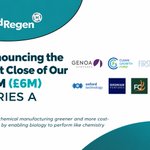
The one and only @drjennyrooke and @genoaventures are leading an $8M (£6M) Series A for @HydRegen_Oxford, a company that swaps precious-metal catalysts in chemical plants for enzymes, cutting manufacturing costs by up to 40% without changing the equipment.
As CEO and co-founder @HAReeve puts it, they let manufacturers “change the catalyst without changing the factory.”
Here’s how it works. They produce a hydrogenase enzyme through fermentation and turn it into catalysts that drop into existing chemical plants. No new reactors. No rebuilt facilities. One enzyme can drive hundreds of different hydrogenation reactions, and each catalyst turns over millions of times.
Why it matters:
→ Hydrogenation is part of 14 to 20% of processes in the trillion-dollar industrial chemicals market
→ Up to 40% cost savings for manufacturers
→ Lower carbon emissions
→ Already working with pharma and specialty chemical customers
For years, industrial biology has asked manufacturers to change too much at once. HydRegen goes the other way and fits into what plants already run.
The new capital goes toward expanding into agrochemicals, materials, and bulk chemicals.
Huge congrats to Holly and the whole HydRegen team, and to Jenny and Genoa for leading.
Great to see @CleanGrowthFund and First Imagine! Ventures in the round, along with @OxfordTechVC, @rapidinnovation, Oxonian Ventures, Headington Holdings, and Foxglove Capital.
Biology is starting to compete with chemistry on chemistry’s terms. This is what that looks like.
#SynBio #Biomanufacturing

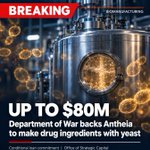
The Department of War just put up to $80M behind making drug ingredients with yeast.
@antheiabio received a conditional loan commitment from @DeptofWar's Office of Strategic Capital to scale U.S. production of key starting materials and APIs for generic drugs.
Why this matters:
- Most active ingredients in U.S. medicines are made overseas
- Antheia engineers yeast to turn sugar into pharmaceutical ingredients through fermentation
- Biomanufacturing is now one of the Department of War's six critical technology areas
This is a loan, not a grant. It gets repaid from commercial revenue. That is a vote of confidence in biomanufacturing as an industrial business. The deal still has to clear due diligence before it closes.
Christina Smolke has made this case on the @SynBioBeta stage for years, from her 2023 talk "Leveraging Synthetic Biology to End Drug Shortages" to our 2026 main stage.
Congrats to Christina Smolke and team.

John Cumbers retweeted
Huge congratulations to Ilya Captain on another sold-out DataDrivenPharma West.
I've been coming to Ilya's events since early 2024. This year every conversation landed on the same question: what makes data worth having?
As a recovering data scientist, I've watched the field go from R and Python, to Snowflake and Tableau, to today's agentic, chat-based era. Go to most bio events and you'd assume AI is everywhere. Talk to the people implementing it and you get the real picture.
That's who fills #ddpwest26. Bioinformaticians, biostatisticians, data scientists, and data vendors from @Amgen, @genentech, @GileadSciences, @LillyPad, and @AstraZeneca. Asked what's holding AI back, the room's biggest answer was "Data." Not models.
Three questions kept coming up.
1. What data are we missing?
The design space for proteins, DNA, and RNA is massive, and we've measured a fraction of it. Even big pharma's best models are only proven in the chemical space they've already worked in. No single company has enough data on its own.
Accuracy drops as molecules move away from the training data. The practical rule for agents: stop iterating when uncertainty gets high.
2. What data actually helps you decide?
Useful data gets you to a defensible go or no-go, fast. Most late-stage failures aren't chemistry. Teams didn't understand enough about who took the drug.
That puts weight on negative data. Every success is probably an edge case. Most of what we learn is failure, buried in an ELN. The catch is trust. Was the hypothesis wrong, or did someone mix up the tubes? Data that doesn't reproduce should be rerun, not cleaned.
Benchmarks are one way to price data. Show a frontier model fails on it, then show the lift after training. But every seller picks the benchmark they win on. The simpler test: 100,000 curated cancer patients sells itself. Raw records from 1,000 hospitals doesn't.
3. Can anyone actually use it?
A typical multimodal program spends 8 of 9 months on setup and 2 to 4 weeks asking questions. The first question pays for the setup. The twentieth is nearly free.
Batch effects go unsolved because wet lab records were never linked to the analysis. Agents rebuild context from scratch every morning. Reasoning without memory produces answers. Reasoning with memory accumulates science.
The value sits where all three meet. Data where models are blind, tied to a decision, in a form someone can use.
Can't wait for next year's DataDrivenPharma West. Looking forward to seeing it even bigger than this year.
#DataDrivenPharma #DrugDiscovery #AI #Bioinformatics


John Cumbers retweeted
Biotech still runs on who owns the patent and who approves the drug.
That was my takeaway from @alexkesin's session at DataDrivenPharma West last week.
Alex wrote one of the most widely shared analyses of China's biotech rise this year, and it has become a reference point in the policy debate. He also co-hosts @approvedfm with [@MatthewPech], a podcast on how drugs get discovered, developed and sold. He walked a room of operators through where the value sits now.
Four quick hits:
- 1:3. Doing the work in China costs a half to a third of the US price.
- Rent, don't sell. Beijing's new export controls block the sale of biotech platforms. Licensing, partnerships and contract research stay open.
- 3x. China tripled its university patent conversion rate in two years, to 10.1%.
- 8% to 32%. China's share of the global early-stage pipeline, from 2015 to 2024.
The first hit explains the last five years. China got cheap and fast, and the West bought what it built. Most of those deals were fast-follows on targets Western labs discovered. The West owned the original IP and rented China's speed.
The other three point to the next five.
The export controls dropped the same morning as the session. Read them next to the new five-year plan, which makes biotech and biomanufacturing a national priority through 2030. The strategy looks clear to me. Generate IP faster than the US, keep ownership at home, and let the world license it.
Pipeline share has quadrupled. Patents are moving out of universities and into companies. Nine out of ten still sit unused, so there's plenty of room to grow.
Patents are still the currency. Regulators still set the exchange rate. The FDA turned away a Chinese PD-1 copycat because its trial ran only on Chinese patients. To get paid in the US, you still need FDA approval and a partner who can launch here.
What changes is who holds the paper. When the West generated the IP, licensing meant Western companies owned the value and paid for speed. As more IP is generated and kept in China, the same deal structure sends more value the other way. The West ends up renting the molecule instead of owning it.
This is a gold rush for intellectual property. The question is who can generate novel IP in a specific area, and do it first.
Therapeutics is the beachhead. The US market pays enough for new drugs that the long road through the FDA still earns a return.
In this gold rush, anyone can be a miner. The fastest ones will have the best maps.
And maps only come from data.
#ddpwest26

John Cumbers retweeted
🔥 Week 43! 40 Bay Area Bio-economy events, Oct 19-25 🔥
🔗 docs.google.com/spreadsheets… 🔗
New this week: the sheet has two tabs.
📅 By Day runs in calendar order, so you can plan your week.
🗂️ By Topic groups every event by field, so you can jump straight to yours.
𝗕𝗬 𝗧𝗢𝗣𝗜𝗖
11 💊 Drug Discovery & Trials
9 🧬 Genomics, Proteins & Omics
7 🚀 Capital & Dealmaking
5 🌱 Industrial & Environmental Bio
3 🏥 Clinical & Care Delivery
3 🧠 Neuro & BCI
1 💪 Human Performance & Wellness
1 🌸 Women's Health & Fertility
𝗕𝗬 𝗙𝗢𝗥𝗠𝗔𝗧
11 Seminar / Lecture
6 Webinar
5 Workshop / Hands-on
4 Mixer / Social / Outdoor
4 Panel / Salon
4 Vendor Lunch & Learn
3 Conference / Symposium
2 Pitch / Demo Day
1 Info Session
𝗕𝗬 𝗟𝗢𝗖𝗔𝗧𝗜𝗢𝗡
12 Virtual
11 San Francisco
5 Berkeley
4 San Carlos
3 South San Francisco
3 Stanford
1 Fremont
1 Oakland
𝗕𝗬 𝗗𝗔𝗬
7 Mon Oct 19
7 Tue Oct 20
13 Wed Oct 21
10 Thu Oct 22
2 Fri Oct 23
1 Sun Oct 25

We wrote about this microbe in 2024, back when nobody could get DNA into it. That just changed.
UTEX 3222 came out of volcanic seeps off Sicily. It grows to extraordinary density and settles out of water on its own, which helps with harvesting, a costly step. The catch was that it shredded any plasmid you handed it.
Subscribe to our newsletter and get the biggest biotech news straight to your inbox 🧬
syntheticbiologysummit.com/?…
General Biotechnologies read the cell's own methylation signatures and used them to disguise incoming DNA. CEO David Kim describes it plainly.
"We analysed the methylation signatures of its own genome. Then we found a way to methylate the DNA going into the cell, using the cell's own signatures, which evades the cell's own endonuclease systems from recognising our DNA as foreign."
This is what I love about our field. A strain scraped off the seafloor becomes a candidate chassis for oral peptide drugs, and the company says its cargo survives stomach acid. That claim still needs data behind it and the preprint is not peer reviewed, which is exactly the kind of thing worth arguing about in person.
None of this leap happens without biologists, founders, investors and pharma partners finding each other. Relationships are built in the room, deals happen in the room, and breakthroughs happen in the room.
Visit the SynBioBeta website to read the full article.
synbiobeta.com/read/general-…

About 60 people came out to Laptop and Learn in Walnut Creek last night, and most of them didn't come from SF. Danville, Oakland, Berkeley, San Ramon, Pleasant Hill, Moraga, Dublin. The SF crowd who made the trip told us they're not used to commuting to a networking event.
We opened with small groups and one question from John Cumbers: what's one AI tool that doesn't exist yet that you want? That question alone kept people talking.
Then the demos. No slides, just laptops. Thanks to everyone who showed their work:
Rupert Yip and Sarosh Naseem of @mithrl_ai
Frederik Schulz of @jgi
Jim Dickey of Argentys.bio
Sean Jungbluth of BioKEA
Robin Green
Erika Trauzzi of @Agilent
Dion Whitehead of metapages
Ahmad Salehi of Donor Network West
Flavius Miron of Human Squared
Zack Zheng of Vazyme
Haotian Guo of Ailurus Bio
Mariam of Nurfy
Harborsite
Igor of Angstrom
and a Saint Francis High School student who built a de novo protein design pipeline targeting avian flu
We also had an open discussion on AI models refusing legitimate bioinformatics prompts. A lot of people in the room had run into it.
Big thanks to Jacob Thomas and @Acrisure for hosting us, and to @humaninterest for supporting the night. The weather helped too.
@SynBioBeta #AI #biotech #synbio


John Cumbers retweeted
100+ people signed up for tonight's Laptop and Learn in Walnut Creek. For a Thursday night event east of the tunnel, that's kind of wild.
The format is simple. People in bio show each other how they actually use AI at work. One-minute pitch to the room, then 15-minute demos around laptops. No slides.
Here's who's demoing tonight:
Rupert Yip and Sarosh Naseem of Mithrl will show Mithrl-1, their biomedical world model.
Frederik Schulz of @jgi is bringing an AI scientist benchmark and next-generation bioinformatics tools.
Jim Dickey of Agentis will walk through their AI approach to designing antibodies and nanobodies against cancer neoantigens, on a timeline of weeks after biopsy.
Sean Jungbluth of BioKEA is demoing a workflow that goes from a prompt to a 3D-printed biological tool prototype.
Robin Green, founding scientist at a stealth startup, will show data pipelines built in Claude and how wet lab scientists with no coding background can build their own tools.
Erika Trauzzi of @Agilent will show how to pitch a product idea in one step.
Dion Whitehead of metapages is bringing open source AI artifacts that let you build with any AI while keeping control of your data.
Ahmad Salehi of Donor Network West will talk through organ donation in Northern California.
Flavius Miron of Human Squared will show AI creators producing short-form video for brands.
Plus demos from Zack Zheng of Vazyme, Haotian Guo of Ailurus Bio, and a Saint Francis High School student who built a de novo protein design pipeline targeting avian flu.
5:00 drinks and networking
6:00 demos, three rounds
7:00 more drinks, more networking
Free, thanks to our friends at @Acrisure and @humaninterest. Steps from Pleasant Hill/Contra Costa Centre BART.
Request a spot: luma.com/xioobrw7
See you at 1350 Treat Blvd tonight.
@SynBioBeta #AI #biotech #synbio
John Cumbers retweeted
Boston lab space is 28.9% empty. The Bay Area is at 30.7%. Houston is at 26.3%.
The XBI is up more than 20% this year. So why is no one moving back into these labs?
Honestly, it shouldn't surprise anyone. Back in 2021 and 2022, the whole game was cramming as many researchers and benches into a building as you could. A few things changed that pretty fast.
- AI-native biotechs lease about a third less space per person.
- Pharma is licensing molecules and sending manufacturing overseas. When we ran a talk at MBC Biolabs, we heard that close to 80% of the companies there outsource some or all of their manufacturing to Chinese firms.
- Later-stage companies want office, not lab. They're managing assets already in trials.
The lab of 2026 just looks different. Teams are smaller. The science is AI-native. And a lot of the actual work isn't happening in Boston or SF anymore. It's happening in Shanghai and Suzhou.
The R&D that does happen here is smaller, leaner, and set up to scale out somewhere else. Those teams don't need rows of benches. They need machines. If your building has 500 benches but not a single mass spec, liquid handler, or flow cytometer, nobody's going to want it. The equipment is the real bottleneck for early-stage work.
The few groups that still want big footprints are building them around robots and power. @LilaSciences grabbed about 244,000 sq ft at Alewife Park in Cambridge for autonomous labs. @medra_ai put hundreds of robots into a concrete industrial building in SF.
So here's the uncomfortable part. These buildings were built for a tenant that doesn't exist anymore. That tenant isn't coming back. Leaving the space empty and hoping 2021 returns isn't a plan.
You have to rebuild it for who actually needs space now.
- Deep tech and hard tech. I've been talking with groups here in SF, and a lot of robotics and hardware teams are looking for exactly this kind of space. Strong floors, real power, good ventilation. Retrofitting a lab is way faster than building new.
- Incubators built around machines, not benches. Rip out the bench rows and put in the instruments early-stage companies can't afford on their own.
MBC Biolabs is already doing this. Shared instruments, shared equipment, small teams that don't need 50,000 sq ft.
Landlords who follow that blueprint will fill their buildings. The ones waiting on 2021 are going to keep sitting empty.
Plot twist: @TwistBioscience is back for #SynBioBeta2027 🧬
They're taking part in the Tools & Platforms track, May 3–6 in San Jose.
Watch Emily Leproust's "10-Year Overnight Success" fireside chat → youtube.com/watch?v=CqicoqEW…
Tickets → syntheticbiologysummit.com/?…
The team that tracked COVID in our sewers is now watching chickens that make medicine.
Neion Bio turns eggs into factories for biologics.
Barnwell Bio reads a whole flock’s microbiome from the environment around it.
Put them together and you get a drug plant that can see trouble coming.
Subscribe to our newsletter and get the biggest biotech news straight to your inbox 🧬
lnkd.in/g5_whUQF
“At Barnwell Bio, we often identify elevated pathogen load in the barn environment ahead of clinical signs, giving producers early visibility into animal health and the data they need to act,” said Michael Rhys, cofounder and CEO of Barnwell Bio.
This is the future of biomanufacturing.
Distributed, biological, and measured.
And it is happening in #Manhattan.
I first heard this story in conversation.
That is how this field moves.
The relationships, the deals, and the breakthroughs happen in the room.
Visit the SynBioBeta website to read the full article: lnkd.in/gqWygNrg
In 2010, Joseph McAuliffe stood up at the American Chemical Society and showed how engineered bacteria could turn sugar into the raw material for Goodyear tires.
Today he chairs the committee writing the standards for industrial biotech and synthetic biology.
Joe has spent more than 25 years doing the unglamorous work that makes biomanufacturing real: the analytical chemistry, the enzymes, the process, and the proof. He has published 63 papers cited more than 2,800 times, and his name is on a stack of patents for making isoprene from renewable feedstocks.
In 2027 he joins us at @SynBioBeta to moderate our Chemicals & Materials breakout, "New to Nature: Beyond Drop-In Replacement in Chemicals and Materials."
Few people are better placed to run that conversation. He spent years building one of the most ambitious drop-in programs in the field, and has watched what it actually takes to get a biobased molecule from a fermenter into a product.
His work at a glance:
- Presented the Genencor and @goodyear BioIsoprene program at the 239th ACS National Meeting, a fermentation process that recovers isoprene, the monomer behind synthetic rubber, straight from the gas phase
- Co-authored the 2010 technology update on that gas-phase bioprocess and is named on the patent family behind it
- Chairs @ASTMIntl Committee E62 on Industrial Biotechnology and Synthetic Biology, which develops the standards for biobased products, microbe-based products, and carbon intensity
- Co-authored "Industrial use of immobilized enzymes" in Chemical Society Reviews, one of the field's standard references on enzyme immobilization
His career runs through the companies that built industrial biotech:
- @UAlberta and @sbpdiscovery, where he trained in carbohydrate and organic chemistry
- Genencor, the Palo Alto enzyme company that pioneered industrial fermentation, where he worked as a staff scientist on BioIsoprene
- @dupont, which acquired Genencor in 2011, where he led the bioanalytical department
- @IFF, which merged with DuPont's Nutrition & Biosciences business in 2021, where he was a Technical Fellow and Senior Principal Scientist in analytical chemistry
- McAuliffe Consulting Services, his Sunnyvale firm, where he now advises investors and companies across industrial biotech and synthetic biology
Back in 2010 he put the goal simply: "We want to make biochemicals from renewable materials, partially as a hedge against rising crude oil prices and much more so because this approach moves us to a more sustainable future."
This year he wants to push past that first chapter. Drop-in replacements taught the field how hard it is to compete on price with petroleum. The next question is which molecules only biology can make, and what it takes to bring them to market.
If you're building in chemicals or materials, or investing in companies that are, Joe is the person to find.
Come find him in San Jose, May 3-6th.

John Cumbers retweeted
Check the tag on what you're wearing. There's a better than 50% chance it contains polyester.
Polyester makes up 55% of global fabric production. Cotton is ~23%.
How did cotton, king of fibers for 200 years, lose its crown?
Cotton had limits. Output was tied to land, water, and weather. Yields have been stuck at 25-30 million tonnes a year for the past 40 years.
Polyester, made from oil in refineries, faced no such cap. It could expand as fast as new plants were built. In the 1990s, China built them. To do it, China needed two key petrochemicals:
- Paraxylene (PX → PTA): an aromatic ring with two methyl "handles," oxidized into terephthalic acid. It forms polyester's rigid backbone, giving it strength and durability.
- Monoethylene glycol (MEG): a two-carbon chain with -OH groups on each end. It links the terephthalate units into long chains and makes the material processable.
Heat PTA and MEG together and they form ester bonds, producing long PET chains that go into everything from clothing to packaging.
For decades, Japan and South Korea led PTA and MEG production. By the 1990s, both had moved into higher-value industries. Toray and Teijin went into high-performance fibers and electronics. Samsung and LG went into semiconductors. That left an opening.
China bought PX and MEG from Japan and Korea, then built the plants to spin them into polyester at colossal scale. Japan and Korea exported feedstocks. China turned them into fabric. Polyester flooded the world.
The supply surge hit just as demand shifted. Zara and H&M scaled fast fashion. Nike and adidas pushed performance wear. Uniqlo's fleece boom made polyester a staple.
Polyester overtook cotton in 2002. As of 2025, more than 80% of the world's polyester is made in China.
China has produced roughly 1 billion tonnes of polyester in the past 50 years. That's enough to fill the Empire State Building more than 900 times.
Production isn't slowing. Cotton hit its ceiling decades ago, but polyester keeps expanding. Only ~14% is recycled. The rest is burned, buried, or shed into the environment.
Cotton's reign lasted 200 years. Polyester's has only just begun.
🤖 Made with AI


33 amino acids. Five cancer targets. One drug.
I rarely take interviews myself. For @CaitlynBioE of TwoStep Therapeutics (@TwoStepTx), I made an exception.
Caitlyn built TwoStep out of the @ University labs of Nobel laureate Carolyn Bertozzi and Jennifer Cochran (@CochranLab), with Ron Levy as a co-founder.
Subscribe to our newsletter and get the biggest biotech news straight to your inbox 🧬
lnkd.in/gjytG4mX
The best part is how they found their molecule. The lab was looking for something else, and one peptide kept outperforming everything in mouse imaging.
So the lab kept testing it, because there was clearly something going on.
That peptide binds five integrins on tumors. It means one drug could reach cancers that single-target drugs leave behind. This is what happens when great science meets a founder who will not let a strange result go.
@omri_drory at @NFX introduced us. That is how this field moves. The relationships, the deals and the breakthroughs all happen in the room.
Visit the @SynBioBeta website to read the full article.
lnkd.in/g5T4x22c

