
Scientist at Illumina using AI methods to interpret the non-coding genome and empower new genetic association discoveries.
Joined November 2013
- Tweets835
- Following235
- Followers327
- Likes1K




Pinned Tweet
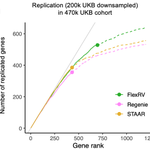
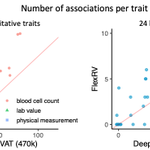
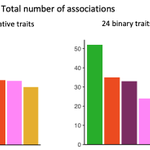
Let’s talk about rare variant association tests - we have a new method that helps you discover more with the same data! It’s called FlexRV to signal our approach: Flexibly modeling rare variant pathogenicity improves gene discovery for complex traits. biorxiv.org/content/10.1101/…

Amazing and fascinating work!

Thanks @anshulkundaje, it means a lot! Wholeheartedly agree a major engine for this work is a multi-disciplinary team: high quality MPRA, deep knowledge of underlying models, and hours and hours of agonizing over a regulator grammar informed validation strategy.
Eye-opening thread on what clinical trials for neurodegenerative diseases have really been focusing on for the past 20 years.

To map the landscape of neurodegenerative disease clinical trials we analyzed 20 years of trial registrations.
The paper: nature.com/articles/s41598-0…
My blog post: cureffi.org/2022/10/24/preve…
Key findings in this thread 👇

What an incredible resource. Can't wait until it's publicly available.

Our pre-print describing the @uk_biobank Pharma Proteomics Project (UKB-PPP) is now online!
biorxiv.org/content/10.1101/…
We identify 10k+ genetic associations w/ protein concentrations; 85% are new.
The data should help drive discovery of new biomarkers, diagnostics & medicines.

Missed this from a few weeks ago - fascinating work finding a distinct mutational signature of somatic mutations in single neurons from Alzheimer brains.

Excited to share our paper “Somatic genomic changes in single Alzheimer’s disease neurons”, published today in @nature!
nature.com/articles/s41586-0…
[1/19]
A wonderfully clear talk on a new model that improves prediction of mRNA degradation rates, and elucidates underlying sequence features.
This post is from an account that no longer exists. Learn more
This was really interesting - certainly more insightful into the dynamics of brainstorming virtually than I expected, given the title.
nature.com/articles/d41586-0…

Richard McElreath's lectures are superb. Must-watch if you want to learn more Bayesian stats and how to think about inference.

Ppl are on twitter for many reasons. I'm here to chew bubblegum & teach scientific inference. And I'm all out of gum. Engage yourself with 20+ hours of free lectures on causal inference and Bayesian data analysis. This isn't an ordinary statistics course. github.com/rmcelreath/stat_r…
5
Amazing opportunity to work with an exceptional statistician and geneticist.

I can't speak highly enough about this plenary talk by @dalygene at the @ICDAbio. (A month late when I finally watched it.) Great overview of where we've come in common disease research, and how to think about steps forward. youtube.com/watch?v=MvIyUPoh…
Alzheimer's disease geneticists have been waiting for this for a long time.
This post is from an account that no longer exists. Learn more
1
3
Wonderfully clear explanation by @scottlundberg

Great post by @scottlundberg on difficulty of causal interpretation of feature importance scores from predictive ML models link.medium.com/UCARYwAhKob
H/T @jmschreiber91

This is really cool work. Check out the interactive manuscript. And I only realised part way through that @theosanderson was one of the main contributors.

Predicting protein function based on amino acid sequences has broad impact, but can be challenging. Check out a new #ML approach that has resulted in ~6.8M new protein function annotations, and try it yourself using an online interactive tool. Read more ↓ goo.gle/3sPKUSw
1
Really interesting approach.

Leveraging the phenotypic correlations to impute the missing phenotype and performing GWAS on the imputed phenotype to drive gene discovery. Creative work by @FrankWendt10 et al. I like it!
nature.com/articles/s41380-0…
3
Good news for Open Targets - adding strength to our target discovery efforts.

We are delighted to announce that @Pfizer has joined the Open Targets consortium
We look forward to bringing their drug discovery expertise into the partnership, complementing our five current partners: @emblebi @sangerinstitute @GSK @bmsnews @sanofi
opentargets.org/news/pfizer-…

ALT The blue Pfizer logo on a white background
Have been waiting for this! Will be working to get the new data into the Open Targets Genetics portal soon.

We are pleased to announce the public release of FinnGen DF6 results and summary statistics!
The results are based on >260K individuals, almost 17M variants and >2860 disease endpoints. #OpenScience
More information on how to access the results here:
finngen.fi/en/access_results

A great opportunity to join us in using large-scale genetic data to find causal genes. (And hopefully therapeutic targets!) Many different avenues to pursue and types of data to use.

Are you a bioinformatician or stat gen? Join my team in @OpenTargets Genetics!
Focusing on target prioritisation & safety using: rare and loss of function variants from consanguineous pop, Mendelian Randomisation, GWAS and cell-specific genomics datasets
jobs.sanger.ac.uk/vacancy/-s…
I'm really enjoying @AndrewYNg courses on neural networks... particularly this drawing of a saddle point in the optimisation cost function, which apparently is meant to be ridden facing backwards on a dragon. 😂

1
Fascinating indeed!

This thread is about our new preprint on transposable element called long interspersed nuclear elements (LINE-1/L1). When expressed excessively in the cerebellum, L1 causes ataxia (impaired coordination).
A fascinating finding by @taka_takehiro 👇🏽 (1/)
biorxiv.org/content/10.1101/…
