
Agentic Post-Training, Self-Improvement | Research Scientist @GoogleDeepMind | Previously PhD @nlp_usc, B.Eng @TsinghuaNLP
Joined May 2021
- Tweets110
- Following955
- Followers1K
- Likes480





Jun Yan retweeted

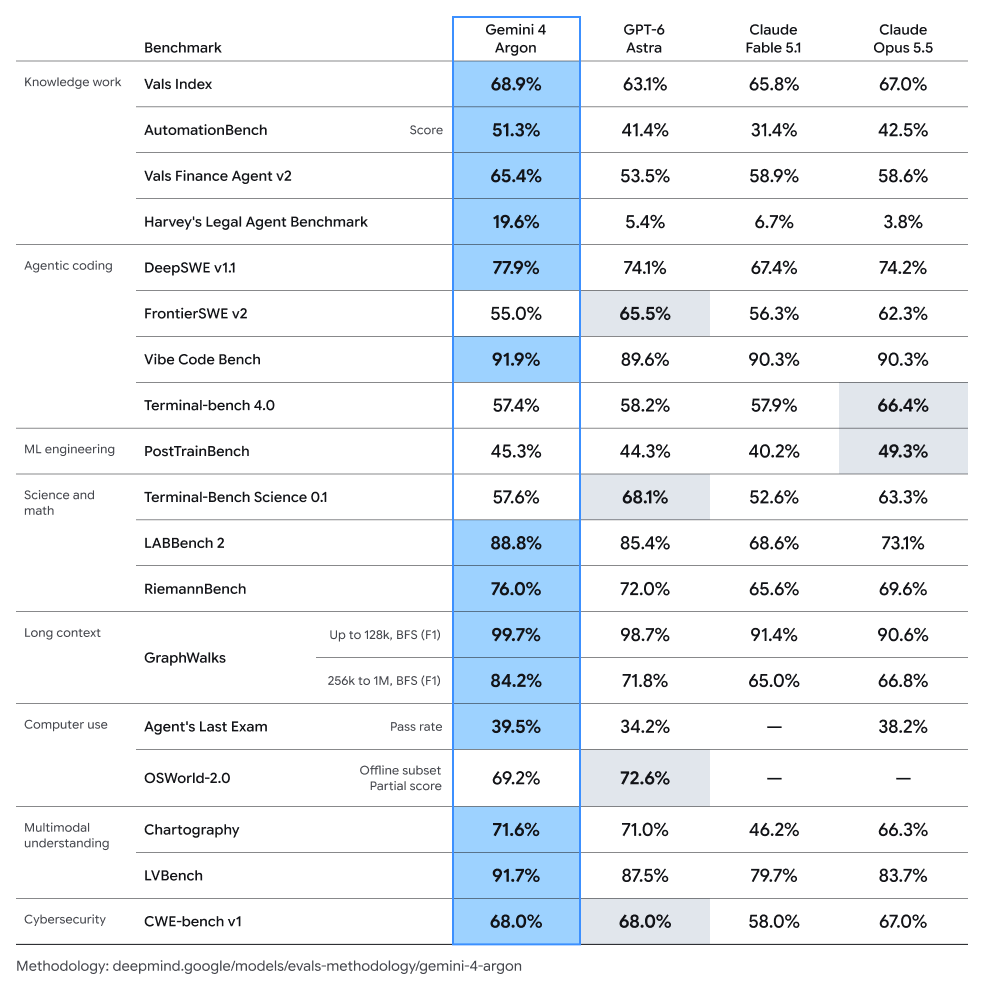
On behalf of Gemini 4’s modeling team to improve VibeCoding capabilities (spanning WebDev, 3D, games, full-stack, Android dev, and more), we just landed 91.9% on VibeCodeBench!
As the AI race heated up, our release cadence accelerated dramatically. The pressure was immense - we worked day and night, non-stop, to land critical recipe improvements and push our model performance forward!
Today, with Gemini 4, we came back strong!
Huge thank you to my teammates who held the line through countless days and nights without ever complaining, and to our horizontal partner teams and leadership who believed in us and gave us unwavering support. Onward and upward!! 🚀


Jun Yan retweeted

Introducing Gemini 4 Argon – our new frontier model.
It’s built for complex workflows across coding, enterprise knowledge work, and cybersecurity defense – rolling out today to a set of trusted testers through our Fairwind Program.
Jun Yan retweeted

We revolutionized environment design by building the "Harness" for environments, not just agents! Static environments bottleneck the growth of LLM agents. When environments can't evolve, agent progress stalls. Enter EnvHarness: a powerful, unified wrapper framework engineered to dynamically adapt environments and unlock rich training signals.
🔌 Non-Intrusive Interception
🌀 Dynamic Environments
🧩 Plug-and-Play Integration
Title: EnvHarness: Awakening Static Worlds for Agent Learning
Paper: arxiv.org/abs/2608.19880
Code: github.com/google-research/e…
Webpage: envharness.com/
Jun Yan retweeted

🧩 How can we assign fine-grained credit over long tool-use trajectories and let agents learn from past attempts in agentic reinforcement learning when rewards are no longer verifiable?
Excited to share RubricEM, an RL framework for long-form deep research agents that plan, search, use tools, and write reports without exact answer checks.
📖 Paper: arxiv.org/abs/2605.10899
(1/n)

How do we train LLM agents to be better continual learners that self-evolve after deployment? 🧠
🛠️ Introducing SkillOS. We propose an RL recipe for training skill curation that distills wisdom from past experiences via indirect and delayed feedback—a core piece of building self-evolving agents.
⭐ First author Siru is on the industry job market! It has been an incredible experience working with her (both on this and ReasoningBank). She brings deep expertise in agentic post-training, continual learning, and agent memory. Don't miss out on hiring her! 👇

Thanks @_akhaliq for sharing our paper!
We study skill curation as a trainable capability for self-evolving agents. This capability actually is ‼️hard to train‼️due to the long-term evolving setting that only has indirect and sparse learning signals.
In SkillOS, a skill curator operates over evolving Markdown skills like an operating system — continuously inserting, refining, and organizing reusable experience over time.
With our training recipe, a trained 8B curator can outperform zero-shot frontier models (Gemini-2.5-Pro) for skill curation in self-evolving agent systems.
Jun Yan retweeted
See yall in Seoul!
First ICML thanks to my brilliant intern @MingZhong_ and the team!
Ming is on job market literally right now, and he’s literally the best. If you’re hiring people for coding agents, can’t think of a reason why Ming’s DM is not full of messages. Please reach out!

Arrived in Rio de Janeiro to attend #ICLR2026 🇧🇷 I will present three posters:
1. Incentivizing Agentic Reasoning in LLM Judges via Tool-Integrated Reinforcement Learning
Thu, Apr 23, 3:15PM — 5:45PM, Pavillion 3 (Poster Session 2, #1511)
2. ReasoningBank: Scaling Agent Self-Evolving with Reasoning Memory
Fri, Apr 24, 3:15PM — 5:45PM, Pavillion 3 (Poster Session 4, #1410)
3. Supervised Reinforcement Learning: From Expert Trajectories to Step-wise Reasoning Sat
Apr 25, 3:15PM — 5:45PM, Pavillion 3 (Poster Session 6, #1315)
Happy to meet and chat about agents, memory, RL, and more!
Jun Yan retweeted

ReasoningBank, a novel agent memory framework, enables LLM agents to continuously learn from both successful & failed experiences. Our evaluation shows that it enhances agent effectiveness, boosting success rates and efficiency. Learn more: goo.gle/4dWrPGb

ALT Workflow of ReasoningBank integrated with an agent during test time.
Jun Yan retweeted

Introducing @NeoCognition, the agent lab for specialized intelligence.
Everyone needs experts, but human expertise does not scale.
Backed by $40M seed funding, we build self-learning agents that specialize across domains to make expertise abundant.
Jun Yan retweeted

🏧Giving your agent unlimited tool calls doesn't make it smarter.
💡Why? It lacks 'Budget Awareness'!
Introducing Budget Tracker, a simple plug-in that enables more effective scaling behaviors: higher performance, lower cost.
Paper: arxiv.org/pdf/2511.17006

Jun Yan retweeted

Happy to introduce my internship work at @Google and @GoogleDeepMind, collab w/ @googlecloud.
We introduce TIR-Judge, an end-to-end agentic RL framework that trains LLM judges with tool-integrated reasoning 🧠🛠️
🔗arxiv.org/pdf/2510.23038
#Agents #LLMs #Judges #RL #reasoning

Jun Yan retweeted

🧠🚀 Excited to introduce Supervised Reinforcement Learning—a framework that leverages expert trajectories to teach small LMs how to reason through hard problems without losing their minds. 🤯
Better than SFT && RLVR.
Read more: huggingface.co/papers/2510.2…
#llms #RL #reasoning

Jun Yan retweeted

New paper from @Google is a major memory breakthrough for AI agents.
ReasoningBank helps an AI agent improve during use by learning from its wins and mistakes.
To succeed in real-world settings, LLM agents must stop making the same mistakes. ReasoningBank memory framework helps agents learn from both successes and failures and turn them into reasoning strategies that generalize.
Traditionally, most agents handle tasks in a stream but do not keep lessons, so they repeat errors.
The system turns each action log into a short memory item with a title, a description, and a concrete next step.
Before a new task, the agent retrieves the most relevant items using embedding search and appends them to the system prompt.
After each run, a separate LLM labels success or failure, and the system writes out strategies and pitfalls.
New items go into the bank with consolidation that removes duplicates and sharpens the content.
MaTTS is a memory aware test time scaling setup that spends extra compute on parallel rollouts or step by step self refinement.
Those extra passes create contrasting traces that make the memory stronger and more precise.
Across WebArena, Mind2Web, and a software engineering benchmark with Gemini 2.5 and Claude 3.7, success rises and average steps drop.
On successful cases, the average step count drops by 2, which means less wandering when the agent is on track.
----
Paper – arxiv. org/abs/2509.25140
Paper Title: "ReasoningBank: Scaling Agent Self-Evolving with Reasoning Memory"

Jun Yan retweeted
🆕Drop from Gemini VibeCoding Team:
Why does code functionality correctness NOT necessarily translate to 𝗯𝗲𝘁𝘁𝗲𝗿 𝘂𝘀𝗲𝗿 𝗽𝗿𝗲𝗳𝗲𝗿𝗲𝗻𝗰𝗲 𝗳𝗼𝗿 𝗰𝗼𝗱𝗶𝗻𝗴 tasks?
In 𝗩𝗶𝗯𝗲𝗖𝗵𝗲𝗰𝗸𝗲𝗿: arxiv.org/abs/2510.07315, we find that the human preference correlates the best with a composite score of functional correctness and instruction following capability.
To evaluate the instruction following capability of LLM for coding, we propose a taxonomy of 𝟯𝟬 𝘃𝗲𝗿𝗶𝗳𝗶𝗮𝗯𝗹𝗲 𝗰𝗼𝗱𝗶𝗻𝗴 𝗶𝗻𝘀𝘁𝗿𝘂𝗰𝘁𝗶𝗼𝗻𝘀 together with their corresponding deterministic checkers.
We evaluated 31 leading LLMs and
show that even the strongest models struggle to comply with multiple instructions and exhibit clear functional regression!
Please take a look at our paper and let us know how you like it!
We also look forward to seeing the community extend the work on real user coding prompts to understand how we can improve 𝗿𝗲𝗮𝗹-𝘄𝗼𝗿𝗹𝗱 𝘂𝘀𝗲𝗿 𝗰𝗼𝗱𝗶𝗻𝗴 𝗲𝘅𝗽𝗲𝗿𝗶𝗲𝗻𝗰𝗲, let us know if you want to collaborate on these topics! (0/1)

Jun Yan retweeted

Extremely honored to be part of this incredible team ❤️! Here is one of my favorite samples ; )

it's an honor to work with such an incredible group of researchers.
massive shoutout to @LiLiunian, @DmytroOk , avi, @ezhang887 , @ryw999 @troyluhman and eric, eric mintun, @bram_wallace @JureZbontar @mmmbchang @gabriel1 @dangengdg and @cmikeh2 for their incredible work on sora 2.
the sora research team is very special.
Jun Yan retweeted

Thanks for sharing our work @arankomatsuzaki ! Really excited about how reasoning-based memory drives and scales for self-evolving agents 💫 :
🏬ReasoningBank stores insights from both successful and failure trajectories;
🛠️ MaTTS builds on this powerful experience learner, and positions memory-driven experience as a new dimension for agent scaling by leveraging the synergy between memory and TTS.


How do we build personalized LLM agents using memory? Come find out at our #ACL2025 poster today!
My colleagues @anmourchen and Long will present. Come say hi to chat about the paper and all things LLM agents.
⏰Tue, July 29th, 16:00-17:30
📍 Hall 4/5, Session 10
#ACL2025NLP

Memory is crucial for building personalized agents. I'll be at ACL 2025 next week to present our paper in reflective memory management, see you in Vienna!
Paper link: arxiv.org/pdf/2503.08026
#LLM #memory #agent #ACL2025

Jun Yan retweeted

@ReviewAcl @emnlpmeeting Urgent help needed.
acFZ: initial score 3
🧊 Complete silence during discussion.
⏰ 4am PST, 9 min before deadline: quietly drops to 2.
with “Thanks for the rebuttal. I have updated the score.”
⚠️ No explanation. No notice. No chance to respond.
(0/n)


Jun Yan retweeted

Is a single accuracy number all we can get from model evals?🤔
🚨Does NOT tell where the model fails
🚨Does NOT tell how to improve it
Introducing EvalTree🌳
🔍identifying LM weaknesses in natural language
🚀weaknesses serve as actionable guidance
(paper&demo 🔗in🧵)
[1/n]


Jun Yan retweeted

I'll be at #NeurIPS2024! My group has papers analyzing how LLMs use Fourier Features for arithmetic (@tianyi_zhou12 ) and how TFs learn higher-order optimization for ICL (@DeqingFu), plus workshop papers on backdoor detection (@jun_yannn) and LLMs + PDDL (@BillJohn1235813)