

Onchain Finance @Dune | “Leadership is making your people uncomfortable at a rate they can control” 🇺🇸|🇪🇬 underexposed maxi ♟️
Washington, DC
Joined April 2013
- Tweets10.3K
- Following1.4K
- Followers2.9K
- Likes136K








They asked about tokenization and i talked about holders for 10 minutes straight. nobody stopped me

1
19
450
Karim retweeted

Might be the coolest data @Dune has ever shipped
Pool Liquidity, delivered in real time

Real-time market data feeds is here!

Today we’re launching Dune Market Data Feeds: real-time trades for spot and perpetual markets.
Onchain trading data is messy and liquidity is fragmented across chains and venues. Dune turns it into market data by putting trades in one normalized data model, alongside reference data that identifies and classifies every asset.
Onchain market data is becoming more important than ever:
- About 25% of spot crypto trading now happens onchain
- Tokenized stocks and ETFs traded more than $37 billion in Q3
- Perpetuals on stocks, ETFs and equity indices traded $201 billion on Hyperliquid in Q3
- The SEC has opened the path for tokenized U.S. stocks to trade onchain, and the first venues are already applying
Request a trial if onchain trades and prices matter to your team: eu1.hubs.ly/H0zjr2W0
1
2
290
Karim retweeted

Stocks on a blockchain, and the people who have to make that work.
What actually changes when RWAs move onchain, hashed out by Coy Garrison, deputy general counsel for crypto at @RobinhoodCrypto, Julie Lascar who runs policy at @digitalasset, @OrestGavryliak, chief legal officer at 1inch, and @kdotkrisp from @Dune.
Groundwork main stage, 3PM
📅 16 October
📍 National Union Building, Washington DC
Moderated by @kartiktalwar of @ETHGlobal.

Hot take: "on-chain" makes your post read like it was written by AI.
It's onchain. One word. For comparison we stopped saying on-line years ago.
9
419
Next week I’ll be speaking at Groundwork hosted by @1inch and @BlockchainAssn during DC Fintech Week.
Panel 4: Everything, Tokenized. What happens when assets move onchain?
Oct 16, 3:00 PM, Washington DC
luma.com/groundwork_dc

8
386

Karim retweeted
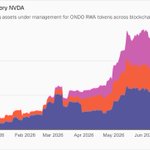
Tokenized real-world assets traded $27.3B onchain over the last 90 days. Volume is the easy number. Ownership is the useful one.
This view shows who holds tokenized NVIDIA exposure on Ondo Global Markets, from investors and funds to exchanges, trading venues, and market makers.
For institutional teams, this is an important layer of market intelligence: monitor holder concentration, track distribution shifts, and understand where tokenized assets sit across the onchain ecosystem.
This growing market is one where anyone can audit the AUM. From reading the SQL to tracing every figure back to the raw trades and attribution.
Every RWA product or token is resolved to an exact legal product AND an onchain contract before it enters our registry.
RWA Dataset: dune.com/data/rwa

RWA Summit conversations are all about the data

RWA Summit is packed! Onchain rwa holders 5x’d this year to 1.5M.
If you need the data behind it @dune team is here. Come find us

8
898

Tokenized real-world assets traded $27.3B onchain over the last 90 days. Volume is the easy number. Ownership is the useful one.
This view shows who holds tokenized NVIDIA exposure on Ondo Global Markets, from investors and funds to exchanges, trading venues, and market makers.
For institutional teams, this is an important layer of market intelligence: monitor holder concentration, track distribution shifts, and understand where tokenized assets sit across the onchain ecosystem.
This growing market is one where anyone can audit the AUM. From reading the SQL to tracing every figure back to the raw trades and attribution.
Every RWA product or token is resolved to an exact legal product AND an onchain contract before it enters our registry.
RWA Dataset: dune.com/data/rwa
Karim retweeted
For 8 years, @dune has served crypto businesses and the wider crypto community with our industry leading data platform.
Today we are announcing that we are changing Dune's free plan and how access to the product works
Karim retweeted

Today we are announcing that we are making the @Dune free plan view only. Meaning you can still look at all the amazing dashboards on Dune, but not run queries without a paid plan. The simple reason is that compute costs for running flexible queries over large amounts of data is very costly. We will still offer incredible value for money self-serve plans at $65 and $349 per month where you have access to vast amounts of blockchain data with completely serverless and hassle free querying. You can also try our very popular and powerful Plus plan on a 14 day trial when you sign up for a free account.
For years Dune has had a very generous free plan including free compute an data access. Hundreds of thousands of users have queried blockchain data with Dune, and millions of people have been exploring the dashboards created. We know of hundreds of users that have built a data career on top of Dune, and there are likely many more. We are grateful to everyone that’s been exploring this data together with us. I’m proud and humbled that we’ve gone from @mewwts, me, some blockchain data in a postgres db and a few users in a Telegram channel, to reaching millions with the Dune platform and community.
During Dune’s 8+ years in business countless data providers have come and gone. And I can tell you that what is worse than losing access to free compute is to lose your mission critical data provider all together. The reason why we’ve been able to stick around, and will keep sticking around, is because we adjust to the market. Thousands of industry leading businesses rely on Dune for their blockchain data, and they can safely keep doing that.
Some have called these plan changes the end of an era. And that might be right, but I think the new era is going to be bigger and more exciting. The blockchain industry is now mature enough that businesses and financial institutions are coming onchain at a blistering pace. Dune is all in on empowering them with onchain data. During this new era Dune data will keep reaching millions of people, businesses and AIs in our mission to make onchain finance observable.
BITCOIN:NATIVE has hit 80K for the first time in 3 months, what do we think does it hold this time?
6
228


Thank you for sharing @0xjayeshyadav 🫡 happy to dive deeper into this all feedback is welcomed as we go down the vault rabbit hole

Subordination as the rating, @kdotkrisp turned this into a live Dune dashboard.
And the clever thing is how he handled Morpho. A Morpho market doesn't call itself tranched, but it is one. The lender is the senior, the borrower's collateral equity is the junior that takes the first loss, and the LLTV is the covenant. So every overcollateralized loan is already a tranche structure, and now you can watch its coverage move in real time.
He flagged the limit too, which I appreciate: subordination is not the full rating. It tells you the size of the buffer, but not the loss distribution of the collateral. 10% behind USDe is not the same as 10% behind a memecoin.
The fix is to risk-adjust the buffer by the collateral's volatility. That, together with subordination, is the actual measure of risk.
Great work.
dune.com/dune/subordination-…

24 of the 50 largest US banks have tokenized deposits on the roadmap. Four have actually shipped one.
Wells Fargo announced its version on August 4, launching this fall with USD to GBP for select corporate clients, on the bank’s own blockchain.
What’s pushing them is stablecoins. And there’s the asymmetry: stablecoin supply, holders and flows are public and measurable today. Tokenized deposits on proprietary chains are not.
So if you’re modeling deposit displacement, the public side has to carry the entire read. That only works if you can separate an issuer redemption from a bridge burn from an exchange sweep, because those look nearly identical in a transfers table and mean opposite things.
If you’re building this internally: what are you using for stablecoin balances by holder type?
#TokenizedDeposits #Stablecoins #OnchainData
3
176
Institutions must track a vaults diversification before deploying capital.
One of the biggest problems with most onchain vaults is they’re not diversified enough.
Diversification only helps when positions fail independently. Most vaults spread TVL across a few strategies and appear diversified, but they mostly share the same risks: crypto exposure, a stablecoin peg, or a common oracle.
CLOs are highly diversified, with thousands of unrelated borrowers where one default says nothing about the next. A crypto vault shares one risk across strategies.
Diversification can’t protect a vault when everything fails together. One hack or depeg, and it all collapses at once.
3
423