

Ex-Talisian, Ex-Board member @P2PU; Governor BFMNS; Transforming Education! Mentor with interests in devops/AI/archery/pen making. Views my own.
Birmingham, UK
Joined January 2007
- Tweets56K
- Following1.7K
- Followers1.5K
- Likes93.6K

Nadeem Shabir 💫 retweeted

This guy utterly dismantles the populist politics of Reform and Restore in 90 seconds. It’s actually quite beautiful.
Take decades of deep-rooted problems in Britain and convince people that a relatively tiny proportion of the population is responsible for all of them. Housing, the NHS, crime. Blame illegal migrants for everything.
Suddenly, you don’t need credible solutions to the housing crisis, NHS waiting lists or crime. You just need increasingly extreme policies on immigration.
And by the time people realise you never had meaningful answers to the vast majority of Britain’s problems, you’re already in power, handing out tax cuts to your donors.
Nadeem Shabir 💫 retweeted

Microsoft is making moves again.
A quiet little Python tool just shot to the top of GitHub’s trending charts.
100,000+ stars.
It’s called MarkItDown.
And it does something deceptively simple:
It turns almost any file into clean Markdown.
PDFs. Word docs. PowerPoints. Excel files. Images.
Drop a file in. Get structured Markdown out.
Sounds small.
It’s not.
Because one of the biggest bottlenecks in AI workflows — especially RAG systems — is getting messy, real-world documents into a format models can actually use.
And real-world documents are brutal.
PDFs are chaotic.
Word docs are full of hidden formatting junk.
PowerPoints are messy and often image-heavy.
Spreadsheets can be a nightmare to parse cleanly.
That’s where this gets interesting.
MarkItDown strips away the friction and gives you something LLM pipelines can actually work with.
In other words: less preprocessing, less pain, faster AI implementation.
Even better, this isn’t some random side project.
It’s an official Microsoft open-source tool.
Free. Commercially usable. Practical.
I tested it on a 200-page PDF.
A few seconds later, I had Markdown that was shockingly clean.
And that’s what big tech does at its best:
They take an annoying, universal problem that everyone has been duct-taping together…
and turn it into a simple standard.
That’s why this matters.
It’s not just a file conversion tool.
It’s infrastructure for the next wave of AI applications.
Get it here: github.com/microsoft/markitd…
===
🚨 Want to learn how to build + ship AI and Data Science projects (that businesses actually want in 2026)?
I am hosting a free workshop to help you get started with AI + DS projects in Python.
Register here (500 seats): learn.business-science.io/ai…

Conventional wisdom says add more AI agents, get more throughput. Maxim's data shows that's wrong. Using Gunther's Universal Scalability Law, he demonstrates his 4-agent setup yields 8.5x productivity, but scaling to 8 agents would actually produce less code.
The culprit: context-switching overhead and merge conflicts, not agent capability. Every team has an optimal concurrency ceiling determined by architecture and workflow design. Exceeding it through brute force doesn't scale, in fact it degrades velocity. The real work in agentic scaling isn't adding more agents, it's redesigning your systems to let agents work in isolation. blog.mempko.com/misconceptio…

Rob identifies a critical problem: as he fed AI agents more company context, organisational knowledge started living inside the LLMs rather than belonging to the company. His elegant solution inverts the relationship. He stores durable knowledge in Git/Markdown repositories and uses AI systems for what they do best: reasoning and synthesis.
This creates clear ownership: deterministic systems establish facts, LLMs reason across context. The result: knowledge-intensive companies can build deeper organisational capabilities in finance, legal, and security without adding departments, change AI models without rebuilding around them, and maintain full oversight of what the organisation knows.
hoeijmakers.net/the-company-…

The headline in Stripe's solopreneur data isn't that more people are going solo. It's that the ceiling moved: $1M+ solo earners more than doubled in two years.
For a century, headcount was the proxy for capacity. AI just broke the correlation, and we haven't rewritten anything that assumed it.
stripeeconomics.com/p/the-ag…
How to structure your entire life using the 80/20 principle: build a stable foundation (the boring part) and run a laboratory on top (the experimental part).
Yew Jin Lim shares how this architecture, applied across career, finance, and contemplative practice, creates compounding returns when you focus on the portfolio, not individual positions.
The key insight: failed experiments aren't failures, they're tuition for learning. Most important is protecting the foundation so you can afford to take real risks in the 20%.
yewjin.substack.com/p/always…
We've drifted from Drucker's wisdom, that corporations should serve customers, toward Friedman's shareholder primacy.
As power concentrates and financial leverage grows, short-term extraction becomes attractive, but financial engineering builds no lasting value. The irony: abandoning customer focus for quarterly returns ultimately harms everyone, including those chasing the profits.
seths.blog/2026/08/the-druck…

Organisations often dismiss people who spot problems early as pessimists or poor communicators. But the real issue isn't their competence, I think it's that most companies structure themselves to reward pragmatic prioritisation while punishing signal detection.
The solution isn't to make early-signal people louder!
Instead, create space where emerging concerns can be explored collectively: "I'm noticing something, but I'm not sure yet" becomes an invitation for others to contribute evidence, challenge assumptions, or connect dots.
This transforms the dynamic from an adversarial binary (act now or drop it) into something genuinely collaborative, making teams righter together rather than creating a gripe club for people who were right all along.
cutlefish.substack.com/p/tbm…
After discovering 5X productivity gains with AI agents, Sierra consolidated role-specific agents into Pinecone, a single unified interface.
They learned that business context, not raw model intelligence, is the real bottleneck. Agents should be proactive, persistent across workflows, and layer on top of existing systems rather than replace them.
Most importantly: measure outcomes (deals closed, issues resolved, time reclaimed) not just activity metrics. With 75,000+ sessions and 600+ users, the lesson is clear: the advantage isn't smarter AI, it's better context and clear ownership of the work being done.
sierra.ai/blog/ai-pilling-ou…

Can you "sell out" without damaging your psyche? This essay examines alienation and compromise through Marx, Situationist theory, Sartre, and American sociology.
Sean basically argues that maintaining a professional persona needn't corrupt your authentic self if you keep clear mental boundaries. I'd probably agree that the real danger is the cumulative humiliation of workplace subservience, but technical competence can provide enough power to counteract it.
I think most of us understand that everyone must find their own balance between integrity and pragmatic compromise in tech. seangoedecke.com/selling-out…
Decision-making isn't actually hard, it's how we decide that drains energy. Most product decisions are reversible and don't require consensus. Instead, use a simple framework: categorise by impact and reversibility, then pick the right method (democratic, directive, consensus, or collaborative). Bad decisions teach you something. No decisions teach you nothing but frustration. dpereira.substack.com/p/the-…
Nadeem Shabir 💫 retweeted

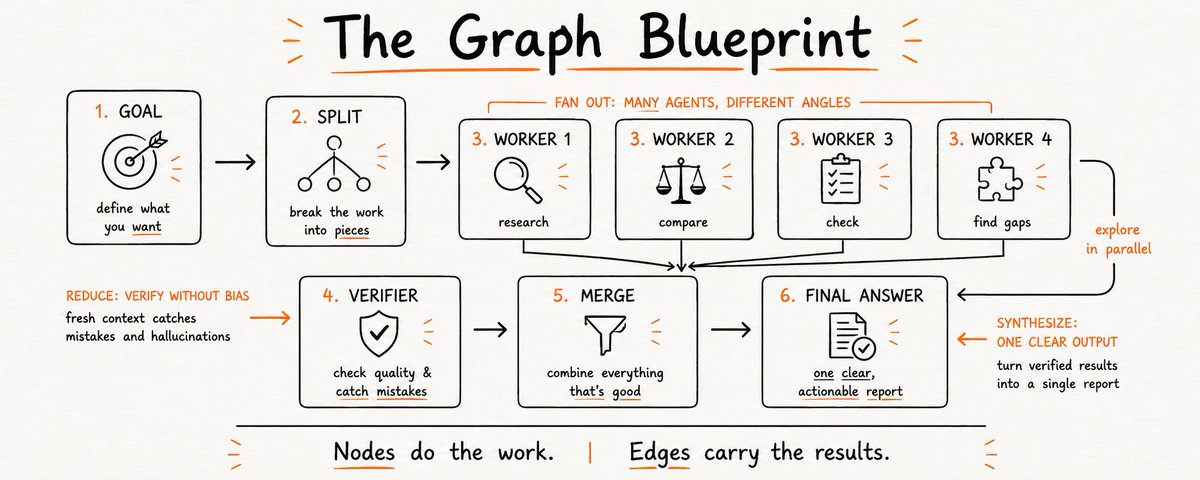
A Chinese developer just explained the shift from Loop Engineering to Graph Engineering better than anyone.
most people are still building agents the way that's about to be obsolete.
> why single-agent loops break and go "goal blind"
> the 4 parts of a graph: nodes, edges, state, policy
> 3 topologies that run everything: diamond, supervisor, pipeline
> Anthropic's 5 official workflow patterns
the punchline: it's not how many agents you run. it's the determinism you build with verifiers, code fallbacks, and reality anchors.
I broke the same architecture down with Kimi K3. Full A-Z guide below.


Nadeem Shabir 💫 retweeted

🚨 HUGE NEWS: Claude now embeds an invisible watermark into every piece of text it generates.
Anthropic just documented how it works. Two marks, both machine-readable:
> Text: an imperceptible watermark woven into the words themselves. You can’t see it, and it doesn’t change meaning, quality, or readability.
> Files (.svg, .png, .jpg): signed provenance metadata on the C2PA open standard, so you can tell if a file’s been tampered with.
The watermark is applied at the model level.
That means it shows up no matter where the text comes from: the API, Claude, Claude Code, Cowork, Claude Tag, and even when a supported model runs through AWS, Google Cloud, or Microsoft Foundry.
Models launched on or after August 2, 2026 mark from day one. Older models are getting it during a transition period.
Every sentence Claude writes for you now carries a signature you’ll never see.

Wow ex LBC host @SangitaMyska reveals how she 'completely fell apart' after lawyers for the radio station 'monitored' her social media following her dismissal. Shocking and deeply difficult for her.
As an aside, I'm really surprised how @mrjamesob was so quick to throw her under the bus at the time.
youtube.com/watch?v=am0vtQu7…

Nadeem Shabir 💫 retweeted

Arwa Elrayess, Oxford Union President, insists the motion is about Islam itself, not extremists, Rejects Collective Suspicion. She supplies the missing context for the sword verse and notes that classical scholars never read it as a universal command against non-believers. (2026)
Nadeem Shabir 💫 retweeted

Anthropic engineer:
"You're not supposed to babysit the model. Put it in a graph, and it catches its own mistakes and runs a dozen tasks at once."
In 25 minutes he breaks down exactly how Anthropic builds agents that run in parallel, check each other's work, and recover when one fails.
Worth more than any paid course you'll find on building agents.
Watch it, then read detailed guide on graph engineering below.

Nadeem Shabir 💫 retweeted

I’m crying this is a 40 min documentary in 4K highlighting all of Argentina’s robberies this World Cup
And they STILL DIDN’T WIN the World Cup 😭😭😭

Nadeem Shabir 💫 retweeted

China open-sourced a model that reconstructs any scene in 3D from a regular video, in real-time.
one camera. no LiDAR. 10,000+ frames without falling apart.
just walk around with your camera and watch the entire world get rebuilt in 3D at 20 fps.
→ runs at ~20 FPS on a single GPU
→ Stable over 10,000+ frames
→ Beats optimization-based methods on benchmarks
→ Works on drone footage, driving videos, indoor walkthroughs
100% open source.

