Khyati Malhan (@kmalhan07) header
Khyati Malhan (@kmalhan07) profile picture
Copenhagen
Joined June 2015
Photo by Khyati Malhan (@kmalhan07)Photo by Khyati Malhan (@kmalhan07)Photo by Khyati Malhan (@kmalhan07)Photo by Khyati Malhan (@kmalhan07)Photo by Khyati Malhan (@kmalhan07)Photo by Khyati Malhan (@kmalhan07)Photo by Khyati Malhan (@kmalhan07)
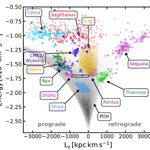
Discovery of two stellar structures in the orbit-metallicity space of our Galaxy. Shiva & Shakti appear to be two of those early, massive fragments that coalesced ~12 Gyr ago, forming the proto-Milky Way. Published in ApJ. arxiv.org/abs/2403.13051 @ESAGaia @APOGEEsurvey @mpi_astro
9
25
3
91
4,598
Milky Way’s Metal-Poor Stars display Chemical Transition near the Solar Radius. Accepted in ApJL. arxiv.org/abs/2508.08360 Results obtained using the data from @ESAGaia and @APOGEEsurvey .
1
129
Khyati Malhan retweeted
Today marks Gaia's end of observations: cosmos.esa.int/en/web/gaia/e…. Gaia now performs a set of technology tests to help future missions: cosmos.esa.int/en/web/gaia/t…. The most up to date view of our Milky Way was created thanks to Gaia, with much more to come with #GaiaDR4 + #GaiaDR5.
6
83
15
274
24,161
Our paper made it to the “Selections from 2024” series that looks back at some of the most-read AAS journal articles published in 2024!
Selections from 2024: Possible Proto-Galactic Fragments in the Milky Way Two stellar structures discovered in the Milky Way this year may be fragments of proto-galaxies that formed before our galaxy was assembled. aasnova.org/2024/12/23/selec…
1
154
In our new paper today (arxiv.org/abs/2407.20483), we report the catalog and photometry of the extragalactic tidal streams found in @theDESurvey as part of the Stellar Stream Legacy Survey. A comparison of the stream frequency with cosmological models is coming very soon!
1
12
2
47
2,749
A schematic overview of MW-mass satellite systems in Local group and beyond (taken from arxiv.org/pdf/2404.14498) #dwarfgalaxies2024 conference in #Durham
2
4
17
1,256
The GD-1 stream surrounded by a "stellar cocoon" in the @desisurvey data! By @monica_valluri et al.
The GD-1 stream shows clear evidence of a broader hotter “cocoon” in DESI Early Release data: arxiv.org/pdf/2407.06336! More data on the way.
1
12
710
Evolution of merger stars in the (Lz, E) space of a Milky Way analog in the TNG 50 cosmological simulation. youtube.com/watch?v=qGNtSWwk…
1
1
269
The Gaia-Sausage/Enceladus stars, which were previously hypothesized to have originated from an ancient (8-11 Gyrs ago) merger event, likely came from a more recent (< 3 Gyrs ago) event, now dubbed as the Virgo Radial Merger (VRM).
📢 @ESAGaia reveals that the Milky Way’s last major collision was surprisingly recent! Gaia unravels our history by studying the wrinkles created by collisions, but there's a catch. Like Benjamin Button, our galaxy is getting less wrinkly over time 👉 esa.int/Science_Exploration/…
2
1
4
1,292
Paper day! A central result from our survey of the Milky Way's outskirts: "All-Sky Kinematics of the Distant Halo: The Reflex Response to the LMC" arxiv.org/abs/2406.01676
5
6
47
3,534
Paper thread!! This was up on arXiv a bit over a week ago: arxiv.org/abs/2405.13124 We show here the dynamical analysis of the first spectroscopic follow-up of extremely metal-poor stars using photometric metallicities based on Gaia XP CaHK magnitudes run on Pristine survey model
1
3
20
1,320
Khyati Malhan retweeted
What stellar substructures does Gaia map? This visualisation of the Milky Way by @StefanPWinc / @kmalhan07 highlights globular clusters, dwarf galaxies and stellar streams. Notice also Shakti & Shiva, subjects of a recent story: esa.int/Science_Exploration/… youtu.be/YQDfdpT6yZ4
1
15
1
31
2,667
The paper I have been working on for a while is out! In this one I predicted the detectability of Globular Clusters in the full 6-year Euclid survey! And then tested detection models and size measurement using the first ERO data on the Fornax Cluster! arxiv.org/abs/2405.14015
4
12
1
74
3,914
Paper day: arxiv.org/abs/2404.11604 We show that Gaia BH3 is part of the ED-2 star cluster. The update astrometry puts GaiaBH3 in excellent agreement with the orbit of ED-2. Using some @ESO data we got last period we also show that ED-2 is very likely a disrupted globular cluster
2
13
3
48
7,073
Paper day! With @ViktorHJonsson looking at velocities of stars in the Milky Way's warp. We find that they just don't match the picture of a steadily precessing warp where we see it today. arxiv.org/abs/2405.09624
3
5
1
41
3,151
A webinar I gave @Swinburne, hosted by Prof. Duncan A. Forbes, on "The LMS1 stellar stream: A very metal-poor fossil remnant of our Galaxy's formation". youtube.com/watch?v=6mtrAz5l…
6
273
A talk I gave for the "@IAU_org Commission H1 - The Local Universe" seminar, on the topic "Atlas of Milky Way mergers created using the @ESAGaia dataset". youtu.be/soabSPRFims?t=129
1
2
13
557
Our paper on the discovery of five dwarf galaxies around the galaxy NGC 253, found by @GJDonatiello in the @desisurvey deep imaging, is available today in: arxiv.org/pdf/2405.03769. This result gives new insights on the presence of a satellite plane in this Sculptor group spiral.
7
1
31
2,554
Galactic map of #StellarStreams detected in the @ESAGaia dataset. Each star in the stream represents an actual Gaia source, color-coded by heliocentric distance (as computed by the STREAMFINDER algorithm): blue for nearer (~1 kpc) and red for distant (>~30 kpc).
1
15
3
65
6,215
Khyati Malhan retweeted
2/ Called BH3, the #BlackHole was discovered by @ESAGaia 🛰️ because it imposes an odd wobbling motion on the star orbiting it ⭐️⚫️ Ground-based telescopes, including ESO’s #VLT 🔭, then found its mass to be 33 times that of the Sun. Artist’s animation of the system 👇
1
9
3
21
1,319
169. A billion radial velocities: DR3 includes 33 million radial velocities. DR4, in 2025, should have 100 million. A recent study has derived 125 million (of much lower accuracy) from the low-res BP/RP spectra, with perhaps 1–2 billion in the future. wix.to/nWiwd2f
1
3
10
549