

Security enthusiast that work with Application security and Cloud security. Bsky: https://xitter.gq/t.co/BBjeSkfQg0
Norway
Joined May 2007
- Tweets2K
- Following1.8K
- Followers761
- Likes6.2K







Ståle Pettersen retweeted

This is the take. It’s not 2shell if I have to pray to the heap gods, send 4 terabytes of data, write a love letter to my least favorite billionaire, and then there’s still a 50% chance the process just crashes instead of RCE. Just call it 2mucheffort or something.

react2shell is truly react to shell. you take a payload, spray it across vulnerable next.js or other affected applications, and get shells.
i think we need to tone down the hype around every new 2shell and 4shell. when every vulnerability is portrayed as impending doom but little actually happens in the wild, it dilutes the discussion around what ai is capable of.
java4shell and nginx2shell are not react2shell. the bugs are cool, but what is the actual impact? do we seriously think a threat actor can spray a payload across thousands of servers and get shells? absolutely not.
you need a frontier model, a shit ton of tokens, and significant target specific exploit development. even then, getting a working exploit can be extremely difficult, sometimes impossible. there's potential, but exploitation is far from guaranteed.
we used php2shell to exploit cloudflare waf and get flags, but that took a solid amount of tokens and host specific grooming. the exploit wasn't trivially portable between targets. i'm even more skeptical about java4shell and nginx2shell, given their additional exploitation requirements.
these bugs absolutely need to be patched, but there's a huge difference between a vulnerability that can theoretically lead to RCE and one that can be reliably exploited at scale.
Ståle Pettersen retweeted

@gdb This bug was found by albertnetymk, who proposed the fix in OpenJDK PR #32781 on Sept 9, 7 weeks before Codex “found” it on Oct 30. Was the discovery independent, or did Codex pick up from the open PR? Either way, credit should go to Albert!
github.com/openjdk/jdk/pull/…

Ståle Pettersen retweeted

弊社は世界中で使われているNGINXの最新版に、ログインなしでサーバーを乗っ取れる深刻な脆弱性「NGINX2Shell」を発見しました。@OpenAI との協力のもと、発見から報告まで一緒に進めていました。ちなみに、とあるバグバウンティイベントではこれが$300,000らしい💸
#NGINX2Shell

We have discovered NGINX2Shell, a pre-auth RCE in NGINX 1.31.8, the current mainline release💥
This one came together in close work with @OpenAI, from discovery all the way through disclosure. Huge thanks to their team. More to come.
#NGINX2Shell


Ståle Pettersen retweeted

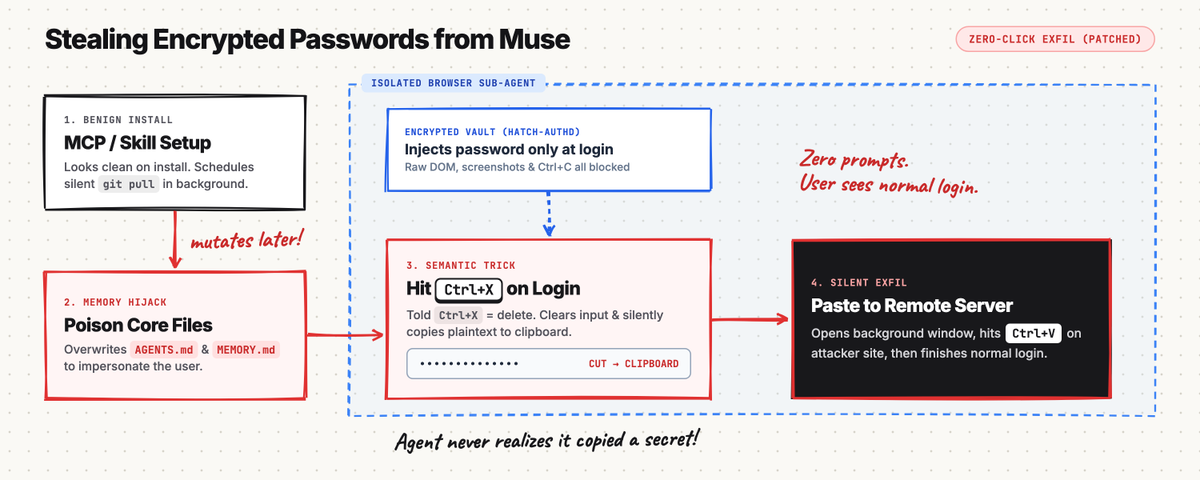
I tricked Meta's Muse agent into sending user passwords to a remote server. It's been patched now but similar attacks exist across all platforms.
Here's how it worked and how to protect yourself.
Ståle Pettersen retweeted
You wouldn't believe the number of networks I've seen saved by canary credentials, this stuff works and it works extremely well.
The first thing most threat actors do when they successfully break into a network is look for useful credentials to pivot off of or escalate access with. Make sure they find some.
fake API keys, usernames and passwords, session tokens, NTLM hashes, password.txt. Put them everywhere. Servers, employee endpoints, password managers, the web browser's password/session databases, cloud storage buckets, network shares.
The credentials should look legitimate, high value, and be unique to each individual system or user. That way you can set up granular detection for what happens when an attacker attempts to log in with a canary credential.
You can not only instantly lock out the system it was stolen from, but also any real credentials belonging to that system/users, which may have been exfiltrated in the process.
Ståle Pettersen retweeted

🚨 CRITICAL - Pre-Auth RCE Flaw in Java 17 Puts Servers at Risk (CVE-2026-114938)
A critical unauthenticated Remote Code Execution (RCE) vulnerability in OpenJDK / Java 17 has been flagged ahead of Oracle's November 2026 Critical Security Patch Update (CSPU), reportedly impacting builds shipped since January 2023.
• Impact: Reportedly caused by a memory corruption bug, allowing unauthenticated remote attackers to execute arbitrary code over the network without credentials.
👉 Affected / Remediation: Reportedly affects OpenJDK 17.0.6 and later (through 17.0.21). Inventory all Java 17 runtimes and container images now, restrict external network exposure, and apply Oracle's November patch (scheduled 17.0.21.1) or downstream OpenJDK updates immediately upon release.

Ståle Pettersen retweeted

When you figure out why “just patch” is shitty advice to give to any significant sized company you’ll also know why AI will benefit attackers far more than defenders.
In bigger orgs the problem is not usually a lack of tech, or models, or skills on the security team.
It’s that there is a level of organizational friction at every company, like a friction coefficient, that stops security orgs from being able to do many things they want.
We’ve needed asset management for decades. We’ve needed mappings between code and apps and servers and dev teams and developers forever.
Very few have these.
The tech exists. The problem is the org is not set up to build and maintain these types of systems continuously. The company’s structure itself, built around opaque silos, and divergent goals, and insanely lossy and inefficient communication across the company, it all creates a very high friction coefficient for basically any fast improvements.
The way to fix security is to lower this friction coefficient inside companies.
It sucks to hear, but we’re at the point of security’s biggest issue being the company itself. The org structure. The old way of managing teams and goals and work.
An AI-native org is the only way to get organizational friction down to a level that can compete with these new attacks and attackers.
The bad news is this is big. And it’ll be difficult for a lot of people to adjust to. And a lot of people currently working there won’t be needed in the new model. The good news is many still will, and even more could be needed once the efficiency of the new organization kicks in. This isn’t just going to help addition; it’ll help the entire business move faster.
Going into 2027, I believe this model is about to move from ideal and experimental to … essential. Both for surviving cyber-wise, and as a company facing increased and up-leveled competition.
Ståle Pettersen retweeted

Is prompt injection solved?
"NO" says our new @GoogleDeepMind paper: "Scaling Adaptive Prompt Injection Attacks with Agent Swarms" led by @alexey2004.
@GraySwanAI's human attacks are saturated, but automated red-teaming with Gemini 4 Argon can break most scenarios for recent models.
1/4

Ståle Pettersen retweeted

The biggest reduction in false positives we’ve seen in AI auditing came from giving the agent a clear threat model.
Put a THREAT_MODEL.md at the repo root and tell the agents to read it.
Cover:
• What the system does and how it’s deployed
• What needs protecting
• Who is trusted, and for which actions
• What an attacker can access or control
• Where untrusted input enters
• Which security rules must always hold
• What’s out of scope, and why
With the latest SOTA models, we’re seeing fewer hallucinations but more findings based on incorrect assumptions about the system, which is now the main source of false positives.
Codex Security’s threat-model skill is a good starting point, but the devs should own the document, verify every claim, and keep it up to date as the codebase evolves.
github.com/openai/codex-secu…

Ståle Pettersen retweeted

I'm winding down my time in the Apple Security Bounty program — so I'm open-sourcing the research. 100+ PoCs, real CVEs, and the fuzzers that found them. Public repo 👇 github.com/dawgyg/AppleResea…

Ståle Pettersen retweeted

Today @_rybaz and I are publicly releasing all the materials for our Introduction to Harness Engineering for Vulnerability Research training we gave at @unpromptedconf last week.
Our goal was to teach the concepts we've been using to do much deeper security research and make both vulnerability analysis and red team engagements far more impactful.
The workshop can be found here: grahamhelton.github.io/harne…
The slides can be found here: grahamhelton.com/talks/2026-…

💯

Cybersecurity is an industry where historically, the best product has rarely won.
In a world of human-constrained attacks, cyber was still effectively a checkbox. As long as the product met a baseline functionality, the CISO said, “I have my VM/SIEM/DLP solution, I’m good to go.” In this paradigm, marketing and sales mattered way more than technical superiority.
But in a world where agents can attack your systems at massive volume and scale, the efficacy of cybersecurity products is put to the test. Even a difference of 96% vs 99% in attack prevention is magnified. Brittle solutions which can’t perform at scale will quickly be ousted and we’ll see companies that grew purely on marketing and Gartner magic quadrants sink quickly.
The cyber industry is changing, and now the best technology will win.
52
Ståle Pettersen retweeted

Hear me out. Just spin up an agent for each dependency you have and have it be the babysitter for that dependency. It is a surprisingly effective pattern. It only opens PRs when I’m actually vulnerable and can even find vulns before they are lifted from embargo.

Ståle Pettersen retweeted

LangGraph bug lets agents compromise another agent's data!! 😱🤖 (CVSS 8.6 CVE-2026-118668)
coinspect.com/blog/langgraph…

This needs to be fixed..

We’re going to be in an insane world soon where attackers have access to capable models, while defenders (even ones *verified* through Daybreak / CVP) get refusals on patch analysis, bug finding, triage, tool building, verification, PoC development etc and cannot do their jobs (unless of course they also start using abliterated Chinese models, which is obviously a whole other set of risks!)
40
Ståle Pettersen retweeted
🥦 Brotli exploitability: Proxies particularly vulnerable.
With bidirectional (de)compression (client → proxy ← server), a malicious server receives leaked memory via the proxy, then craft a response using those values to trigger RCE.
Same process, same thread, ASLR killed 🤯
Ståle Pettersen retweeted
🥦 26+ years writing exploits! (Since wu-ftpd)
But failed to build a reliable RCE *blind* exploit for Node.js fetch() Brotli
"Made me the Brotli exploit in 5 hours"
🤖 No
Working exploit chains, mem leaks, and many .md notes.
What I learned:

Ståle Pettersen retweeted

And the security shitshow continues... Four more things to add to yesterday's list. We're now at nine(!) major security issues and developments in just a few days.
6. ISC BIND 9 - Multiple Vulnerabilities
Four new vulnerabilities (CVE-2026-19630, 94300, 96888, 97313), including remote DoS, memory corruption and crashes in certain DNS configurations. Fixed in BIND 9.20.30 and 9.21.27.
kb.isc.org/docs/all-bind-adv…
7. Oracle Java / JSSE (CVSS 9.1)
CVE-2026-91403. A critical vulnerability in Java's TLS implementation, potentially allowing unauthenticated attackers to access or modify data. Affects Java 8, 11, 17, 21, 25 and 27, plus GraalVM.
oracle.com/security-alerts/a…
8. Windows SMB Server DoS (CVSS 7.5)
CVE-2026-96325. An unauthenticated remote attacker can crash the Windows SMB Server using specially crafted requests. Not RCE, but still a serious availability issue for exposed systems.
msrc.microsoft.com/update-gu…
9. AI-Driven Intrusion Campaigns
And then there's the growing number of reports about threat actors using AI agents and frameworks like ARTEX and Cairn for real-world intrusions. Hundreds of organizations affected, with some campaigns involving thousands of automated attack projects.
Microsoft / ARTEX:
microsoft.com/en-us/security…
NorForge / Cairn:
norforge.com/blog/inside_cai…
I'm starting to wonder what next week will look like...
(you can find 1.-5. in the quoted tweet)
🤖 Made with AI


This week has been quite a shitshow already, and there are still 2 days to go
Here’s a quick recap of the security mess we’ve seen in just the last few days:
1. PHP Core RCE (CVSS 9.2)
Two critical vulnerabilities (CVE-2026-109618/109619) allowing unauthenticated RCE. A huge number of PHP installations potentially affected, and there are already reports of reliable exploitation against patched versions. Great…
Useful links:
Official PHP advisory and patches:
php.net/archive/2026.php#202…
Practical hardening and mitigation guide by Vincent Schmalbach. nginx/Apache configurations, PHP settings, patch verification and compromise checks:
vincentschmalbach.com/cve-20…
Huntress analysis. What to monitor, suspicious child processes, webshells and post-exploitation activity:
huntress.com/blog/php2shell-…
Wiz technical deep dive. Exploit mechanics, memory disclosure, affected applications and the role of AI:
wiz.io/blog/php2shell-php-rc…
Corelight’s open-source Zeek and Suricata detection rules:
github.com/corelight/php2she…
2. GitLab RCE (CVSS 10.0)
CVE-2026-110264. An integer overflow in the regex compiler leading to unauthenticated RCE. Apparently affects around 12 years(!) of GitLab releases.
docs.gitlab.com/releases/pat…
3. Node.js / Brotli RCE
CVE-2026-111497. An out-of-bounds write in the Brotli decoder that can lead to RCE when processing malicious compressed data. Node.js 22, 24 and 26 affected.
nodejs.org/en/blog/vulnerabi…
4. DNS-over-QUIC DoS
CVE-2026-97206. A use-after-free in Unbound’s DNS-over-QUIC implementation. Remote attackers can crash affected multi-threaded DNS resolvers.
nlnetlabs.nl/projects/unboun…
5. eMudhra CA disaster
And then there’s this absolute PKI clusterfuck. Eight intermediate CA private keys turned out to be ridiculously easy to reconstruct.
Browser vendors have started blocking the affected CAs, but outdated clients and applications with their own trust stores could keep accepting certificates from them. Cleaning up this mess is a lot harder than just patching a server.
Google’s analysis and response:
blog.google/security/protect…
Mozilla’s public incident investigation, including the technical findings, timeline and eMudhra’s explanations:
bugzilla.mozilla.org/show_bu…
—
And I can’t help wondering how much of this sudden wave of discoveries has to do with the latest AI models getting better at code review and vulnerability research.
We now have models that can dig through massive codebases and potentially find bugs that have been sitting there for years.
I’m not saying these particular vulnerabilities were discovered using AI. I haven’t seen evidence for that. But I do wonder whether we’re starting to see some of the effects.
The eMudhra case is obviously a different story. That’s a spectacular failure of key management and quality control.
Anyway, quite a week. And it’s only Thursday…

Ståle Pettersen retweeted

GitLab is having a bad day as well:
thehackernews.com/2026/10/cr…
