

Ethereum core dev (Besu)
Joined October 2013
- Tweets468
- Following173
- Followers232
- Likes64



matkt retweeted

I* is preparing to overhaul Ethereum's state structure with no uptime disruption.
The Partitioned Binary Tree would shrink state proofs until wallets can verify rather than trust. This leads the way to state expiry where nodes drop untouched data until a user asks for it again.
matkt retweeted

Devcon 9 is coming to Lisbon! 🇵🇹
October 11–13, 2027
Building on Mumbai, we're bringing Ethereum's builders together with more friends and allies working toward a freer, more open internet.
matkt retweeted

Yesterday @Consensys announced Sovereign Network Interoperability.
It's the culmination of a decade of building tools like @Besu_eth and @LineaBuild, along with all the underlying research on performance, ZKPs and security, at Consensys. We can now connect institutions to one another with the privacy and confidentiality they require, and the reliability of the whole stack: Ethereum, Linea and Besu.
With Linea and Besu, we now have at @Consensys a complete credible neutral infrastructure stack alongside Ethereum, so institutions can move forward into the tokenized world that awaits us.
Interoperability, with every foundation institutions need: privacy, confidentiality, reliability and sovereignty.

Introducing Sovereign Network Interoperability by Consensys.
State-of-the-art interoperability that enables institutions to do business freely, settling securities, exchanging currencies and posting collateral across ledgers, without bridges or moving assets onto a shared ledger.
consensys.com/blog/consensys…


matkt retweeted

Ethereum is preparing to move its state from the Merkle Patricia Trie to the Partitioned Binary Tree: smaller proofs, easier proving.
The fork just went live on glamsterdam-pbt-1, a mainnet shadowfork by @ethPandaOps, tested by @kt2am1990, one of our Besu maintainers.
Our @Besu_eth nodes switched to the PBT with no missed slot, and no issues so far.
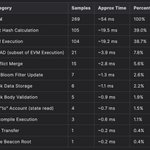
Before the fork, Besu built its PBT from its own database in 2h41.
Full results in the video below. ↓

matkt retweeted

Very bullish on Ethereum's future, particularly the progress on potential I* fork (2027/28) headliners!
Decoupled Consensus separates voting on the chain head from finality voting, making Ethereum more resistant to reorgs, reducing time to finality and laying the groundwork for post-quantum security.
EIP-8453: github.com/ethereum/EIPs/pul…
Partitioned Binary Trees replace today's state structure (MPT) with one that's much easier to prove, with smaller proofs, more efficient ZK proving and a path toward partial statelessness.
EIP-8297: eips.ethereum.org/EIPS/eip-8…
Both are big steps toward a faster, more secure and more scalable chain and it's exciting to follow along the progress being made!


It's happening!🚨🚨🚨
The next @ethereum's tree Partitioned Binary Tree is finally here! And we're migrating to it!
We are doing the first tree & DB migration in the Glamsterdam-devnet-8 with @go_ethereum @Nethermind @Besu_eth @ErigonEth
This is gonna be huge! Ready for I*🎉

matkt retweeted

It's happening!🚨🚨🚨
The next @ethereum's tree Partitioned Binary Tree is finally here! And we're migrating to it!
We are doing the first tree & DB migration in the Glamsterdam-devnet-8 with @go_ethereum @Nethermind @Besu_eth @ErigonEth
This is gonna be huge! Ready for I*🎉
matkt retweeted
From Linea to @Besu_eth and Teku, every team across @Consensys is focused on one goal: institutional adoption.
Thrilled to see this partnership between Consensys and ClearToken to bring 24/7 settlement to wholesale markets.
Consensys and ClearToken have announced a strategic partnership to bring 24/7 settlement to wholesale markets, pairing cryptographic finality with settlement finality.
Read the full announcement ↓
consensys.com/blog/consensys…

matkt retweeted
🎄🌲When Binary Tries?🌲🎄
You're witnessing @Nethermind @ErigonEth @go_ethereum and @Consensys 's Besu all handling a reorg while moving into Partitioned Binary Trie (eips.ethereum.org/EIPS/eip-8…)
You can't get it more solid than this!
Next step 👉 Mainnet migration tests
👇👇

matkt retweeted
@kt2am1990 just made the first Besu <> Geth Partitioned Binary Trie migration pass!
You can see here the 2 clients reorged (under a provoked attack) across the fork boundary only to pass correctly and continue through I*!
This is huge news!🎉🎉🎉
Next step: Benchmarking the migration in mainnet and get real numbers! 🫡🫡
If you wanna hack on it 👇
github.com/CPerezz/pbt-devne…


@Besu_eth We’re joining the effort! Just completed our first PMT → PBT migration with Besu and Geth using @CPerezz19’s migration testing tool.
Exciting to see this coming together across clients 👀
matkt retweeted
Besu 26.7.0 is out
• PoW sunset complete - Ethash, mining RPC, PoW classes removed
• PoS now the default when genesis declares no consensus
• New HealthCheckService plugin API
github.com/besu-eth/besu/rel…

matkt retweeted

CLIENT DIVERSITY UPDATE
Graffiti analysis from 272987 blocks:
EL identified: 40.7% | CL identified: 42.9%
EL Client Distribution:
go-ethereum : 44.9%
Nethermind : 36.0%
Besu : 17.4%
Reth : 1.5%
Ethrex : 0.0%
Erigon : 0.0%
CL Client Distribution:
Lighthouse : 43.9%
Teku : 26.4%
Prysm : 22.7%
Nimbus : 4.9%
Lodestar : 1.5%
Grandine : 0.6%
matkt retweeted

1/ Ethereum's state grows far faster than it churns. Most of it goes dormant and never gets used again, while real activity sits on a tiny set of active applications.
Here's a deep dive into what 10 years of mainnet access data shows about how Ethereum's state is actually used. 🧵👇
matkt retweeted

Why LLMs are a dead end for human-level intelligence, and especially for Physical AI / Robotics.
The next leap isn’t bigger language models.
It’s World Models.
I just dropped a full 1-hour presentation from Shanghai:
“World Models: the ChatGPT moment for robotics?”
→ Why LLMs hit a wall
→ Why action-conditioned world models planning in latent space are the real path
→ Live World Forge demo with LeWorldModel + Hugging Face LeRobot
Watch here.
The future of intelligence is embodied, not just chatty.
matkt retweeted
When a Fields Medalist of the caliber of Sir Timothy Gowers @wtgowers tells you this, you should probably listen.
LLMs are already genuinely useful research assistants for him.
He even put them at the level of “quite good PhD students.”
Big takeaway from his talk:
the next frontier in math AI is not more « brute force ».
It’s intuition.
Models are getting better at producing proofs.
They are still bad at explaining the path that led to the proof.
And as Gowers pointed out, that’s not surprising.
Human mathematicians rarely document that discovery process either.
That’s why his effort to gather data on how mathematical discovery actually happens is such an interesting direction.


matkt retweeted
Ethereum is about to fundamentally change how blocks are executed. With the upcoming Glamsterdam hardfork, it's shipping EIP-7928: Block-level Access Lists, a proposal that brings parallelization to the EVM.
Here's a short explainer of what it is, how it works, and why it's a big deal for scaling.
Let's start from the top. Alongside EIP-7732 (ePBS), EIP-7928 is the execution-layer (EL) headliner for Glamsterdam. Like ePBS, the main focus has been scaling Ethereum, though both proposals come with a bunch of other, equally important properties on the side e.g. removing trust requirements from the PBS pipeline or improving sync.
EIP-7928 adds a Block Access List (BAL) to every Ethereum block. A BAL is a list of accounts and storage slots that the block touches, but that's not all: it also contains post-transaction state diffs (this part is critical!).
Post-transaction state diffs tell you what the state looks like after each transaction. Quick example: user A swaps 1 ETH for DAI on DEX B. The BAL tells you that user A's ETH balance decreased by 1 ETH + tx fees and their nonce went up by 1; that DEX B's ETH balance went up by 1 ETH; and that inside the DAI contract, user A's DAI balance increased while DEX B's decreased.
In other words, all of that info becomes statically available, something that previously required tracing the transaction.
Client software (Geth, Nethermind, Besu, Erigon, Reth, Ethrex, Nimbus) can use this to do a few very powerful things:
1. Parallelize transaction execution. Knowing the post-state of each tx resolves the dependencies between them. No transaction has to wait on the previous one anymore, so execution can be perfectly parallelized. Instead of large parts of block validation sitting idle waiting on sequential execution, clients can finally make much better use of modern hardware.
2. Batch prefetch. One of the most cumbersome jobs for a node has been fetching the state needed for execution from disk. Because state locations (e.g. the exact storage slot in the DAI contract where user A's balance lives) are only discovered along the way, while executing, state-fetching has been a real drag on scaling: it blocks execution, takes time, and eventually slows everything down. With BALs, everything a node needs for execution is known upfront and can be loaded into cache in one go, in parallel. This speeds things up even further.
3. Parallelize post-state root calculation. Another expensive task is walking the updated state tree to compute the post-state root, which is needed so that everyone agrees on what's on disk after executing the block. With the post-tx state already in the BAL, nodes can do this in parallel while executing. A heavy task that used to wait until all transactions had finished can now run alongside prefetching and execution.
4. Snap sync (v2). An often overlooked, less sexy aspect of blockchains is syncing. Nodes need to catch up with the chain, and they need to catch up faster than the chain progresses. Today, most nodes do snap sync: downloading blocks, headers, and state in parallel while chasing the tip, and then "healing" the database once they're close to the head. Healing means asking peers for trie nodes, receiving them, validating them, and updating the local DB. It's iterative, networking-heavy, can take a while, and especially higher throughput pushes that phase to its limits. BALs help here too: with snap v2, nodes can catch up to the tip and skip the healing phase entirely. Syncing at higher throughput becomes more robust and reliable.
So, to summarize, a BAL contains two things:
-> The state locations the block accesses
-> The state changes after each tx (incl. the new values)
We're already seeing big performance gains today: on 6-core machines, EL clients validate blocks up to 5x faster, making block gas limits of 300M a very realistic outcome. ePBS will add to that by decoupling the block from the payload, giving validators 2-4x more time for execution.
To not overshoot (security stays priority #1), the fork will likely ship with a 200M gas limit, but we shouldn't be stuck there for long before pushing to 300M and beyond. That's a 10x in scaling since we started taking the topic seriously, without touching hardware requirements.
None of this would have happened without people going all-in, heads down, shipping: so many hours spent in calls debating the right design, so many iterations refining the specs, and tons of test cases written (and still being worked on). The road from whiteboard to production-ready code has been a journey, and we're not at the finish line yet, but from what I can tell, things look super bullish for Ethereum.
Glamsterdam will be a fork that shows what's possible when a distributed, decentralized community works on a shared goal, laser-focused on providing enough block space to onboard the next wave of users.
matkt retweeted

Our new blog post on parallel state root calculation is out. It shows up to 40% performance improvement on block processing on certain hardware.
Check it out : lfdecentralizedtrust.org/blo…


