

Designing proteins in public | Currently going after a hair-loss target 🥸
Binder campaigns 👉
Joined September 2022
- Tweets131
- Following93
- Followers296
- Likes454





Pinned Tweet
I'm going to try to design a new therapeutic protein for hair loss.
From my laptop.
No company. No lab of my own. No funding.
Just modern protein design tools, rented GPUs, published research and curiosity.
The idea is simple:

6
4
1,517
Day 12 of trying to design a protein binder for hair loss.
Two protein design pipelines have been getting a lot of attention lately: BindCraft2 and RFD4-Proteina.
Since it's time to start designing binders, why not put them head-to-head on our EDA-A2 challenge.
Here's the plan

If the budget allows I'd also love to experiment with Mosaic, using structural carryover to refine some of the designs.
This idea is from ArcRefine and its results on TNFα make this quite interesting, since EDA-A2 also belongs to the TNF superfamily:
foldarc.com/research/structu…
1
2
193
There's this glycosylation site right next to our epitope. A glycan there could block our binders’ access to the epitope.
I used GlycoSHIELD to graft glycan conformations to see the problem.
But I’m curious how others would approach this.


Day 11 of trying to design a protein binder for hair loss.
Epitope selection (here we go again).
This time, finding a good binding site isn't enough.
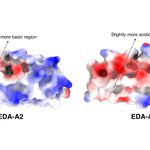
We need one that allows us to selectively bind EDA-A2 while avoiding its almost identical isoform, EDA-A1.
That's what I did:

There is a glycosylation site very close to the proposed epitope, and this could block binder access.
So, I still need to figure this one out.
But hey, we have a concrete structural hypothesis.
1
1
54
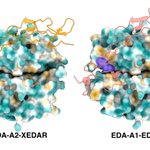
The impact of just 2 extra residues on local structure (EDA-A1 in orange, EDA-A2 in green).
This tiny difference changes receptor preference, leading to different signaling pathways.
We want to block one but spare the other.

So the goal is to block EDA-A2 while leaving EDA-A1 untouched.
But how do we distinguish 2 almost identical proteins?
Interestingly, a 2023 paper showed that Val307 and Glu308 don't directly contact the receptor.
1
89
Instead, these 2 residues reshape the surrounding protein structure, creating a different receptor-binding surface!!
That's what we want to exploit.
1
80